100 Year Starship Study report
January 5, 2012
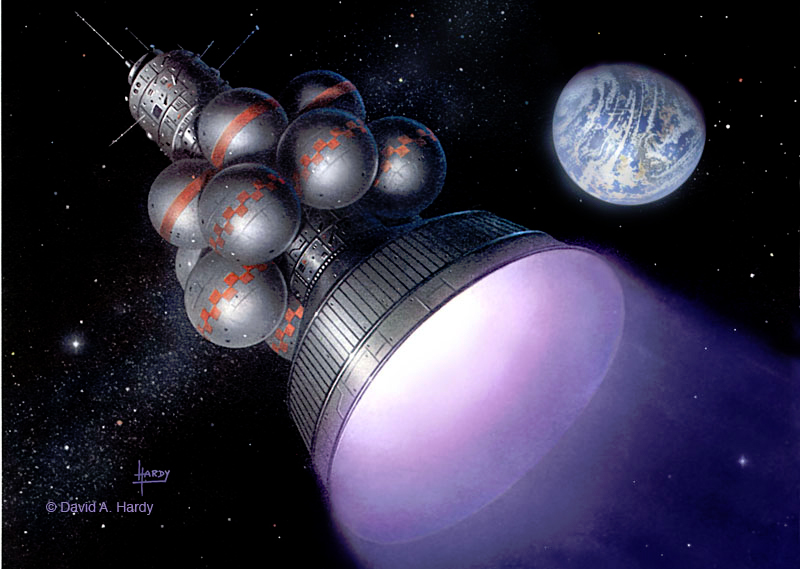
Physics World’s January issue features a report on the 100 Year Starship Study (100YSS) conference, where delegates, from ex-astronauts to engineers, artists, students, and science-fiction writers, looked at the range of issues facing scientists who would like to make interstellar travel a reality.
Starting with the development of a rocket engine that can reach high velocity, humans are not short of initiative, but, as Perkowitz describes, even with engines based on photon-powered sails or nuclear fusion, we are still a long way from reaching the speed of light.
With current propulsion technology only able to move spacecraft at 0.005% of the speed of light, a one-way trip to the star system nearest our Sun, Alpha Centauri, would take 80,000 years to travel the four light-years to our nearest stellar neighbours.
Some theoretical models present tantalizing options, such as Miguel Alcibierre’s idea to contract space-time in front of a spaceship and expand space-time behind it to create a bubble that would propel the spacecraft at any speed without violating special relativity.
Accepting that interstellar travel will, at very best, take decades, some are now considering using suspended animation, or even carrying the DNA and other resources necessary to recreate humans on an unmanned ship, the report says.
Related Site Content:
- Hubble movies provide unprecedented view of supersonic jets from young stars | August 31, 2011
- NASA needs strategic plan to manage orbital debris efforts | September 6, 2011
- NASA studying ways to make ‘tractor beams’ a reality | November 1, 2011
- Astronomers discover complex organic matter in the universe | October 28, 2011
- Chinese spacecraft dock in orbit | November 3, 2011

Comments (6)
by Giulio Prisco
@qraal re “The Polises most committed to reality rather than VR mental masturbation led the way” Given that Polises are communities of uploads living in VR scapes, I find your statement surreal.
by Giulio Prisco
@qraal re “[in Egan's Diaspora] those that continued to engage with the real world were the ones who secured extended Humanity’s future.”
Not really. They go to the stars as uploads without physical bodies, and they secure an extended Humanity’s future by finding a way to escape from this universe into a safer one.
I agree with your main point though. Instead of passively waiting for a Singularity, we must make our best to make it happen. And I think one of the best we can do is going back to space. This will ignite the imagination and passion of the young (like in the 60s), and motivate them to dedicate their life to science and engineering instead of financial scams, and this will speed up the Singularity.
by qraal
The Polises most committed to reality rather than VR mental masturbation led the way. Egan’s point is not to denigrate the joys of VR but to revalue the real world, even if it’s interacted with via proxies.
by qraal
Passively waiting for the Singularity to make interstellar travel happen is the same as passively waiting for the Singularity – futile. Get involved and make them both happen quicker.
Personally the virtual reality option leaves me cold. The real world is too fine grained for a detailed emulation to ever come close – all our VR worlds will be coarse grained kludges compared to the real thing. Greg Egan’s novel “Diaspora” described the arrival of the Singularity as the “Introdus” when most of humanity opted to upload into VR worlds. But those that continued to engage with the real world were the ones who secured extended Humanity’s future. That should be obvious to even the most ardent VR junky. We know too little to imagine that our VR nirvanas will be secure against possible existential threats.
Personally I look forward to uploading into a more durable medium than the kludgy darwinnowed flesh-bots that evolution has given us, but I think some form of embodiment will prove to be the norm even after a real Introdus. Eventually we might travel the stars as information packets to be re-embodied at destination, but someone has to travel the slow way first and there will be no shortage of volunteers to captain those pioneer missions. Whether they will retain old-style bodies or upgrade before they go will be a matter of taste.
by Giulio Prisco
@gospacyoungmn – Yes, perhaps it makes more sense to wait for the Singularity. I believe it is uploads that will ultimately colonize the stars.
But I think space is fundamental for our collective mental health as a species. We have lost a lot of our sanity since the Apollo program in the 60s, and we must recover our sanity to facilitate a positive Singularity. We need to see people walking on the Moon again, to recover our optimism and hope.
At this moment in history, we much choose between Apollo 11 and September 11.
by gospacyoungmn
In my surmise, considering Ray Kurzweil’s near singularity, the real tantalizing option for interstellar travel is to wait for the singularity. If the singularity is near, and if, considering that all the laws of nature are ubiquitous throughout the universe, then why go there when we can create any imagined otherly reality right here at home…experiencing it in all its majesty and wonders right here at home. Why would we need or want to go there in person? Would the risk be to great?
We should not assume a benevolent universe. In any case, it may make more sense to wait for the singularity at which time we will be able to bypass any today imagined technologies on there journey to the stars.
Maybe interstellar travellers have not come to earth because they already know what is earth life. Considering the singularity, even if they did come to earth, they would likely exist in a form alien to our primal nature….and remain out of sight for all intense purposes!
Having said this, it’s still interesting to imagine new technologies for planetary and interstellar travel.
http://www.drwarpenstein.com