3-telescope interferometry allows astrophysicists to observe how black holes are fueled
May 18, 2012
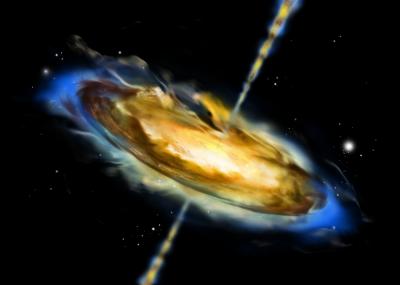
Artist's view of a dust torus surrounding the accretion disk and central black hole in active galactic nuclei (credit: Sonoma State University, Aurore Simonnet)
By combining the light of three powerful infrared telescopes, an international research team has observed the active accretion phase of a supermassive black hole in the center of a galaxy tens of millions of light years away, yielding an unprecedented amount of data for such observations.
The resolution at which they were able to observe this highly luminescent active galactic nucleus (AGN) has given them direct confirmation of how mass accretes onto black holes in centers of galaxies.
“This three-telescope interferometry is a major milestone toward directly imaging the growth phase of supermassive black holes,” said Sebastian Hoenig, a postdoctoral researcher at the UC Santa Barbara Department of Physics.
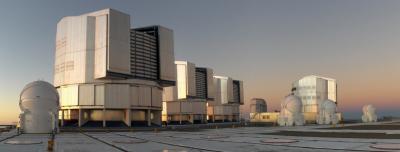
Very Large Telescope Interferometer at the ESO/Paranal Observatory in Chile (credit: Sebastian Hoenig)
They found that a ring of hot dust that marks the transition from a more-distant mixture of gas and dust in a toroidal (doughnut-shaped) structure to a gaseous disk closer to the black hole. The dusty part is interesting because it dominates the infrared emission of active galactic nuclei and can be easily observed, said Gerd Weigelt, a director of the Max Planck Institute for Radio Astronomy.
By using the AMBER interferometry instrument to simultaneously combine the light from three 8-meter telescopes at the Very Large Telescope Interferometer (VLTI) at the Paranal Observatory in Chile, the research team was able to achieve the angular resolution needed to observe the hot dust ring. The Paranal Observatory is operated by the European Southern Observatories (ESO). To achieve the needed angular resolution in a single telescope, it would have to be 130 meters in diameter.
The combination of the light from the three telescopes was no small feat, as the tiny differences in the arrival of light in the individual telescopes have to undergo constant correction with an accuracy of a few microns.
Participating institutions:
- Max-Planck-Institute for Radioastronomy
- UCSB Department of Physics
- Department of Physics and Astronomy, University of Firenze
- INAF — Astrophysical Observatory of Arcetri
- Lagrange Laboratory, University of Nice Sophia-Antipolis, CNRS
- University Joseph Fourier (UJF) — Grenoble
- Institute of Planetology and Astrophysics of Grenoble (IPAG)
Ref.: G. Weigelt et al., VLTI/AMBER observations of the Seyfert nucleus of NGC 3783, Astronomy and Astrophysics, 2012, DOI: 10.1051/0004-6361/201219213 (open access)
Comments (5)
by egore
Did you ever hear of the “Big Bag Theory?
Everything in the Galaxy is in a Big Bag. The heavier it is, the more it stretches the bag. {Gotta have a little fun.}
by Mortran
We know that there is a lot of mass in the center of a galaxy, but this is still no proof of a black hole. We know pretty little about gravity. We cannot even explain how galaxies are held together considering how fast they rotate. But there are still people who simply extrapolate Newton’s equation up to infinity coming up with black holes, and odd things as singularities, wormholes and whatever.
Nobody has ever observed a black hole. We don’t know if space has a maximum density of matter or not. So why are we still talking about speculations like black holes as if they were a matter of fact?
We have found a circular accumulation of matter in the center of a galaxy. So what? This doesn’t come as a surprise. How else was matter supposed to be organized in the center of a galaxy. This tells us nothing about the question if there is a black hole or not.
I say, in the center of the galaxy is a giant neutron star. And this is the highest density that matter can have, because matter is a property of space with an upper limit. It’s just a speculation, but prove me wrong first! And then I can still come up with some other ideas that don’t include black holes. It’s just as likely as the existence of black holes, a highly speculative theory, which still has a lot of unanswered questions.
by egore
What gets me is how does a Black Hole know which way is up? ( Wheres the fabrick of space?]
by Lord Penguin
What makes you think that the black hole knows which way is “up”? Matter forms into disks in space, their direction based on variables like concentration of gases. It’s like if I stood a pencil on one end and it fell, it falling one direction or the other is not based on anything but the way it was set.
by KS
I think that egore refers to pictures such as this one
http://t0.gstatic.com/images?q=tbn:ANd9GcTF6a-mQVRihD4l6AKOwHLQTfQcOrC7N0hd3qhSquceXYhFwWec
where you see space time as a deformed fabric/grid with an up and down.
The thing is, this kind of picture is only a representation, the real thing has no up and down, i think the up and down represents the gravitational potential energy, or maybe 2d sheets of spacetime distorsions in 4d.
Also to answer Mortran, just because it has a name doesn’t mean we know exactly what it is, but we can say that, theoretically, there is a critical mass beyond which a stellar remnant shouldnt be able to exist as a neutron star and must be something else entirely. This is what we call black hole, and it’s certainly an area of science where many questions are still unanswered. Now when you’re talking about singularities and such, those are theories, ideas that we try to put to the test through observation and experiment, it doesnt mean that they are definite answers or should be treated as such.
In fact this article is only about the observation of the accretion disk around a black hole candidate, no one is saying it is proof of anything, but it is data that we can analyse to improve our understanding on the subject.