$99 Raspberry Pi-sized ‘supercomputer’ touted in Kickstarter project
September 28, 2012
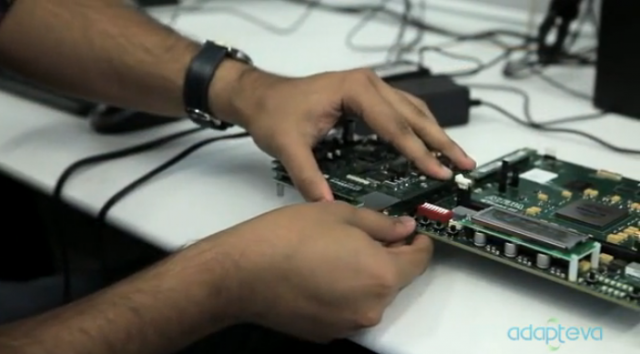
Raspberry Pi-sized board called Parallella puts “supercomputing” power into a $99 package (credit: Adapteva)
Chipmaker Adapteva wants to make parallel computing available to everyone, using a Kickstarter project to raise at least $750,000 and a stretch goal of $3 million, Ars Technica reports.
Adapteva calls it “Parallella: A Supercomputer For Everyone,” a 16-core board hitting 13GHz and 26 gigaflops performance, costing $99 each. If the $3 million goal is hit, Adapteva will make a $199 64-core board hitting 45GHz and 90 gigaflops. (Adapteva seems to be counting GHz on a cumulative basis, adding up all the cores.)
Both include a dual-core ARM A9-based system-on-chip, with the 16- and 64-core RISC chips acting as coprocessors to speed up tasks. The Adapteva architecture hits performance of 70 gigaflops per watt, and 25GHz per watt, the company says.
A pledge of $99 guarantees supporters a 16-core board by May 2013, while a pledge of $499 guarantees delivery by February. The current hardware is in the prototype phase.
Parallella devices would be fully functioning computers, shipping with an Ubuntu 11.10 port to ARM, with 1GB RAM, two USB 2.0 ports, 16GB of MicroSD storage, HDMI, and Gigabit Ethernet. An open source SDK would allow development of applications for Adapteva’s Epiphany architecture using C, C++, and OpenCL. Sizewise, Parallella would be 3.4” x 2.1’’, very similar to the Raspberry Pi.
Olofsson said Parallella will offer anywhere from 10 to 50 times the performance of Raspberry Pi, with the latter figure coming from the potential 64-core version. While it’s three times pricier than the Raspberry Pi, $99 is dramatically cheaper than most parallel computing platforms, he notes. Boards containing Adapteva chips that are already sold by partner company Bittware cost thousands of dollars.
The definition of “supercomputer” is somewhat nebulous. The slowest supercomputer on the Top 500 list hits 61 teraflops. A cluster of 100 16-core Parallellas would cost $10,000 and provide 10 teraflops, Olofsson said. Whether or not you call it a supercomputer, it could be useful to many people.
Comments (17)
by Kire Alyad
The talk about supercomputer is nonsense and I’m not impressed with the numbers.
I have more gflops on my PC and if I wanna get cheap gflops I can for instance buy a GeForce GTX 560 for under $100 and get another 200 gflops. It will most likely take at least a year before they can ship and then we will have even faster chips…
Give me a 1 teraflop chip for under $100 within a year and I will sign up.
by snake0
You seemed to have missed the point of this project, which is to spur the paradigm of parallel computing. GPU Compute isn’t as scalaeble not as open as this project is. It’s about innovation, not ‘current’ max power.
by 320x200
I dunno, it’s easy to pooh-pooh ideas, and maybe this has some sort of size advantage I’m just not paying attention to, but ANY modern GPU absolutely destroys this as far as compute power…
by Steven Roth
Please donate your computer’s power to scientific research at World Community Grid by IBM and email me if you want me to send you flyers to help promote it
by melajara
I’m not impressed by the 90 gigaflops figure for the 64 cores version.
As I’m typing this on my notebook, from this page
http://www.ocaholic.ch/xoops/html/modules/smartsection/item.php?itemid=537&page=3
I see that I can tap from my CPU (Intel Core i7 3820) 91.87 gigaflops !
So no need for this $200 board, or am I missing something?
Anyway, for more power, I would prefer to invest in a CUDA based GPU (see http://developer.nvidia.com/cuda/cuda-gpus)
by melajara
Besides, from this source:
http://vr-zone.com/articles/large-supercomputers-to-speed-up-100-pflops-in-2014-1-exaflop-by-2017-/16018.html
One can read that the upcoming Intel Haswell CPU
“will incorporate fused multiply add (FMA) instructions, allowing for up to 16 double precision on 32 single precision FP ops per core per cycle. On a, say, 10 core Haswell-EP Xeon (or similar Core iXX desktop variant) at 3.2 GHz, that would give you 500 GFLOPs in double precision, or whole round 1 TFLOPs in single precision FP peak performance. Haswell EP processors should be available by early 2014″.
by Gustavo
The difference is that you didn’t pay $99 for your i7 computer :)
by John
Probably the difference, besides price, is that you can’t stack your laptops into one big machine easily, as you can with these things. I hope my understanding is correct.
by Marcos Marin
Not “in business” yet but now we are at least talking. I predict this will pass quickly through our commune’s senate, i.e. Kickstarter ;-)
by Mario Calderon
I’m a long time lurker and a first time poster. Hi, all. :)
This is incredible news, but I do have one point of clarification:
By the nature of Kickstarter, a pledge does not “guarantee” anything. Anyone who pledges should think of themselves as angel investors; there’s always a chance with all Kickstarter projects that backers will get a big, fat empty set for their money. It seems unlikely, but there’s always the chance.
Having said that, I’ll be backing this project; thanks for bringing it to my attention!
by Editor
Hi, Mario, and welcome. Yes, mileage may vary…. Let us know how it works out?
by Marcos Marin
Those ‘guarantees’ are made by the project owners, thus, by definition, under this assumption.
Welcome.
by GatorALLin
@Mario… Yes, to be clear Kickstarter is a pledge and NOT a guarantee… You can however tell a lot about a KS project by who is doing it, what experience they have on past accomplishments, etc. I have myself pledged or involved with over 80 Kickstarter projects and not been disappointed once…yet. I love that it gives an opportunity to make things happen that would have never been possible without prefunding… or the viral marketing that is often required for them to meet their financial goals. In a way their project is about ME…. without me it likely would have not happened… or sot it is fun to think so. Sure some of the projects would have been done anyhow… but some of them need the crowd sourcing to make them happen. Angle investor is a great term…. just multiply that by a thousand or more… Thanks for believing in that project… I hope to see your cool idea up on Kickstarter.com project… what if we all had an idea that would change the world…. Just saying…
http://www.kickstarter.com/profile/326187434
by tim the realist
with the advertized price and performance per watt many robotic applications come to mind. It’s all about the software :)
by Dan
This is awesome, people might not realize how big a step forward this is by making this system open source but it is huge
by Gorden Russell
Say, Dan, would “13GHz and 26 gigaflops performance” be enough to control a robot that could do real work?
by snake0
Just my 2c but the limiting factor in such a robot would be sensor and motor quality, not the raw CPU power.