A 3,000-vehicle test of wireless crash-avoidance system
August 22, 2012
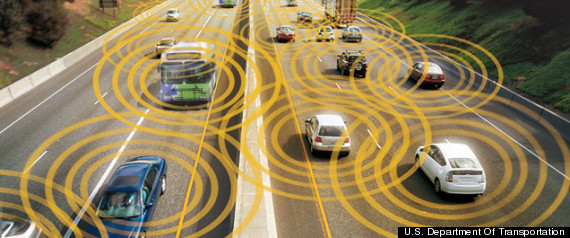
Tuesday’s launch of a new year-long test of “smart car” technology conducted by the University of Michigan Transportation Research Institute is designed to save lives and reduce injuries among American motorists.
The researchers plan to install wireless communication devices on nearly 3,000 vehicles that will let passenger cars, commercial trucks, and transit buses “talk” to each other, as well as to traffic lights and other road signals located at intersections, curves and highway sites throughout a test-pilot area in northeast Ann Arbor.
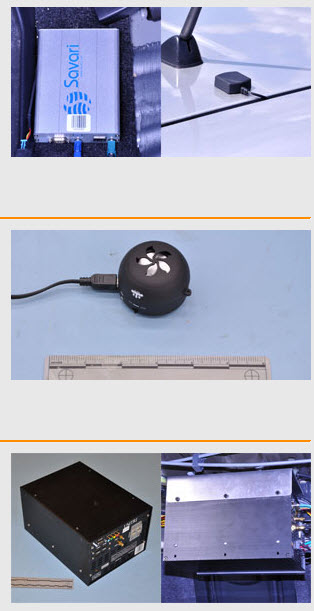
(Top) Vehicle Awareness Device (VAD) securely and privately transmits your vehicle’s speed and location (from GPS device) to other vehicles in the immediate area. (Middle) Aftermarket Safety Device (ASD) includes a VAD but also receives speed and location data from other vehicles, providing information about the position of other vehicles and audio warnings if the threat of a crash exists. (Bottom) ASD + Data Acquisition System (DAS) collects video and data on driver performance. (Credit: University of Michigan Transportation Research Institute)
The connected vehicle technology involves both vehicle-to-vehicle and vehicle-to-infrastructure communications that transmit and receive vehicle data such as position, speed and direction.
Drivers are alerted to a potential crash situation —such as a nearby vehicle unexpectedly braking, a sudden lane change, merging traffic, etc. — by a visual or audible warning inside their vehicles.
The data generated and archived as part of the project will be used to inform future regulatory and policy decisions by the USDOT.
It also will be made available to the transportation industry for use in developing additional approaches to vehicle safety, mobility and environmental sustainability. The testing phase will last one year, but the overall program will operate for 30 months.
Safety Pilot Model Deployment, a $22 million partnership between UMTRI and the U.S. Department of Transportation, is part of a joint research initiative led by the National Highway Traffic Safety Administration to see how well wireless communication technology works in the real world.
It is the largest connected-vehicle, street-level pilot project ever conducted.
No word if drivers will hack into the WiFi to send text messages. — Ed.

Comments (7)
by SaltyCoins
You are focusing on being lazy. But think about how many lives could be saved! All those people who drive drunk or were texting or were not paying attention. Hundreds of thousands per year.
Who cares if there may one day be a switch to turn on auto drive. Seriously boomers grow up.
by Kiwini
“Drivers are alerted to a potential crash situation —such as a nearby vehicle unexpectedly braking, a sudden lane change, merging traffic, etc. — by a visual or audible warning inside their vehicles.”
-so they can put their call on hold, or what?.
WTF???… isn’t that a task that the driver is SUPPOSED to be doing?.
Hang up the electronic distractors, and DRIVE!
by charlie
sounds like there could be a lot of privacy concerns here. what is there to prevent governments from using this to track individuals, determine their driving habits, monitor where they go, determine if they are speeding?
by Bri
Yea!!!! I’ve driven well over one million miles. I love to drive for many reasons. I can’t stand how other people think of it. Like they are sitting on thier living room coach!!!!!
by Edwin
I’d love it if my car was like sitting in my living room (except moving). Think of how much more productive it could be, how much more time to work, or be with family there could be if you didn’t have to concentrate on driving. Driverless cars could completely revolutionize the way we think about travel, never mind how it would change the form of the car itself.
by Bruce Wright
This technology doesn’t appear to be anywhere near “driverless” cars, but might be one of a number of steps in that general direction.
The thing that concerns me the most about the study is that with only 3000 cars and a handful of static point stations, are they going to get enough interactions to make this a worthwhile experiment? From the descriptions, it doesn’t sound like the vehicles are sensing objects around them, they’re just communicating with other similarly-equipped cars and with static point stations at intersections and the like, and I’d expect 3000 cars would be a rather small fraction of all the cars in the city – so most potential crashes will probably not be between cars equipped with this device. Are the static point stations better-equipped, so that they can sense what cars are passing or approaching them? That’s the only way I can think of that might make this a bit more realistic, but there apparently aren’t a whole lot of them.
by Gorden Russell
Right, Edwin. I’m pushing 60 years-of-age now and just don’t want to go on another 18-hour road-trip. I don’t even want to try it until this system is available.