A 3D-printed Moon base baked from lunar dust
March 20, 2013
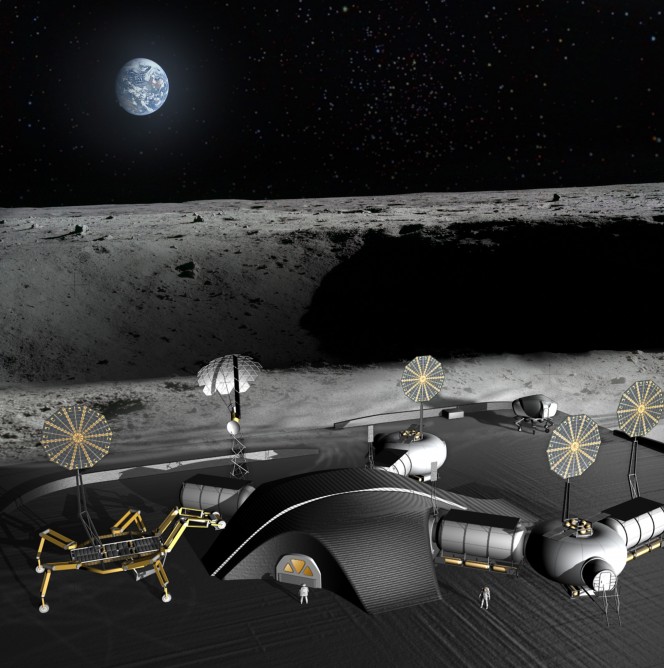
A possible lunar station near the Moon’s south pole (credit: SinterHab Design Team)
Space architects have unveiled a concept for a 3D-printed Moon base called SinterHab near the lunar south pole. Modules would be constructed from lunar dust by microwave sintering and contour crafting, built by a large NASA spider robot.
Unlike an earlier, more bulky concept using a mobile printing array of nozzles on a 6 meter frame to spray a binding solution (glue) onto a sand-like building material, the new concept uses microwave sintering to create a solid building material similar to ceramics — no glue requiired.
The iron nanoparticles in the lunar dust (produced by space weathering) make it possible to heat the dust up to 1200–1500 degrees C and melt it, even in a domestic microwave oven. When the lunar dust (regolith) is heated and the temperature is maintained below the melting point, particles bond together and the building blocks for the lunar habitat can be created.
In the future, we could build structures of entire cities on the surface of the Moon by using solar energy, the designers suggest. We can significantly decrease mass, costs and environmental impact if we don’t need to send glue or other binding agents from Earth. Furthermore, the hardening of the surrounding surface of the base would help mitigate the hazards of contamination from lunar dust, which is highly abrasive and harmful to both astronauts and equipment.
The radiation shielding is provided by the regolith structure, polymer layers of inflatable membrane, and water tanks in critical places.
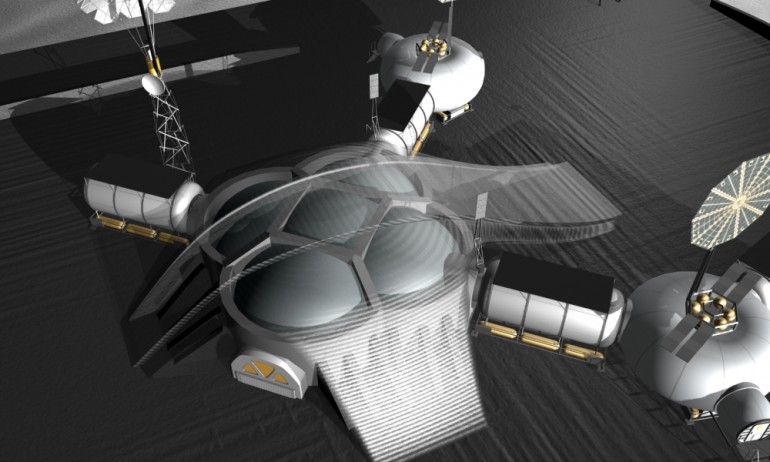
The SinterHab designers claim there would be enough space inside the domes to cultivate gardens as part of a bio-regenerative life support system (credit: SinterHab Design Team)
Project SinterHab was initiated in 2009 at International Space University by space architects Tomas Rousek, Katarina Eriksson and Dr. Ondrej Doule in collaboration with Richard Rieber from NASA JPL.
Comments (29)
by Chris
Um… Is Pete a computer program? What exactly has Ray been up to over at Google?
by anthrobotic
Gingrich was right!
Send robots, send 3D printers! Roll the ball, you sissies!
Related long-winded technosnark:
“Even a Broken Newt is Right Twice a Day. The U.S.A. Needs More Space in Politics.” – http://goo.gl/BVlOC
-Reno at Anthrobotic.com
by Pete
Great motivational slogan. I think it would be great to build doomsday vaults on Moon (containing encyclopedia of all science knowledges and some dormant robots).
I am reminded of the proposed “Telescope-Supercomputer complex on Moon” project.
You can find it on KurzweilAI.
by JC
We are going to have to solve this problem, so we should get busy on it NOW and with intensity. The living spaces would have to have VERY good shielding, since you know the workers would be getting high doses of radiation when they are out and about. And they can’t depend on crawling into special holes when a solar event drives up the radiation, since one missed warning and they would all be dead. Probably MUCH thicker walls than these pictures show. “a NASA design study for an ambitious large spacestation envisioned 4 metric tons per square meter of shielding to drop radiation exposure to 2.5 mSv annually (+/- a factor of 2 uncertainty).” NASA SP-413 Space Settlements: A Design Study. Appendix E Mass Shielding Retrieved 3 May 2011.
by tim the realist
Maybe not so much shielding will be needed in the near future. CBLB502. Look it up
by Jon
How soon could this concept be realized? Is there anything, besides funding, preventing it from happening now?
by Dale Ziemianski
3D printing at it’s best. And what if we made a robot that could 3D print 100,000 robots that could 3D print environmentally designed, weather/earthquake/flood/cold resistant houses out of dirt/sand/rock?
by Pete
Thanks for mentioning 3D printing and reproducing robots.
I believe that we need to print computer server-farms and labs.
These server farms will contain Superintelligences.
The labs will be used for experiments (that cannot be done in computer-simulations).
Human houses are unnecessary because by then (when 3D printing and robotics become that mature) humans will all be uploaded and are infomorphs.
The “Von Neumann Probe” concept will be achieved, once the newly-printed robots can leave the Moon (or planets) and travel to other locations in the Universe. They should also be designed with powerful artificial brains.
by Pete
I wish to elaborate:
The Superintelligences (inside the non-mobile supercomputer server-farms) will be the coordinators/”master-minds” of many Von Neumann Probes.
Their societies be similar to the social-insects.
The Superintelligences should work hard (devote massive amount of their computing powers and time) on making Faster-Than-Light travel come true.
With Faster-Than-Light travel, the Superintelligences of far-apart planets and star-systems can communicate effectively and in real-time with each other.
by Pete
I guess that, ultimately, the Moon (and all other colonized planets, satellites and asteroids) will be (almost) completely converted to
supercomputer-server-farms.
Once most of the mass in Solar System (excluding the Sun itself) is converted to computing structures, we should reconfigure their “shape” and create a “Dyson Sphere”.
Most of the computing power, I believe, should be devoted on making math/physics discoveries.
With the Dyson Sphere’s gigantic computing power, our civilization will achieve Faster-Than-Light travel, entropy-reversing and other magics.
by H.K. Fauskanger
Hear, hear! 50 years from now, the elaborate schemes to keep biollogical humans alive in space may seem ludicrously overwrought, simply because the dominant form of intelligence in the Solar System may no no longer be dependent on biological brains as its substrate.
by uncle23
ant hills ?
by graham caldwell
i like melajaras idea is there enough iron in the desert sand to do this if so it could be used as a trainig facility for future astronauts.
by Pete
By the time we have powerful-enough spaceships for travelling and colonizing the Outer Solar System (and beyond), we would have cyborgization techs. Work on cyborgization (of astronauts) first, put in the implants, then leave Earth.
by Tom B.
Now all we need is someone like JFK to inspire us take on such a grand project. Maybe Richard Branson will take it on for us.
by Pete
Thanks for mentioning Richard Branson.
I hope such entrepreneurs as Branson, Musk and their likes can also donate their resource and time to research on robotics.
Robotics will be indispensible in space-colonization. Research on robotics will be necessary for achieving their ideal on colonizing the space.
by Pete
The Russian entrepreneur, Dmitri Grishin, is devoting his effort on commercial robotics.
I hope there can be more robotics-minded entrepreneurs like him.
As well, I hope the robotics-minded entrepreneurs can work with the space-minded entrepreneurs.
This way, our ambition of colonizing the Space will be fulfilled very quickly.
by Bri
This article illustrates the need for space based solar collectors. The regolith is heated by microwaves rather than focused sun light. You either have to produce that with radiological means or do it from the abundant solar energy. Make a solar collector on the moon is more costly than doing it in near earth orbit. The energy can be easily transmitted to the lunar surface. Later, after the base is built the energy could be used to power the base and do lunar manufacturing of solar collectors. Once the lunar base is self sufficient then the near earth solar can be used locally.
by asiwel
Once you have an object built in space, it seems a minor matter to send it/put it wherever you want it. I’d think the people on the moon base would want to have their “own” solar collectors, right nearby and be able to depend upon beamed power from earth orbit, etc., as a backup. Heck, the power company on earth might decide to raise the rate!
by Bri
I’m thinking that the solar collectors utilize consolidation techniques. A target conversion area and a ” field” of mirror reflectors. Something on the order of micro satellites. The collectors would be ferried to stable points and unfurl inexpensive reflectors. The system could start working as soon as one receiver and one reflector were in orbit. Other reflectors could be sent up as funding allows. These would get more sophisticated with each deployment. At some point the receiver would be maxed out and an upgraded one would go up. It’s easier and cheaper to keep it near earth. Transmission isn’t that bad.
The moon base would be built first because it can be built entirely from regolith, so it’s inexpensive. Many tons of components would have to be shipped to make it habitable, so I’m not that interested in habitation.. Autonomous robots or telepresencent controlled construction techniques would build other manufacturing capabilities. After quite awhile of construction I would send up people. At that point it would already be self sufficient in terms of energy and materials. The earth orbit solar collectors would be very evolved and functional for earth needs by that time. I’m thinking in time frames of at least two to three decades of preparations and deployment. Most human in space activities I would keep to very near orbit. Mainly in the tourism trades. Most commercial activities I would prefer be done robotically.
by asiwel
@Bri: Good idea. By “near earth,” are you thinking L1 or L2 Lagrange points .. or near earth orbit, say out above the space station, etc. Sort of a general purpose power station that could beam power around wherever needed. That could be an effective way of getting around – to Mars or to near-Earth asteroids, rescuing people, cleaning up space debris,etc. – as well as powering various outposts on the Moon. But it would seem two or three decades is a long time frame for something that “simple” to be constructed. If we can build a “space-web” now for interplanetary communication, building a beamed power grid in space, of all places, would seem fairly easy (maybe easier than upgrading our own “not-so-smart” power grids on Earth). I like the idea of fusing and 3-D printing with regolith dust on the moon. Even I think 3-D printers and robots can fabricate blocks and frames and covers and build housing (but not quite yet print and fabricate things like motors and chips, etc., in their entirety).
by Pete
RE (but not quite yet print and fabricate things like motors and chips, etc., in their entirety)
With Quantum Computers and Evolutionary Computing, we will “evolve” better hardwares (better quantum computers, better 3D printers and other machines).
We will use a 3D printer to print a even better 3D printer (for example, with more miniaturized print-head). This new 3D printer is designed by the Quantum Computer.
Through this process, we will eventually create Moravec’s bush-robots, Utility Fogs, and other “ultimate-manufacturing-techs”.
by asiwel
@Pete: You are thinking and on the right track, for sure. But we really don’t have much in the way of a “quantum computer” quite yet, D-Wave notwithstanding. 3-D printers will vastly miniaturize and improve and will soon print chips, etc. (after all, we already print these things with lithography and fabricate with robots). But that will be a few years from now. And nanotech in full flower does promise similar fantastic fabrication from the bottom-up so to speak. Telepresence is as much or more for us, as you say, (and for cloud-based GAI) as it is for robots and that is very close to or already real enough. Dyson Spheres, however, seem much farther away .. post-Singularity technologies, for sure.
by Pete
” Dyson Spheres, however, seem much farther away .. post-Singularity technologies, for sure. ”
Once we reach the Singularity, we (or at least the fully uploaded and the pure AIs, who runs on much-faster-than-biological-brains substrates) will make major scientific/mathematical discoveries every few nanoseconds.
And, as well, I believe that the “total number” of potential scientific/mathematical discoveries/knowledges is “infinite”.
The more scientific/mathematical knowledge a civilization have, the more further discoveries/knowledge the civilization can derive (using the existing ones).
I forsee this as a “Knowledge Explosion” (in addition to Vernor Vinge’s “Intelligence Explosion”). We will then (I guess) master the techniques to build Dyson Spheres quickly and errorlessly (in addition to the possible FTL, entropy-decreasing and space-time engineering technologies).
I imagine that, in the far future, we will compute using the very individual quantums of space-time (according to latest discoveries, space-time is somehow “pixelated”).
I guess, ultimately, the total volume of this Universe can be used for computation and supporting sentiences.
by Pete
The superintelligences, I also believe, should focus mostly on mathematics.
Mathematics, as known by many, is the most fundamental of all sciences.
Breakthrough in mathematics will potentially lead to breakthroughs in many other fields of science.
by Pete
” Autonomous robots or telepresencent controlled construction techniques would build other manufacturing capabilities ”
I believe we need to be aware of the Whole Brain Emulation and the related projects. Once these projects succeed, we will have knowledge on how to build super-powerful artificial brains for our robots.
Telepresence will be not much needed once the robots possess their own intelligence.
Despite this, telepresence will be wanted (by humans) in some situations (and is used in a way that is more versatile than most developers today imagine) once mind-uploading is achieved.
by Pete
It would be great if we (all of humanity plus the robots) can work together on building a “Dyson Sphere” immediately.
Radical cyborgization and mind-uploading will soon come true. Humans’s minds will be transfered to super-fast and super-powerful computers.
I guess it will take much less energy (than the energy/food requirement of natural humans) to support human minds on computers.
I believe the “energy competition” you described will not happen if mass-uploading happens.
Banding together as a single civilization and work hard on building a “Dyson Sphere” is a much better path.
by melajara
I like it very much. This is not looking to me as fanciful SF anymore but a very reasonable goal.
First implement a proof of concept terrestrial base, e.g. in the Atacama desert nearby the new astronomical observatory for synergy, then GO!
by Bri
Hey you left out one name in the credits for Sinterhab. Gordon (Flash) Russell!!!