A 50 gigapixel camera five times better than 20/20 human vision
June 21, 2012
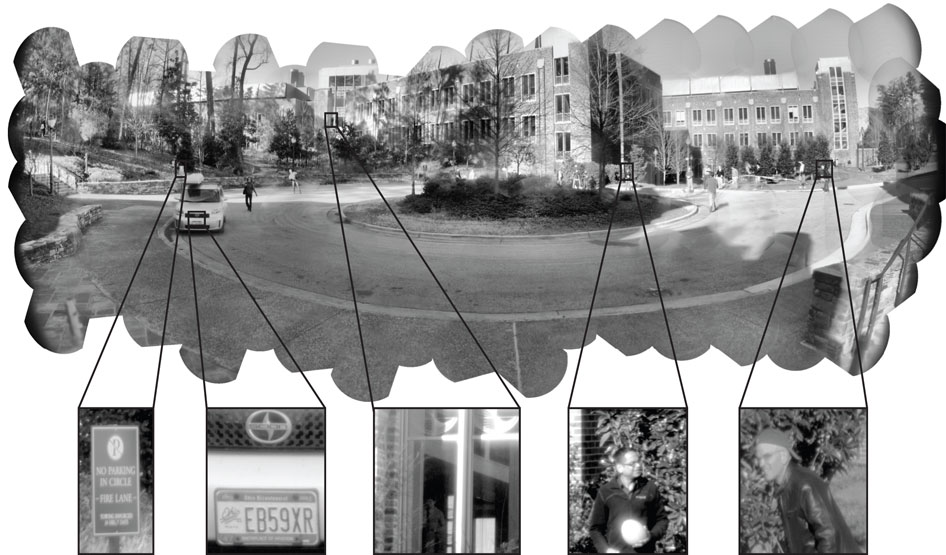
Traffic circle captured using AWARE-2 (credit: Duke University Imaging and Spectroscopy Program)
By synchronizing 98 tiny cameras in a single device, engineers from Duke University and the University of Arizona have created a prototype camera that could capture up to 50 gigapixels of data (50,000 megapixels) and images with unprecedented detail.
The AWARE-2 camera’s resolution is five times better than 20/20 human vision over a 120 degree horizontal field.
By comparison, most consumer cameras are capable of taking photographs with sizes ranging from 5 to 40 megapixels.
The researchers believe that within five years, as the electronic components of the cameras become miniaturized and more efficient, the next generation of gigapixel cameras should be available to the general public.
The camera was developed by a team led by David Brady, Michael J. Fitzpatrick Professor of Electric Engineering at Duke’s Pratt School of Engineering, along with scientists from the University of Arizona, the University of California – San Diego, and Distant Focus Corp.
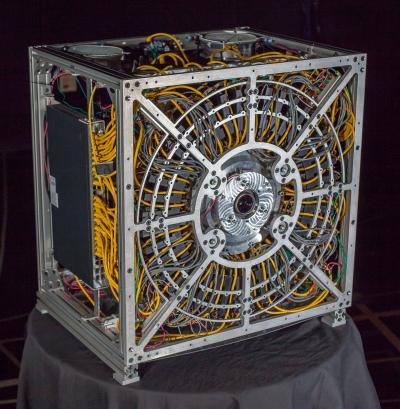
The camera can capture images of things that photographers cannot see themselves, but can only detect when the image is viewed later.Brady said.
“Each one of the microcameras captures information from a specific area of the field of view, A computer processor essentially stitches all this information into a single highly detailed image.
“The primary barrier to ubiquitous high-pixel imaging turns out to be lower power and more compact integrated circuits, not the optics.”
The software that combines the input from the microcameras was developed by an Arizona team led by Michael Gehm, assistant professor of electrical and computer engineering at the University of Arizona.
Traditionally, one way of making better optics has been to add more glass elements, which increases complexity and cost, Gehm said.
“Our current approach, instead of making increasingly complex optics, is to come up with a massively parallel array of electronic elements,” Gehm said. “A shared objective lens gathers light and routes it to the microcameras that surround it, just like a network computer hands out pieces to the individual work stations. Each gets a different view and works on their little piece of the problem. We arrange for some overlap, so we don’t miss anything.”
The prototype camera is two-and-half feet square and 20 inches deep. But nly about three percent of the camera is made of the optical elements; the rest is made of the electronics and processors needed to assemble all the information gathered. This is the area where additional work to miniaturize the electronics and increase their processing ability will make the camera more practical for everyday photographers, the researchers said.
“As more efficient and compact electronics are developed, the age of hand-held gigapixel photography should follow,” Brady said.
The research was supported by the Defense Advanced Research Projects Agency (DARPA).
Comments (17)
by Chrispium
The raw output is actually 200Gb per picture. 32bpp = 4 bytes of data per pixel.
Depending on the speed of your permanent store (HDD, SSD or other) you might want to even do away with compression in order to save CPU cycles used to decode the picture during usage. But if compression is needed I would choose .png as a non-lossy format.
by MarkOates
Maybe it’ll eventually catch up with that 150 year old technology known as color photography.
by James
Anyone know how large the file size would be for something like this? Are we talking 50GB picture size? Also, file format? Please tell me it is .bmp
by Editor
50GB, which is one reason for the dedicated hardware. The files would not be readable on PCs directly. The user would be restricted to subsets of the data. http://www.paris-26-gigapixels.com/index-en.html is an example of a user interface for a 26-gigapixel device.
by Omni
The important aspect of this technology is in that fact we’ll make better cat videos soon.
by Gorden Russell
With a system like this the drones can spot the terrorists when they are out on the open road between villages. The only civilian hit will be the driver. And how innocent can he be if he’s driving a terroist?
by dilbiz
gota militariz everything!?
by steve
I posted this in reply To Gordan Russell but it has been attached to Diibiz
by Gorden Russell
Well, Chris, when the Air Force get this we will put it in drones and kill more Al-Quaeda and fewer civilians.
by Ralph
How is the user supposed to handle a 50-gigapixel image? We will have to invite 98 friends just to look at it.
by Gorden Russell
Good call, Ralph. We will have to break each image down into 98 enlargements. I would like to be able to pick that many 8X10s out of a single pic.
by Chris
I would like to see the same technique used to enhance the image quality of a diagnostic ultrasound machine.
by Steve Engard
Far better visible light space telescopes and higher resolution satellite images for ecological surveys, for serious work. For fun options, better Google Earth images. For government spy stuff,…well that is a given.
by Conrad Green
will till get it but they will do some crazy things and back it with serious money.
by Gorden Russell
You gave me an idea, Conrad. County Sheriffs will put these systems in drones and spot every backyard that has pot growing in it.
by Chris
The Air Force Research Laboratory and SPAWAR will soon be all over this.–then what happens?
by Bri
Totally impractical for drones. Too expensive,too much data to process,too much data to transmit back to base, too much extra weight per benefit. The smart dust that Ray wrote about would be far more effective. Lasts for years, you could find the terrorist before he got into the truck, see and hear all their plans, etc. This is mainly for science. Boy you guys love to kill bad guys. You ever talk to someone from the region? Shoot first, ask questions later? My grandfather ran a military base during WW2 . part of my understanding comes from family discussions. With great power, there comes great responsibilities. I’d take a long hard look at any enemy, before taking their life! There are much better options. Alexander the great, is one of my role models. Brilliant use of force. When you train to be an officer, you don’t take lightly the responsibility of military action. It’s not about revenge and gloating over your enemies demise..