A cheap and easy plan to stop global warming
February 8, 2013
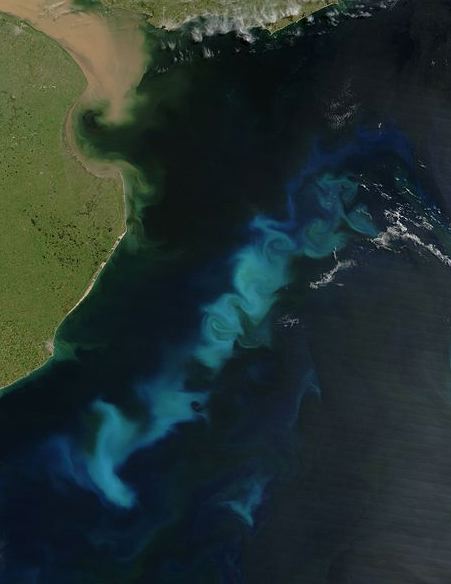
Phytoplankton bloom as a form of geoengineering (credit: Wikimedia Media)
Here is the plan. Customize several Gulfstream business jets with military engines and with equipment to produce and disperse fine droplets of sulfuric acid. Fly the jets up around 20 kilometers-significantly higher than the cruising altitude for a commercial jetliner but still well within their range. At that altitude in the tropics, the aircraft are in the lower stratosphere, reports MIT Technology Review.
The planes spray the sulfuric acid, carefully controlling the rate of its release. The sulfur combines with water vapor to form sulfate aerosols, fine particles less than a micrometer in diameter. These get swept upward by natural wind patterns and are dispersed over the globe, including the poles.
Once spread across the stratosphere, the aerosols will reflect about 1 percent of the sunlight hitting Earth back into space. Increasing what scientists call the planet’s albedo, or reflective power, will partially offset the warming effects caused by rising levels of greenhouse gases.
The author of this so-called geoengineering scheme, David Keith, doesn’t want to implement it anytime soon, if ever. Much more research is needed to determine whether injecting sulfur into the stratosphere would have dangerous consequences such as disrupting precipitation patterns or further eating away the ozone layer that protects us from damaging ultraviolet radiation.
Even thornier, in some ways, are the ethical and governance issues that surround geoengineering — questions about who should be allowed to do what and when. Still, Keith, a professor of applied physics at Harvard University and a leading expert on energy technology, has done enough analysis to suspect it could be a cheap and easy way to head off some of the worst effects of climate change.
According to Keith’s calculations, if operations were begun in 2020, it would take 25,000 metric tons of sulfuric acid to cut global warming in half after one year. …
Once under way, the injection of sulfuric acid would proceed continuously. By 2040, 11 or so jets delivering roughly 250,000 metric tons of it each year, at an annual cost of $700 million, would be required to compensate for the increased warming caused by rising levels of carbon dioxide. By 2070, he estimates, the program would need to be injecting a bit more than a million tons per year using a fleet of a hundred aircraft.
One of the startling things about Keith’s proposal is just how little sulfur would be required. A few grams of it in the stratosphere will offset the warming caused by a ton of carbon dioxide, according to his estimate. …
(More)
Comments (80)
by John
Supposedly humanity would have to do this continuously for centuries, right?
by Erik
In the seventies, when people believed we were heading towards an ice age, it was talk about covering the ice caps with black soot so they would melt.
Today we should be glad they didn’t go ahead with their plans, or maybe not?? The number of sunspots is decreasing and we may be be heading towards a small ice age similar to the one we had around 1700, when we also had very few sunspots.
by dag.wood
If warming is such a problem why haven’t governments banned building any new black asphalt roads? Concrete roads much better in terms of cost when looking forward 20 years worth of maintenance.
by Robyn
Perhaps before re-engineering global weather patterns,
or even before slapping J58-P4 engines on a business jet.
you should check your most basic postulates.
The newest of the new Gulfstream, the G650,
which just got its papers from the FAA six weeks ago.
It is only certificated for operations up to 51,000 feet
or 15.5 KM, not the 20 KM you would have them crashing from.
Maybe some basic Earth science should precede the magic show.
by Cybernettr
Our dependence on fossil fuels is a problem that is already solving itself, since the efficiency of solar energy is increasing on an exponential basis. This year, it will only provide 1% of our energy needs, but shortly into the next decade it will be satisfying 16% of our total energy requirements and in 2027 that number should reach 100%.
by Spikosauropod
What this shows is that if global warming is ever a serious problem, we will have a serious solution.
by Spotted Marley
yeah! let’s spray more shit in the sky!! can’t wait
by MikeB
Quick question: why do we have to ‘control the thermostat on the planet’ rather than simply adapt to the changes? Occam’s razor: we _can_ adapt without understanding the planet and its processes. The same is not true of safely geo-engineering the planet, etc.
Interesting _fact_: we have caused more harm than good to our environment by playing God. Please think about that.
by Prof. Dr. Hugo de Garis
GLOBAL BLOSSOMING
Why doesnt anyone consider the positive side of “global warming?” For sure if the green house gasses cause the polar ice caps to melt and raise the sea level, then the coastal cities will be swamped, a bad thing, but consider how much of our current global land mass is too cold for human habitation, Greenland, northern Canada, Alaska, and a whopping fraction of north Russia. Global warming might make this huge total land mass fit for human habitation, and hence more than offset the negative effects of rising sea levels. Why does noone even mention this idea of “global blossoming?”
by WLGJR
Oh yeah, then we will have places to relocate the Israelis to (in your political theory). The excess population of China and India can also benefit from this Blossoming.
But, if the sealevel rise go overboard, and something akin to the movie Waterworld (where sealevel rise to cover 99.9% of land, despite how improbable that scenario would be) happens, how should we (humanity) react?
by Gabriel
I feel you should go deeper into your thoughts Professor – this is something I can’t say I’ve ever heard before, but you must realize that you are, in a sense, rationalizing climate change. As you develop your reasoning, keep that in mind; otherwise, people will reflexively disagree, even if their is some sense to what you are saying.
by Chris
Because those areas are all tundra and nothing will grow on tundra. Also there is 6 months of all or nearly all daylight followed by 6 months of all or nearly all night.
by Sue
There’s already too much being sprayed into our atmosphere ie chemtrails. The real truth about their content and purpose has not been forthcoming, or who is behind this worldwide phenomenon. So the idea of sulphuric acid eventually descending through the layers onto humans is pretty scary. Unless you have a long term plan to exterminate life on this planet, which is possible if we have been infiltrated by aliens or Dr Evil’s scientists. Move over humans!
by Bri
Wikkipedia the sulfur emissions of Mt Pinnitubo or pretty much any volcano. I agree we should find other more beneficial solutions but we are also getting to the point where we are stuck between a rock and a hard place. The amount of sulfur released into the stratosphere can be offset by reductions of sulfur released near the ground by power plants so that there woukd be no net increase. Cheap out the dekka basalt traps in earths history. The amounts proposed wouldn’t have the effects that you fear. In turbofan time there are billions of dollars lost and untold amounts of environmental havoc caused by global warming. This might be a valid stop gap measure until more effective solutions can be found.
by Jim Mooney
We are offsetting the heat increase by decreasing sunlight, but sunlight is the key to plant growth.
by Mega Megan
Bingo! I’m glad at least one other person can use their brain! :D
by Kyle
Once again, more research is needed. So we come up with creative ideas, toss them back and forth, act on a few, and move forward with those things that work. Makes sense. That’s how we got this far.
by GatorALLin
I just remembered the Movie, Night of the Living dead, where acid rain is the cause behind the zombie Apocalypse. Finally, all the movies can come true now and get rid of the human virus affecting the earth (and fix the global warming/melting problem we created at the same time….just brilliant) http://en.wikipedia.org/wiki/The_Return_of_the_Living_Dead
by morganims
you can also diperse nano particles of nickle into the ocean.
Just last week it was shown that the precipitates out the CO2 as calcium carbonate that will settle to the ocean floor.
This gives shellfish and plankton more building materials, and doesn’t flood the ocean with fertilizer like seeding with iron does.
If you want to collect it, it is also used in making cement, and bypasses alot of the energy used to cook it…
by cameronarndt
If we over-estimate the needed amount and accidentally cause too much cooling, is there another opposite process that we could use to cause warming, (other than continue polluting)
by Anasazi
Global warming or impending ice age, regardless, we need to be able to control the thermostat on this planet. We can’t afford either unbridled warming or another ice age. Not that we should go off half cocked, but we can’t afford to let Mother Nature have free rein any more. We are lucky to have had a few thousand years of “nice weather,” the Little Ice Age notwithstanding. But it won’t last forever.
by Howard
Oh, now I understand why we have not detected “intelligent” life for outer space. They put acid in their atmosphere and froze to death! ;-)
by Howard
A small caveat is in order. What if you are wrong? Is an Ice age superior to your “theory” of Global Warming? Being a bit on the anchient side, I remember too many mistakes made by governments. Politicians are not scientists and there was a time when even respected men of science thought the earth was flat and sailing west from Europe would cause you to drop off the edge.
by Howard
Be careful! Once you introduce a permeant cooling agent into our atmosphere what do you do to repair the mistake if you are wrong? Hot has problems of course, but cold means death. And, I should add, the earth has been very cold a lot longer than it has been warm and very little life has much of a successful record during ice ages. Florida beach property has very little value under sheets of ice. Having a majority of so called scientists and a hell bent government in agreement with you is not science.
by smb12321
Every day, tons of “foreign particulates” enter our systems from space. Volcanos and other emissions routinely spew massive amounts of toxic gasses into the air. Yet life goes on. Alternatively, why not a Manhattan type project for conversion to solar or artificial photosynthesis? Were going bankrupt to the tune of $3B / day so take a weeks worth of debt and invest in the future.
by Greg
isnt the oceans acidity allready increased 30% due to excess carbon dioxide in the air, dont think this would help and seems very irrasponsable to experiment in such a way
by Concerned Human
And if his calculations and simulations are wrong, this spike in the Earth’s albedo will plunge the planet into another ice age. OOPS!
by A4i
I have far better idea, just substitute nowadays concrete with carbon powder/fiber kind. Then build plants for air lithification and carbon extraction and use extracted material for carbon based concrete. It is that simple folks and no sulfuric acid involved
by Arctic Poppy
I suspect that the amount needed at the altitude required is what makes this different than sulfur belching coal plants or acid rain. We are talking about very high altitudes. And, I suspect the complete proposal has addressed all of the obvious issues. That being said, I’d rather get the CO2 under control. Those unintended consequences are the real catch here.
by Gorden Russell
“By 2070, he estimates, the program would need to be injecting a bit more than a million tons per year…”
This makes it all moot. Ray projects all the lines graphing technological progress to go off-chart up to the right by the year 2046. After that we will be into the Singularity and we will know how to make the photovoltaic self-assembling carbon nanocells that I always talk about. When these cells are growing all we need using nothing more than the power of the sun and the carbon dioxide they take out of the air, then no more fossil fuels will be burned to make electricity or lime for concrete. (That latter use is almost as polluting as power generation.)
When the world populace is using nanocells to grow houses, clothes, and cars out of carbon nanotubes and graphene, as well as assembling food out of all the other needed carbon compounds, then the warming will be reversed.
After all the centuries of putting carbon up into the air, it will take a long time to see the reverse…but knowing the human desire for consumption, after some time passes there will be a new cry raised that the atmosphere has lost too much carbon, that too much has been sequestered in towering palaces growing all over the globe.
Then robots will need to start mining coal again and just burn it all in large piles.
by Gorden Russell
On second thought, by the time all the excess carbon is out of the atmosphere, everyone on Earth will be living the abundant life and birthrates will go way down. Also, asteroid mining will be in high swing by then, and carbonaceous asteroids will be brought back to geosynchronous orbit where nanocells can eat them up and grow perfect cables of carbon nanotubes to lower down to the equator for skyhook space elevators.
Then robots on the Moon, on Mars, and throughout the near Earth asteroids, the main asteroid belt, and the Trojan asteroids that lead and follow Jupiter in its orbit, will be building inter-system space liners to shuttle people from the elevator space stations to the cis-lunar Lagrange points where the starships will be built.
These starships will use charged particle accelerators as their drives. These will be like the Large Hadron Collider, only orders of magnitude larger.
When you can shoot enough particles out the tailpipe at near light-speed, you can accelerate your ship until you are up near the speed of light.
These ships will be ramscoops, using electromagnetism to direct interstellar hydrogen into maws that are dozens of miles across, with huge radars and powerful lasers lining their rims to spot and disintegrate all the tiny bits of dust and ice that sprinkles the void between the stars.
With the nanocells to provide all our needs for energy, housing, food, and clothing, we will not despoil the new worlds that we colonize.
by Bri
Sounds like your writing a science fiction adventure Gordon. To infinity and beyond!
by Gorden Russell
If you just read this newsletter every day, along with Space.com, and Live Science and Scientific American and any other you can find, and look forward, it is all foreseeable as science fact. What I’m writing here is a future history. All these things will happen, and more, a whole lot more. Many things are going to happen that will surprise us, things that we can’t imagine.
The Singularity is a black hole for the imagination. You can keep sending your imagination up to the Sing, but you can’t get past it.
Unimaginable things will be commonplace in the second half of this century.
When you can link your brain to a quantum computer, even if you are using a DNA computer as a go-between, you will make stupendous scientific breakthroughs every few nano-seconds.
by Gabriel
I have to agree with Bri – your posts sounded very exciting and optimistic Gordon ^_^
by Gorden Russell
I’ve always seen your posts as very positive and hopeful, Gabriel. Just have a little faith in the articles Amara posts here.
Do you remember the one about graphene being used as a filter for reverse osmosis to desalinate seawater?
Or all the articles she has found about molecular self-assembly?
Or about carbon photovoltaics with 83% efficiency?
These will give humanity what it needs to grow desalination plants far out on the continental shelves with pipelines wider and longer than the Great Wall of China to pump in freshwater to green all the barren deserts of the world.
by Gabriel
Ooh, thank you; I haven’t really written anything substantial here in quite some time, but nice that someone remembers me :).
Indeed, really just posting articles like that are critical to remind people that things are getting done, and to not get bogged down by pessimism….it’s so easy to look at all the articles, all the research and just not care because the economy is in shambles, this and that is happening overseas…really just to pick at anything you can think of to convince yourself that things are getting worse, which is completely not the case.
You are not deluded for thinking things are getting better, and reading articles that seem to reinforce that…for having that idea of the world; you can be called annoyingly optimistic, but it’s even worse to become annoying pessimistic, and to have this vision of the future and seemingly seeing all these different things coming from different sources that seem to perpetuate that….It’s not that you are cherry-picking or being selective; indeed, the world is not perfect, nor is it ever likely to be (it’s debatable what the word even means)…but if you could, say, show somebody the book “The Better Angels of our Nature”, introduce them more to science and technology little by little and try to make them see past the doom and gloom that pervades, well, everything nowadays….I think it’s a worthwhile thing to do.
The last thing in the world that you want to happen is to let your cynicism about the downtrodden state of the world, despite evidence to the contrary, become a self-fulfilling prophecy, and those sorts of situations are the ones to really be fearful for – that lack of appreciation for what you have, is what makes you lose it; next thing you know, the USA starts fighting China, climate change just gets worse, fundamentalism in any aspect just gets bigger….we live in an extraordinary time where things seemingly only become more utopian overtime, with individuals becoming more ‘god-like’ in capability…. the only reason stopping a whole ton of people from having happier lives is to simply change their way at looking at things and realize what they have….I’m not trying to marginalize people’s problems, but for crying out loud…..you’re a fool if you think any sort of apocalypse is going to make things better.
by Gabriel
Kurzweil, among all the other things he’s said that really got to me, once expressed how important it is to recognize what ‘is’ important…and I think that’s really a key issue for alot of people in a philosophical/psychological…that, if they’d adopt more positive, rational and productive viewpoints..they’d become, simply put, alot happier people….even if we reached Peter Diamandis’ era of abundance, it wouldn’t change a thing in terms of people’s actual happiness if everybody is still firmly convinced that we’re all going to hell in a handbasket.
And although this seems random, this quote by Nietzche that I saw yesturday, really sums up alot of my feelings recently:
“Mystical explanations are considered deep; the truth is, they are not even shallow.”
by Klaatu
Oh yes Gorden, you excite me with your optimism
& imagjnation blah blaah blah. Yes Gorden not really.
Space based heat deflectors that also utilize sunlight for power
Co2 filters that actually work might prevent
Houston or China’s capital from becoming more of a sinkhole.
Notice all the right wing seeded comments? Is this becoming
a Breitbot sinkhole?
by Fred
HOPE YOU’RE RIGHT GORDEN, BUT WE STILL HAVE THE TEA PARTY AND FLYING JEWS.
by WLGJR
“These ships will be ramscoops…” You mean Bussard Ramjets, right?
by Joe Prete
I love Peter F. Hamilton…
by Gorden Russell
Yes, WLGJR, Bussard Ramjets that will pull in interstellar hydrogen to fuel fusion power plants.
by Gorden Russell
Wait a minute, Joe Prete, are you sure you’re not talking about Edmund Hamilton? Some of his fans called him, “World Wrecker Hamilton.” (I remember one of his stories that crashed the planet Mercury into an interloping alien world. It was a very old tale when I read it back in 1977.)
by Jump
Pandora’s box!!!
by Jim O'Donnell
This is the same kind of scheme that was perpetrated by amateur entomologist Etienne Leopold Trouvelot who, in the late 1860s, brought gypsy moth egg masses to the U.S. from France for some screwball “experimentation.” In no time the moths escaped and have since ravished America’s hardwood forests from coast to coast. Coincidentally, after losing interest in entomology, Trouvelot was offered a faculty position at Harvard in astronomy. Please Harvard … cease and desist!
by Gorden Russell
Please, Jim O’Donnell, don’t pick on Harvard now. That school has improved a lot since the 1860s. Now they offer MOOCs for free. Today I signed up for Professor Gregory Nagy’s course, “The Ancient Greek Hero,” which starts on March 13th. Just can’t wait for it.
Just check it out at:
https://www.edx.org/courses/HarvardX/CB22x/2013_Spring/about
by Scott
Wouldn’t that increase the acid rain problem at some point?
by Paul Marsh
I’m not an expert, but 20 kilometers is 65000 feet which is quite above where clouds and rain form.
by Paul Marsh
Also, the article makes the point that this is a comparatively small amount of sulfur. Power plants issue far higher amounts of sulfur than that.
by Gorden Russell
That’s the number I get, Paul Marsh. It’s been since 1967 when I took 9th grade Earth Science, so my memory is fuzzy, but I don’t think many clouds form over 20,000 feet. I’ll have to go do a search.
by Gorden Russell
Here is something from Wikipedia:
Polar mesospheric clouds are the highest in the atmosphere and occur mostly at altitudes of 80 to 85 km (50 to 53 mi), which is about ten times the altitude of tropospheric high clouds.[47]
The chart above this paragraph shows the rainmaking cloud called a “towering cumulonimbus” which rises well above 40,000 feet before it comes down as rain.
by Bruce Wright
The issue isn’t that the sulfur would be released at the altitude where clouds form, the issue is whether “enough” of it would circulate down to where they do form. (If some circulates up, then some will certainly also circulate down).
However these are really tiny numbers, even the amount of sulfuric acid needed in 2040 is far lower than that of US power plant emissions in 2012 – and the former number is the amount needed over the entire world whereas the latter number is only the amount produced in the US power plants, which are only about 65% of the total US atmospheric sulfur output, let alone the rest of the world. Additionally, atmospheric sulfur output is declining with the decline in the use of coal, not only in the US but also in places like China which has also been also a very heavy coal consumer.
Bottom line is that increased acid rain appears to be an extremely minor concern.
by Bri
All that sulfur is relatively close to the ground and precipitates as acid rain fairly rapidly. The release of upper stratospheric would eventually come town, otherwise we wouldn’t need to replenish it. Look to Gordon post. Ray also talks about how the use of atmospheric carbon will rapidly deplete CO2. The release of sulfur in this manner might be a good short term solution till we start using it up for manufacturing. I’m not a fan of two wrongs making a right but this proposal does have merit. In the long term I favor controlling the influx of solar energy.. It has many other virtues like the reduction of desearts and the warming of polar regions. Man is destine to teraform this planet and others, so I tend to side with more ambitious plans. We do need to have a strategy in place if we reach a tipping point. Right now our weather is getting very extreme, it could get much worse. Because of the scale of the problem it is better suited to robotics and AI to hash out the details of a true planetary thermostatic control system. My guess is that nanotech will achieve what we want betide our world governments get into any significant global warming strategeies. Let’s face it the bottom line is expense. At 700 million dollars even the sky industry would find it attracive to implement and still be cost effective for them, let alone all the other industries that are affected by glbal warming. The big problem is still consensus.
by Bri
Where’s my awaiting approval? Now I realty feel lost confused and dejected! Oh well maybe I should throw in some penis extention jargon. That will get the spam filter all riled up.
by Bri
Ahhh!!! there it is!!!
by stevewaclo
Someone mentioned waiting for improvements in computer simulation and using that as a tool.
“I’m not an expert, but 20 kilometers is 65000 feet which is quite above where clouds and rain form.”
What is the “upper limit” (pun intended” of extant weather simulation technology?
best wishes
by Tom B.
As long as we have a way to completely reverse its effects if things go awry, it is nice to have an emergency plan in place for the time when our ecosystem starts to completely collapse due to the tampering we’ve already done.
by notthe1st
Mmmm – and does the sulfuric acid stay in the atmosphere forever? Or does it fall back to earth eventually in the form of acid rain? Would we be trading one global atmospheric problem for another?
by Nick
I agree that MUCH more research is needed on that. Although I’m not a scientist, the idea of adding sulfuric acid to offset damage done by pollution doesn’t sound like a great idea.
by ChrisF
This is a very creative solution – I like it. At the very least, it deserves further research.
by Bob
This is horrific, and if this scheme were to work the unintended consequences could kill tens of millions of people around the globe by cooling the globe and destroying crop yields.
Anthropogenic global warming is not a fact- it is a religion fueled by greed and pride (in my opinion).
by Marcos Marin
Yes let us continue with the current spray program instead!
by Ralph Dratman
What has led you to conclude that anthropogenic global warming is non-factual?
by steve
The facts.
by Laura C.
Yes — the facts. There has been no global warming for the last 16 years. If you respect science and reason and your models turn out to be wrong (non-predictive) — well, I mean, really, don’t defend the models.
by ChrisF
Laura, you declined to mention a source is for that 16 years figure, but a similar story has recently made its rounds in the UK’s trashier newspapers. The story has been thoroughly debunked : http://metofficenews.wordpress.com/2012/10/14/met-office-in-the-media-14-october-2012/
Please note the quote, “eight of the warmest years on record have occurred in the past decade.”
by Laura C.
Just noticed your reply. Here’s a quick response. (By the way, if you massage data and don’t let other scientists access the raw data, are you doing science?)
A reaction to the reaction: “The Hadcrut 4 figures that show a ‘pause’ in warming lasting nearly 16 years are drawn from more than 3,000 measuring stations on land and at sea. Hadcrut 4 is one of several similar global databases that reveal the same thing: that since January 1997 there has been no statistically significant warming of the Earth’s surface.
Between 1980 and the end of 1996, the planet warmed at a rate close to 0.2 degrees per decade. Since then, says the Met Office, the trend has been a much lower 0.03 degrees per decade.
However, world average temperature measurements are subject to an error of plus or minus 0.1 degrees, while any attempt to calculate a trend for the period 1997-2012 has an in-built statistical error of plus or minus 0.4 degrees. The claim that there has been any statistically significant warming for the past 16 years is therefore unsustainable.”
http://www.dailymail.co.uk/news/article-2220722/Global-warming-The-Mail-Sunday-answers-world-warming-not.html#ixzz2KMbmFXUs
“The lack of warming for more than a decade—indeed, the smaller-than-predicted warming over the 22 years since the U.N.’s Intergovernmental Panel on Climate Change (IPCC) began issuing projections—suggests that computer models have greatly exaggerated how much warming additional CO2 can cause…..” [+ much more here]
http://online.wsj.com/article/SB10001424052970204301404577171531838421366.html
by ChrisF
Interesting, thanks. I agree that average temperatures do seem to have levelled off in the past few years, a fact I wasn’t aware of. However, still I tend to agree with the Met Office when they argue that the long-term trend may still be in effect, and that we’re merely “taking a breather” before the next upward leg. I guess we’ll only know for sure in another decade or two – I really hope you’re right.
by zeb
What are you saying, Bob? That the world’s most prestigious scientific institutions have been colluding to falsify data so that it looks like climate change is human-caused? That respected climatologists around the globe have all been corrupted by greed? I suppose they’re all shilling for that huge and powerful “Big Green” lobby. Get real man.
by WLGJR
Would be great if we have some science-informed discussion on conspiracy theories on KAI.
by WLGJR
“That respected climatologists around the globe have all been corrupted by greed?”
Just because someone is in labcoat doesn’t make him/her more trustworthy.
But we also know that it takes too long (for an uneducated person) to educate himself/herself.
by ChrisF
Fair comment, no single human being is incorruptible. But to suggest that climate scientists are in it for the money strikes me as loopy! I’m certain that very few academics entered the field to get rich.
Btw, in the interests of balance – surely Big Oil has vastly more cash available (not to mention a far greater incentive) to influence the debate via PR, lobbying, astro-turfing, bogus thinktanks, etc ? It’d almost be neglectful of them not to make these “investments”, so as to protect their future profits.
by zeb
“Just because someone is in labcoat doesn’t make him/her more trustworthy.”
Sure, but Bob’s claim is that there is some far-reaching conspiracy going on here among the entire world’s top scientific academies and institutions. This is just ridiculous on its face. It would be far too difficult to pull off for one thing, and the motive just isn’t there.
by B.J. Murphy
Broad scientific consensus would disagree with you wholeheartedly.
http://earthobservatory.nasa.gov/IOTD/view.php?id=80167
by Bruce Wright
It is irrelevant whether global warming is anthropogenic or natural, if it’s causing harm to the Earth’s ecosystems it makes sense to counter it. Naturally it is essential to understand the consequences of doing something like this, especially to avoid causing excessive global cooling or disrupting precipitation patterns, for example.
by ErikSMeyer
Average global temperatures have not increased since 1998. The problem with the Dangerous Anthropogenic Global Warming claims is that they haven’t established:
1. That the globe is warming
2. That such warming has been caused by human activity
3. That whatever warming is happening is dangerous.
I’m often amazed by the extreme hostility people manifest towards CO2, which after all, is necessary to life. Increasing CO2 concentrations in the atmosphere seems to have minimal effects on temperature (CO2 concentrations, whatever the source, have gone up significantly over the last 14 years with no corresponding rise in temperature, for example), but it does stimulate plant growth, quite markedly.
As best we have been able to determine the medieval warm period was considerably warmer than now, as was likely the Roman warm period (and probably the Minoan), to cite recent examples. None were caused by humans and all seem to have been prosperous times.
Cooling is the thing to worry about, if you’re worrying about the climate changing (whatever the reason).
by ChrisF
Erik, please take a look at http://www.metoffice.gov.uk/hadobs/hadcrut4/diagnostics.html – your claim about global temperatures is simply not supported by the evidence.
by ErikSMeyer
The lack of statistically significant warming since 1998 has been a consistent topi of discussion for quite some time, I didn’t make it up. the source you cite shows a plateuing, as also here:
http://www.metoffice.gov.uk/news/releases/archive/2012/global-temperatures-2012
This is why the people promoting warmist agendas have resorted to various PR tricks in the way they structure their talking points (such as the statement that the 1990s were warmer than the 1980s the 2000s were warmer than the 1990s, the 2000s were the warmest decade “on record”, etc.). Global average temperatures appear to have risen between 1980 and 1998, then plateaued, which would be consistent both with the 2000s being warmer than the entire decade of the 1990s and with warming having stopped. Further, the “record” they are referencing is only the instrument record, which does not include data from more than 150 years ago.
Though the marketers have successfully created the image in the public mind of skeptics being paid shills for various corporate lobbies, the truth is the real money is on the other side; many billions of dollars a year are funneled into grants, projects, carbon credit schemes, etc. all predicated upon confirming the DAGW agenda (which would not in itself make their conclusion false, per se, but should be taken into account whenever you hear them attempting to discredit people who question their claims).
The reason these people switched from using the expression “global warming” to using “climate change,” I strongly suspect, is because the climate is always changing (whatever the reason), whereas warming appears to have stalled out.
If, somehow, we were to fall into another Little Ice Age, or worse, I really don’t doubt the bulk of these people would persist with their “climate change” arguments and keep talking about CO2 or whatever, finding some way to hold mankind responsible that will keep their funding coming.
by me
alternatively remove the adjustments made to official temperature records and hey presto spurious warming signal massively reduced
by Aleksander Wishman
wow!