A circuit diagram of the mouse brain
October 24, 2012
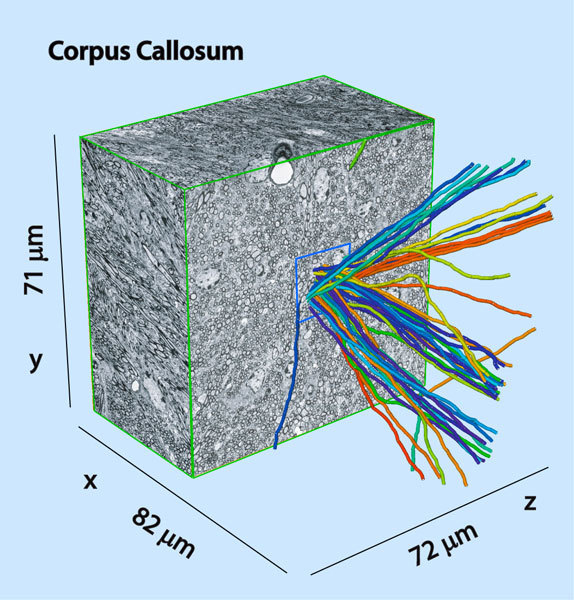
Serial block-face electron microscopy stack from the corpus callosum, cut down the middle, with 50 traced myelinated axons emerging, randomly coloured (credit: MPI f. Medical Research)
Max Planck Institute (MPI) for Medical Research scientists are developing a complete circuit diagram of the brain of the mouse using an electron microscope to make fine extensions of almost every single neuron visible.
Most axons are less than one micron thick, some even smaller than 100 nanometers. “The electron microscope is the only microscope with a high enough resolution to enable individual axons lying next to each other to be distinguished from each other,” says MPI scientist Winfried Denk.
In 2004, scientists working with Denk developed a new method that enabled “serial block-face” scanning electron microscopy. To examine tissue using this method, it must be fixed, stained and embedded in synthetic material.
This works for small pieces of tissue, but up to now it was not possible for tissue the size of a mouse brain.
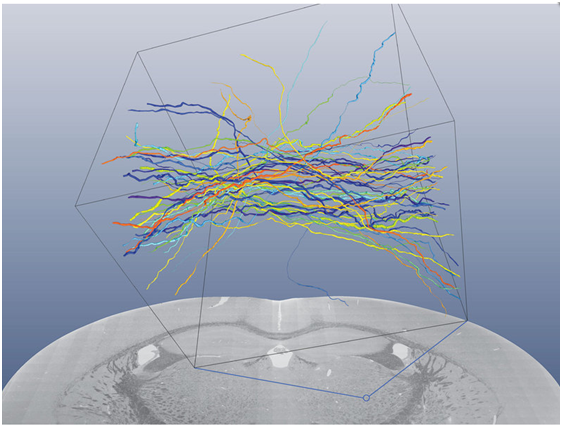
Scanning electron microscopic mosaic of a coronal blockface through a whole mouse brain acquired at 80 nanometer pixel size. Also shown are reconstructions of 50 myelinated axons from the ventroposterolateral nucleus (VPL) of the thalamus from a similarly prepared sample. Each axon has a unique color. (Credit: MPI f. Medical Research)
In their latest study, the Heidelberg-based researchers demonstrated that the brain of a mouse can be prepared in a way that enables it to be analyzed whole using “block-face” electron microscopy.
The challenge facing the scientists was to treat a large piece of tissue so that it is evenly fixed and stained right through to the inside. To do this, they developed a complex process in which the brain is treated in different fixing and staining solutions for days.
With scanning electron microscopy, an electron beam scans the surface of a tissue section. A single electron microscope image thus corresponds to a cross-sectional view through the tissue. To obtain a three-dimensional image of a tissue, it is cut in fine sections using traditional methods, and these are then microscoped individually.
This approach is not only tedious, it is also error-prone. Block-face microscopy overcomes this problem. This involves inserting an entire piece of tissue in the microscope and scanning the surface. Only then is a thin section cut, and the layer below is scanned. This makes it easier to combine the data on the computer.
In an initial analysis of the method, the scientists followed the axons of 50 randomly selected neurons and marked them by hand. The axons can be clearly reconstructed using the process. “However, it would take far too long to trace all of the neurons in this way as a mouse brain consists of around 75 million neurons,” says Denk.
So the image evaluation must be automated. “Our images have sufficient resolution and contrast to follow all myelinated axons. If we manage to scan an entire brain in the years to come, this should provide a major incentive for computer scientists to develop the necessary analysis methods.”
A detailed map of the connections in the brain will make a major contribution to the clarification of neuronal functions. “Every theory on brain function is based on an idea of the corresponding information paths in the brain. It is very important that we find out about the connections between the nodes so that we can distinguish between different models of brain function,” explains Denk.
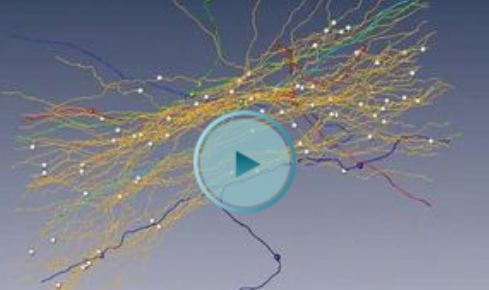
Reconstructed axons from the ventroposterolateral nucleus of the thalamus (credit: MPI f. Medical Research)
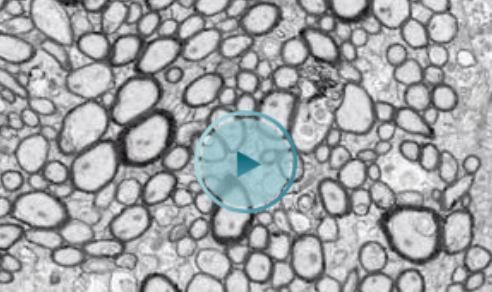
Glimpse into the nerve tissue with block face electron microcospy: the procedures enables researchers to analyse the tissue layer by layer. The sequential layers depict a cross-section of cell extensions (circles with black borders) and cell bodies with the cell nucleus (grey circles). (Credit: MPI f. Medical Research)
References:
- Shawn Mikula, Jonas Binding, Winfried Denk., Staining and Embedding the Whole Mouse Brain for Electron Microscopy, Nature Methods, 2012, DOI:10.1038/nmeth.2213
- Wolfgang Mittmann et al., Two-photon calcium imaging of evoked activity from L5 somatosensory neurons in vivo, Nature Neuroscience, 2011, DOI: 10.1038/nn.2879
- Sebastian Berning et al., Nanoscopy in a living mouse brain, Science, 2012, DOI: 10.1126/science.1215369
Comments (13)
by Michael Zeldich
Even if one will develop a functional model of a brain, it will be useless because the role of a brain is still unknown, as well as the reasons for developing and loosing synaptic connections. Neural net is dynamic reflections of the events in the particular body life, a moment after a moment, and without that history cannot be understood.
by eldras
Brilliant article thanks Amara. Hurdle is the synapse.
by John Middlemas
This mouse brain decoding is a huge problem similar to travelling to the distant stars, we will never get there and we know it. You cannot decode billions of brain cells and trillions of connections. These sort of problems are beyond the realms of the imagination. Even if you could make a map you will never understand it and even if you could you would not reproduce intelligence if it lies outside of physical items, e.g. the soul. Without strong evidence the soul does not exist it is a pure guess to invest loads of money in these researches. If the sould exists then it must surely be the source of intelligence and other higher functions and the neurons and connections are just the “lower end” of the system.
This makes sense when you think that neurons and connections are just like a map of roads and roundabouts with traffic buzzing around. How can such a simple and inert system produce higher functions like appreciation of beauty, stress, love and the like. I am not just a collection of roundabouts and roads thank you very much.
by Jon
Don’t be afraid of such developments. You are everything you are, regardless of what the building blocks are. If scientists were to figure out exactly how your thoughts and feelings work, it wouldn’t devalue them in any way.
It wouldn’t change anything. The underlying structure of your mind is what it is, the only difference would be whether we understand it, or not.
by EP
Souls and evolution aren’t really compatible, see Dennett’s “Darwin’s Dangerous Idea.”
If you don’t believe in evolution, I don’t know what could possibly convince you at this point.
by Bri
I’ve said this many times on this web site, and I’ve gotten a bit of flack for it. I live with psychic experiences. I’m very scientific by nature. Have been all my life. Many friends have nicknamed me science. I have given my experiences a very intense evaluation. The soul exists I don’t know the reasoning that Dennets uses, but it would be meaningless to me. I consider it a boring day if something psychic doesn’t happen, and some aspects I can summon at will. I’ve always known that I’ve lived before, since before I new words to speak the concept. All I can tell you is that the experience is often like what was depicted in the movie The dead zone, in that it jolts me. It’s more like an elevator drop, but instead of down , you fall briefly inward. Most of what I see is very personal. I would imagine that you would be increduous, but that doesn’t change the fact, that I live with it. Truth is truth. I’ve tested this innumerable times. It is very real. My mother was in psychology. She had her concerns that it might be a mental aberration like schizophrenia. I’ve been tested five times. The report is always the same. I’m of above average intelligence and if anything, extremely well balanced. Whether you like it or not, you have a soul. Your spirit, which is different from your soul, changes and evolves in relation to what you experience. I’m very familiar with brain research, and I feel no conflict with how it functions. It’s not an easy issue to resolve. As it stands now, there is no hard proof of what I say. I have a way to prove it, but it’s turning out to be hard to find an organization that is willing to test it. I will continue to seek an avenue to give credibility to what I’m saying. Right now the responses I’m getting are that there is a lack of funding, because of the economic times. I’m hoping to get the Templeton Foundation interested, but I have received no response from them. It’s actually their charter to prove or disprove the existence of the soul. I hope to end this debate. For me it is annoying to think that people don’t know. I hear and read about how there is no soul, and that it’s just superstition. As I’ve said, I’ve known it since before I could walk.
by EP
If you’re really confident in that, go win a million dollars from James Randi.
by MrFriendly
I say this a lot, but it’s true that even simple models of neural circuits can still yield great advancements in many areas of computing.
The big issue here, though, is that a lot can be learned to advance medicine.
by Ralph Dratman
That image analysis program is going to be running for a long, long time.
by Vin
So the breakthrough is instead of cut and image, its image and then cut? Standing upside down on the head, its the only way to fly.
by tim the realist
if this technology can be made quick and efficient, then comparison sturies of cloned mice will reveal any structural differences. we will be able to directly measure physical brain changes during development and due to different environmental effects including nutrients, exercise, and learning / training.
This technique could also be used to measure efficiacy of different brain preservation methods and any physical degradation over time using mice brains from control clones raised as identically as possible. Given enough data it should be easy to distinguich normal variation patterns from defects introduced during preservation and storage.
by Gorden Russell
This is exactly the area of research that will lead to repairing the brain damage caused by freezing in cryogenics.
This leads us to think of young Kim Suozzi. Can you tell us how she’s doing, Amara? Are the donations near her goal?
by Editor
Gordon, please see http://www.kurzweilai.net/23-year-old-with-terminal-brain-cancer-hopes-to-be-cryopreserved-update for an update from Alcor.