A step towards total autopilot
September 20, 2012
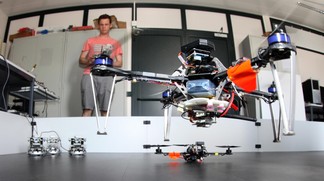
(Credit: EPFL)
Will planes someday fly without pilots? Three EPFL laboratories are working on a completely automated aerial collision-avoidance system by developing collision-prediction, avoidance, and real-time vision algorithms.
The project is a formidable technological challenge. It will first be used for small airplanes or drones in non-military applications, such as forest fire surveillance or monitoring access to industrial sites and borders. And it could prove invaluable in missions that are hazardous or simply not possible with human pilots, such as taking measurements in a volcanic ash cloud or above a nuclear power plant after an accident.
The scientists involved in the project have joined forces under the aegis of EPFL’s Transportation Center, which is called TraCE. The Real-Time Coordination and Distributed Interaction Systems Group — known as REACT — is working on predicting trajectories and in-flight collision avoidance. The Computer Vision Laboratory, also known as CVLab, has the job of outfitting the aircraft with a veritable visual intelligence system. And the Distributed Intelligent Systems and Algorithms Laboratory, DISAL, will test algorithms on small, lightweight flying robots.
“It is a project that confirms EPFL’s unique expertise in the transport research field. The multidisciplinary character of the project unites three laboratories from three different Schools who have teamed up with a large company like Honeywell to remain as close as possible to industrial requirements”, says Michaël Thémans, Associate Director of the Transportation Center.
For Honeywell, the project has great potential in both the civil and commercial sectors, far beyond just aviation. “These new technologies will not only help us improve general flight safety, for example by providing better autopilot systems, but they will certainly also have other uses in automating everyday life,” says George Papageorgiou, director of the Aerospace Advanced Technology Europe System Engineering & Applications Department at Honeywell.
Goal: zero accidents
The REACT team has been working for several years on issues involving driverless vehicles. They will now also work on developing algorithms that can predict position and trajectory for aircraft occupying a given segment of airspace based on the data from all available devices — GPS, ground-based radar, cameras, and infrared cameras. They’re looking to provide very reliable programs to avoid all accidents as far in advance as possible. “It’s a project that places the technological bar very high,” says group director Denis Gillet.
CVLab scientist Vincent Lepetit is developing a system to analyze images taken by high-definition cameras. “What seems to be a simple task for the human eye is incredibly complex to reproduce technically,” he explains. “The main difficulty lies in the enormous amount of information that has to be processed; each image is made up of several hundred thousand pixels.” In addition, it’s not enough to perceive objects in the immediate vicinity; they must also be identified, their trajectory and speed calculated, and their time of approach predicted.
DISAL, the third group involved in the project, will work on algorithms to network data with other nearby aircraft. The group has recently acquired a flight-testing area with a testing room and will soon have a state-of-the-art 3D positioning system. Sensors and algorithms will be tested on small flying robots called quadrirotors. “We will work on integrating trajectory prediction, avoidance, stability, vision, and data-exchange algorithms developed by various laboratories, and see how to get them working together in real time,” explains laboratory director Alcherio Martinoli.
By working with EPFL, Honeywell is in search not only of cutting-edge research expertise, but also a new perspective on aviation technologies. “We have much to learn from scientists in other research fields, because they will certainly look at the problems from a different angle and propose different solutions and ideas,” says Papageorgiou.