Acoustic cell-sorting chip may lead to cell-phone-sized medical labs
October 3, 2012
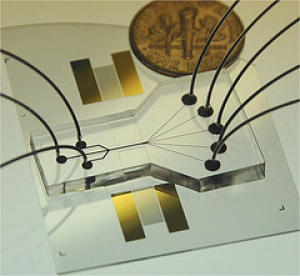
Cell-sorting device uses two sound beams to act as acoustic tweezers (credit: Penn State University)
A technique that uses acoustic waves to sort cells on a chip may create miniature medical analytic devices.
The device uses two beams of standing surface acoustic waves (SSAW) to act as acoustic tweezers to sort a continuous flow of cells on a dime-sized chip, said Tony Jun Huang, associate professor of engineering science and mechanics, Penn State.
By changing the frequency of the acoustic waves, researchers can easily alter the paths of the cells. The device can sort cells into five or more channels, allowing multiple cell types to be analyzed simultaneously and paving the way for smaller, more efficient and less expensive analytic devices.
“Eventually, you could do analysis on a device about the size of a cell phone,” said Huang. “It’s very doable and we’re making in-roads to that right now.”
Biological, genetic and medical labs could use the device for various types of analysis, including blood and genetic testing, Huang said.
Most current cell-sorting devices allow the cells to be sorted into only two channels in one step, according to Huang. He said that another drawback of current cell-sorting devices is that cells must be encapsulated into droplets, which complicates further analysis.
“Today, cell sorting is done on bulky and very expensive devices,” said Huang. “We want to minimize them so they are portable, inexpensive and can be powered by batteries.”
Using sound waves for cell sorting is less likely to damage cells than current techniques, Huang added.
In addition to the inefficiency and the lack of controllability, current methods produce aerosols, gases that require extra safety precautions to handle.
How it works
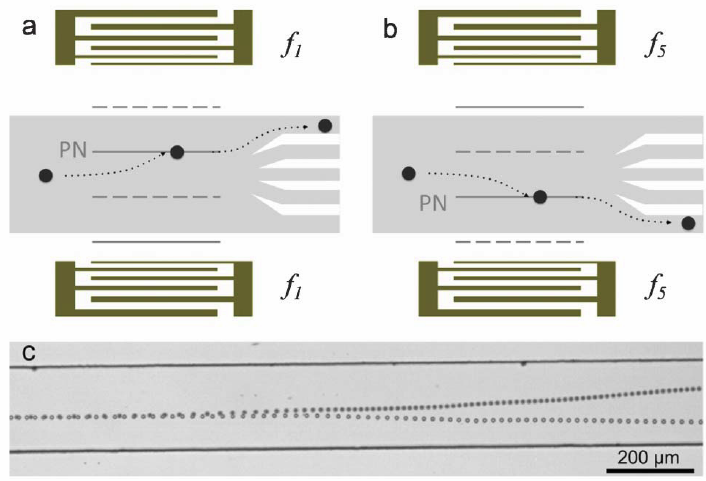
Working mechanism of the SSAW-based cell-sorting device. When the SSAW is switched on at a frequency of (a) f1 and (b) f5, all particles/cells are driven to the pressure node (solid lines) and directed in the (a) upper or (b) bottom outlet. (c) The stacked trajectories of two 10 mm polystyrene beads at two frequencies respectively in the SSAW working region. A lateral shift of 100 mm is achieved after passing through the cell-sorting region. (Credit: Xiaoyun Ding et al./Lab on a Chip)
The researchers created the SSAW cell-sorting chip using a layer of polydimethylsiloxane (silicone). Two parallel transducers, which convert alternating current into acoustic waves, were placed at the sides of the chip. As the acoustic waves interfere with each other, they form pressure nodes on the chip. As cells cross the chip, they are channeled toward these pressure nodes.
The transducers are tunable, which allows researchers to adjust the frequencies and create pressure nodes on the chip.
The researchers sorted human white blood cells that were affected by leukemia. The leukemia cells were first focused into the main channel and then separated into five channels (more can be added).
The National Institutes of Health Director’s New Innovator Award, the National Science Foundation, Graduate Research Fellowship and the Penn State Center for Nanoscale Science supported this work.