Aerobic exercise boosts brain power in elderly
December 17, 2012
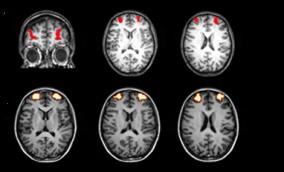
Highly fit older adults exhibit less age-related atrophy in the prefrontal and temporal cortices. Note: for illustration only; not related to this specific literature review. (Credit: UBC Dept. of Psychology)
Evidence for the importance of physical activity in keeping and potentially improving cognitive function throughout life was found in an open-access literature review in Psychonomic Bulletin & Review by Hayley Guiney and Liana Machado from the University of Otago, New Zealand.
- Cognitive functions such as task switching, selective attention, and working memory appear to benefit from aerobic exercise. Studies in older adults reviewed by the authors consistently found that fitter individuals scored better in mental tests than their unfit peers.
- Scores in mental tests improved in participants who were assigned to an aerobic exercise regimen compared to those assigned to stretch and tone classes.
- Exercise has been found to positively affect mental tasks relating to activities such as driving, an activity where age is often seen as a limiting factor.
- MRI studies of aging have shown that, as compared with unfit, highly fit older adults exhibit less age-related atrophy in the prefrontal and temporal cortices; preserved neural tracts connecting the prefrontal cortex to other regions of the brain; superior white matter integrity in the corpus callosum; greater gray matter density in the frontal, temporal, and parietal cortices; and greater hippocampal volumes.
- Physically active older adults have both higher circulating neurotrophin levels and gray matter volumes in the prefrontal and cingulate cortex.
- These results were not replicated in children or young adults, except for memory tasks. Both the updating of working memory and the volume of information which could be held was also better in young fitter individuals or those put on an aerobic exercise regime. “Although the evidence to date supports a wider range of executive functions benefiting from regular exercise in older adults, the relative lack of supportive evidence in young adults and children may, in part, reflect a poverty of studies, especially controlled trials, in these age groups,” the authors suggest.
Comments (6)
by GatorALLin
I thought this video on exercise and health benefits from TED.com was very well done and worth a peek. See if you agree…
http://ed.ted.com/on/Mot8KdLT
by trakk
i am sorry i dint understand the last paragraph. Working memory is better in fitter older individuals or in younger individuals?
by Editor
Does adding “also” make it clearer? “Both the updating of working memory and the volume of information which could be held was also better in young fitter individuals ….”
Crowdsourced editing rocks!
by trakk
yes
by Mr.X
Your question isn’t directly answered in that paragraph.Here is the gist of it (as I “understood” it):
Aerobic exercise conducted by children and young adults, contrary to older people, lead only to improvement in memory tasks
Individuals (both old and young) who were considered fit (whatever is meant by this) or were put on an aerobic exercise regime could hold more information (my interpretation) in their working memories and update their working memories “better” (whatever is meant by this).
Other improvements that are well attested for in older people -such as those mentioned in the preceding paragraphs- are subject to a relative lack of evidence in younger populations (children, young adults), and this may be due to a relative (to older groups) lack of studies (on these attributes) in these age groups.Especially controlled trials are rare.
Now to your question:
Just reading this paragraph, we don’t know whether unfit (!) young people have better working memories than fitter, older people.Because nothing specific is said about the starting points and end values of the tested groups.
We know that aerobic exercise/being fit “improves” wm in both groups, old and young, and we know that the starting point before training is lower in older people (due to age related decline).
Therefore, it stands to reason, that all else (besides age,) being equal, the younger person has a better working memory.
But we can’t actually “know” this from this article, since the rate/amount of improvement isn’t explicetly stated.Maybe old people improve much more per invested time, till both groups reach the same maximum!? Maybe young people improve even more?
There is nothing said about this in that paragraph.
So you see, I could only partly answer your question.We don’t know how fit older people compare to unfit younger people (you asked for younger only, but this isn’t the only variable), but we can assume that fit, young people will have better working memories than fit, old people.
by asiwel
I just read this actual article and I strongly recommend it to anyone interested in this subject. This is not just some study. It is an extraordinarily thorough 14-page review of practically the entire current literature on the subject, including about 34 major studies utilizing cross-sectional, randomized controlled trial, non-randomized controlled trial, and randomized uncontrolled trial methodologies. They focus on “…three specific components of executive functioning …tested most extensively in the exercise–cognition literature and …linked to effective performance of daily activities: (1) task switching, (2) selective attention and inhibitory control, and (3) working memory.” I have been involved in several past research initiatives regarding exercise and elderly homebound populations and plan to share this new review with those colleagues. Thanks to the editor for choosing this and summarizing it well.