Aging heart cells rejuvenated by modified stem cells
July 25, 2012
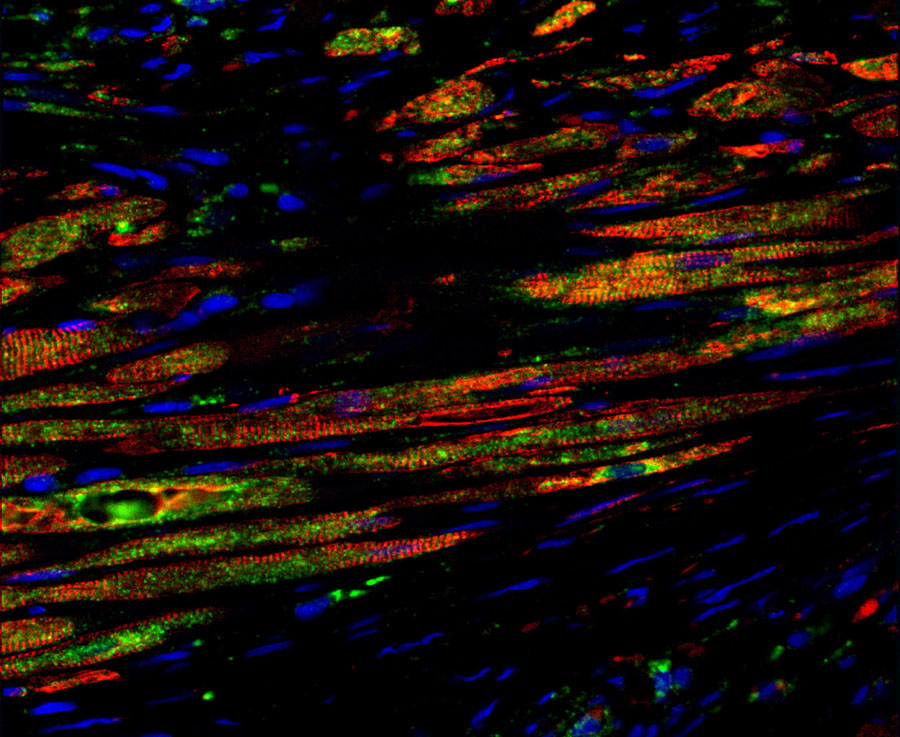
In this image, green represents myocytes newly formed by the transplanted cardiac stem cells. Red represents myocytes, blue shows the nuclei of the cells. Red and green colors together means that the transplanted cardiac stem cells have formed new myocytes. (Credit: Mohsin et al./American College of Cardiology)
Damaged and aged heart tissue of older heart failure patients was rejuvenated by stem cells modified by scientists, according to research presented at the American Heart Association’s Basic Cardiovascular Sciences 2012 Scientific Sessions.
The research could one day lead to new treatments for heart failure patients, researchers said.
“Since patients with heart failure are normally elderly, their cardiac stem cells aren’t very healthy,” said Sadia Mohsin, Ph.D., one of the study authors and a post-doctoral research scholar at San Diego State University’s Heart Institute in San Diego, Cal.
“We modified these biopsied stem cells and made them healthier. It is like turning back the clock so these cells can thrive again.”
Modified human stem cells helped the signaling and structure of the heart cells, which were biopsied from elderly patients. Researchers modified the stem cells in the laboratory with PIM-1, a protein that promotes cell survival and growth.
Cells were rejuvenated when the modified stem cells enhanced activity of an enzyme called telomerase, which elongates telomere length. Telomeres are “caps” on the ends of chromosomes that facilitate cell replication. Aging and disease results when telomeres break off.
“There is no doubt that stem cells can be used to counter the aging process of cardiac cells caused by telomere degradation,” Mohsin said.
The technique increased telomere length and activity, as well as increasing cardiac stem cell proliferation, all vital steps in combating heart failure.
While human cells were used, the research was limited to the laboratory. Researchers have tested the technique in mice and pigs and found that telomere lengthening leads to new heart tissue growth in just four weeks.
“Modifying aged human cardiac cells from elderly patients adds to the cell’s ability to regenerate damaged heart muscle, making stem cell engineering a viable option,” Mohsin said. “This is an especially exciting finding for heart failure patients. Right now we can only offer medication, heart transplantation or stem cell therapies with modest regenerative potential, but PIM-1 modification offers a significant advance for clinical treatment.”
This study was supported by the National Institutes of Health.