Agricultural robots may reduce costs of organic produce
September 20, 2012
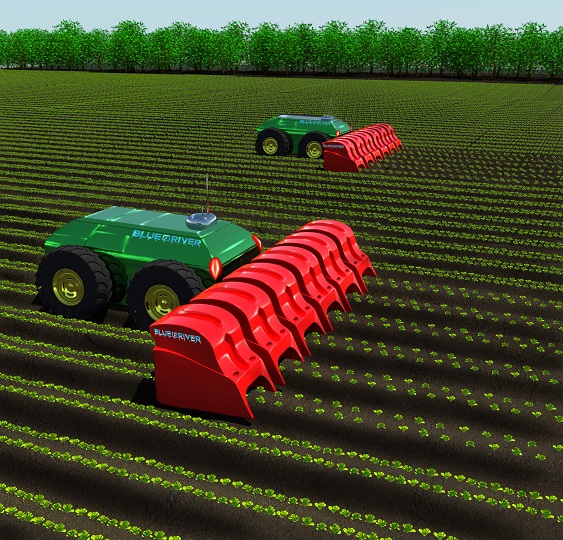
Blue River Technology has announced $3.1 million in funding for its plans to develop agricultural robots that can automatically kill weeds and thin out plants like lettuce that need adequate room to grow, CNET reports.
It could help reduce the cost of organic produce.
The startup’s prototype Lettuce Bot uses a camera to image the plants beneath it. Machine learning algorithms then identify which ones are desirable and which are weeds.
“Once a plant is identified as a weed, a target spray, which is mounted behind the camera, will then shoot a targeted spray of an organic compound, such as hot steam or hot organic oil, at the plant and the plant will quickly die,” the company told CNET Startup Lab.
The plant-classification algorithm is 98 to 99 percent accurate, and the kill mechanism is accurate to a quarter of an inch when the prototype is moving a 1 mph. The firm wants it to move at 3 mph while keeping it on target.
Blue River says its machines will be more efficient than other means of weed-killing, and will work well in organic fields or those that have chemical-resistant weeds.
“With global population expected to increase to 9.5 billion by 2050, increasing food production in a sustainable way is going to be one of the great challenges of this century,” investor Vinod Khosla was quoted as saying in a release. “Blue River Technology’s solution will not only be more cost effective than current solutions, but has the potential to reduce U.S. herbicide use by over 250 million pounds a year.”
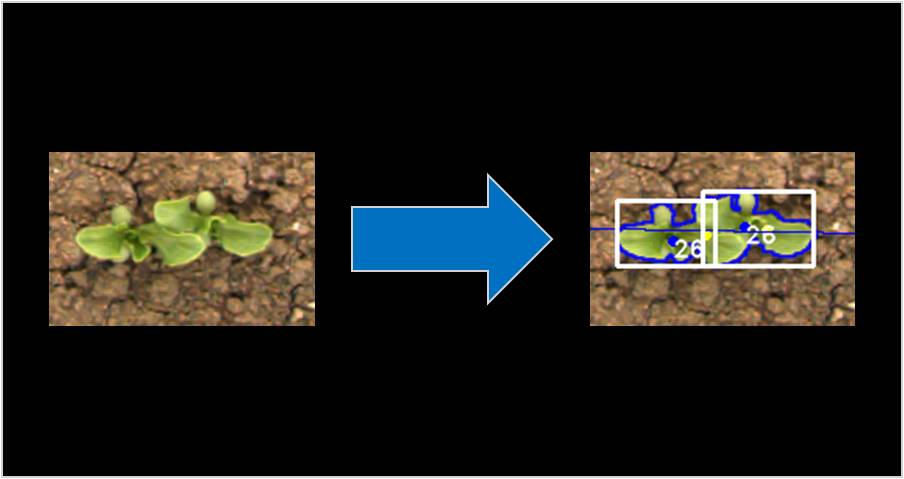
As the machine moves through the fields, the computer vision system can detect and segment individual plants — even those touching each other (credit: Blue River Technology)

Comments (19)
by epdh89
Monoculture and Mass production by massive machines/robots destroy biodiversity!!!!!!!!!! and jobs and the economy.
The healthies veg is hand picked from the wild, local seasonal farming is the way forward. At the same time this will build stronger social and econmic communitties.
by martinandsusie
Let’s be clear about this. What issue are you talking about? I believe I know what it is but let’s make it clear. The issue is technology versus jobs.
And I agree with you when you say these are interesting times we live in. Technology is moving forward at a breakneck pace while the economy is not. Never has an economy or country, or even our whole world faced a situation such as this. There are several solutions, but, quite frankly, none of them are very appetizing. Adaption is not an option. The conditions for adapting are way out of balance.
The way I see it, this is a question of balance. If our society can come up with the right mix of jobs and technology, then maybe we can survive. If not… checkmate!
by Ken Peterson
this device doesn’t need to be that complex. Video glasses feeding info to a wheel-chair handicapped person could make decisions a hell of a lot faster than 1 mile per hour. Plus other problems: loss of bees may require hand pollination, all types of crop thinning, insect eradication, etc, etc, etc,…
by Thomas Jensen
“Blue River Technology’s solution will not only be more cost effective than current solutions, but has the potential to reduce U.S. herbicide use by over 250 million pounds a year.”
Monsanto will not be happy to hear this.
by Chrispium
The first thing I thought was: I need to buy shares in this, in order to keep Monsanto and Dow away from it. You all should too ;)
by Bri
Technology like this should be promoted as much as possible. These robotic systems, which I also include robotic harvesters for fruits and vegetables, will solve more problems than they create. The ones pictured here are large scale industrial models. Smaller versions can help local food production to. Even down to one acre plots and less. Food is a key stone issue and deserves extra special attention.
by melajara
Well said, and with proper sensors (e.g. high precision synthetic smell) they can even monitor parameters not obvious to observe for the farmers. Tremendous opportunities here.
by Ante
Whenever I encounter an article about automatization or involving robots in any economical activity, it’s always the same debate. Although, that’s just another proof that this is the most pressing issue of our time. I wish they would debate about this in public forums with FACTS rather than emotions and fears dominating the discussion.
So far there is no real evindence that this paradigm shift would be any more devastating or disadvantageous in the long run than any other previous one in the history of mankind. Although, none of them has gone by without civil unrest, and my only fear is that we won’t see long term benefits without going through a difficult short period. But society always adapts in the end.
by Keegan
I don’t think old Rome would agree with your last statement, or any other of the multitude of nations that fell due to their inability to adapt.
by Hoss
We definitely live in interesting times. All the political and economic philosophies go out the window when you factor in the impact of the rise of tech, which no previous generation has had to seriously account for. Its true that the cotton gin and tractor were cheaper than slaves, and were a technological solution, which validated a political solution, but this generation will have to do the opposite and validate a technological solution with a political solution. I would imagine that the political debates will be very different in 2016 as both sides come to terms with the true situation.
by Mr.X
I think almost everyone, but especially those living in the period 19th century to 21th century, lives/lived in interesting times.
by alfri
What you have pointed out is a likely senario but it is also time for these governments south of the border to operate with less corruption and use their tax revenues to support a safety net for those families. You can’t stop innovation because it is our salvation and the answer to some of our most pressing problems. Water, Energy, poverty etc. ….
by Matheus
I agree with you that innovation is the answer to so many problems, but science, and specially scientists, should have such ethical concerns in mind when they choose what to develop and how to develop it. There are plenty of examples in history of technological innovations that, despite their intended benefit, created huge unintended collateral problems (DDT, CFCs). Besides, don´t think it´s that simple to change culture and the institutional framework of a country. Some of these countries carry a heavy historic burden, in some cases directly caused by USA and other nowadays developed countries.
by Gorden Russell
One historic burden, Matheus, is that some of these southern countries are still governed by the descendents of the Conquistadors and still have that 1% attitude. Many of them won’t provide a safety net unless they are about to be overthrown.
by PedroC.
As if the northern countries had any safety nets…
The 1% rule over all. Go ask Spaniards or Greeks about their pensions. Or check Chicago’s future pension liabilities, for a closer example.
by Gorden Russell
Of course nobody enjoys chopping weeds with a hoe. But when these robots get into the fields in large numbers, all those farm workers who we dismissively call “illegals” will be left with no work. The money they send back home to their families has been propping up the economy of their home countries. Without these funds being sent back from the North, governments will fall south of the border. Just how do you think this will effect us here?
by Bri
We will do better in the short run. It is our money that they have been sending to other countries. Our economy is far more developed. We hemorrhage a tremendous amount of money to China and south America. The reason we don’t ” fix” these imbalances is that the illegals will do work for less money. My shop is in a neighborhood that has many houses that can have as many as eight tiny rented rooms. For them it’s still a step above what they came from. I talk to them all the time. No one born in America would live in such sqular or live with so few amenities. They have a bed, eat cheap foods, and have a handful of cloths that they get from social agencies or thrift shops. Some can become quit successful and rise up, but most send there money home, build houses there and live like kings. They tell me all the details. One of my workers owned three properties in his home country. Another built a fine woodworking shop in El Savadore and is living back there . Robots will take all their jobs away.Ther countries will suffer but ours will gain strength from not sending the money away. In terms of China, the products that we had mare there I’ll be made here again, so the first effects will be very beneficial to us. Later down the road it will come back and bite us too.
by Mr.X
The quality of the products will rise too.And I hope China won’t react violently (I’d really not underestimate 1,3 billion people).Would be a really waste, regardless of the specifics.
The losers of this will be the people without connections, alleged “lack of education”, etc. People just like me, in some sense^^ But our socialist-communist-satanist governments will take care of that.One way or the other.
by PedroC.
That is until Bernanke prints the dollar out of value and we are all left holding worthless pieces of paper.
The coming economic catastrophe cannot be ignored when making future scenarios.