Another Earth just 12 light-years away?
December 19, 2012
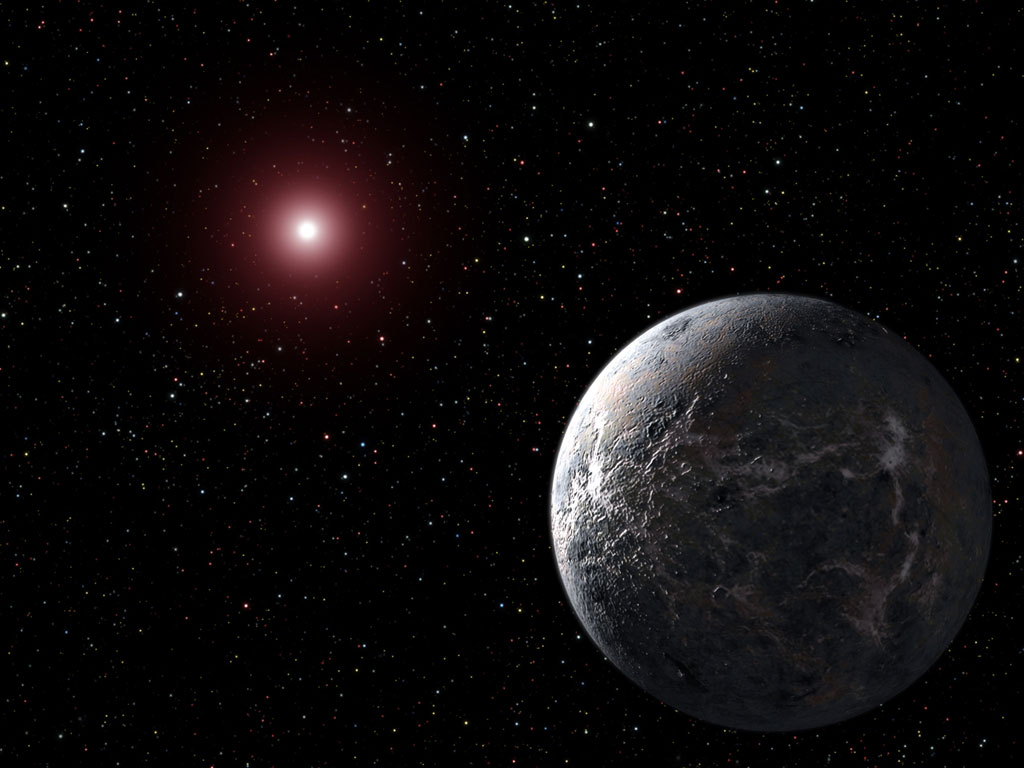
This artist’s concept shows a generic Earth-size exoplanet in the habitable zone of a sun-like star (credit: NASA)
Astronomers have discovered what may be five planets orbiting Tau Ceti, the closest single star beyond our solar system whose temperature and luminosity nearly match the sun’s, Science Now reports.
If the planets are in fact there, one of them is about the right distance from the star to sport mild temperatures, oceans of liquid water, and even life, and slight changes in Tau Ceti’s motion through space suggest that the star may be responding to gravitational tugs from five planets that are only about two to seven times as massive as Earth.
Tau Ceti is only 12 light-years from Earth, just three times as far as our sun’s nearest stellar neighbor, Alpha Centauri.
Early SETI target

The Sun (left) is both larger and somewhat hotter than the less active Tau Ceti (right).
Tau Ceti resembles the sun so much that astronomer Frank Drake, who has long sought radio signals from possible extraterrestrial civilizations, made it his first target back in 1960. Unlike most stars, which are faint, cool, and small, Tau Ceti is a bright G-type yellow main-sequence star like the sun, a trait that only one in 25 stars boasts.
Moreover, unlike Alpha Centauri, which also harbors a G-type star and even a planet, Tau Ceti is single, so there’s no second star in the system whose gravity could yank planets away.
It’s the fourth planet — planet e — that the scientists suggest might be another life-bearing world, even though it’s about four times as massive as Earth.
If the planets exist, they orbit a star that’s about twice as old as our own, so a suitable planet has had plenty of time to develop life much more advanced than Homo sapiens.
Comments (45)
by andrew
Just a note: Galileo, sent to Jupiter has exceeded 64,000 miles per hour.
by Erlis
The potential dangers pointed out by some, including biological hazards from alien bacteria, are slim to irrelevant. The only draw-back is that once you were to land on the planet it would be extremely difficult to get back to its orbit with current ground rocket technology with the higher gravity, its difficult enaugh on earth
by wheljam
I really think that – regardless of the time it’d take to reach a planet suitable for life, the chances of bio-contagion on the bacterial level would be pretty fearsome. And I’m no expert by far, just thinking it’s better to keep your helmet on!
by infinitos
If scientist at nasa could create a wrap engine we could go there in less than 12 years: 3
by dibiase
Who knows!
If these planets have inteligent life they probably will be trying to communicate with us through radiowaves as we are trying to do.
Something in the style of the book (and movie ) Contact of Carl Sagan!
by GatorALLin
there are so many planets out there….yet so much silence. could it be that we are rare…..or at least first…….?
http://en.wikipedia.org/wiki/Fermi_paradox
by WhoKnows3000
Or the last.
by Chrispium
Or the ones living farthest away.
by LGR1945
Would exchange of data and communication be possible?
It would be a long shot for sure but might give us important info sharing without traveling anywhere.
by sailingsoul
I want to scream when I read delusional articles like this. I quote “Tau Ceti is only 12 light-years from Earth” , “only, “ONLY 12LIGHT-YEARS” Gee only a 12 light-years away. Dang let’s get the space shuttle out of mothballs, dust that baby off and get going. Going at space shuttle speed we can expect to get there in,, UMMmmm, Let me do the math,, 2 x7 , carry the one mumble, mumble, there I got it.
Going at space shuttle speed we can expect to get there in 446,400 years. Anyone that who can’t fathom that should be willing to sign up for that mission. No worry’s now about how were screwing up this planet. We can move right next door.
by Gabriel
I think it’s not something done consciously, but I understand your critique – It could be done unconsciously to satisfy two desires….that their are other intelligent beings in the cosmos, and that we can indeed just move somewhere else if something happens; both of which deserve scrutiny.
by Lord Penguin
The author says “just 12 light-years away” because on the scale of space, that is a remarkably close distance. It is not a reason, as you have pointed out, to forget about our planet, but its proximity is useful in several ways. The closer it is, the better we can see it with telescopes, and the sooner we’ll be able to go there ourselves, in a hundred years if we have to. If there was intelligent life (however unlikely), we would be able to communicate with it over a reasonable time period, or pick up its radio signals with better detection than we have now. We’re going to have to start somewhere on the soon-to-be interstellar search for life, and this may be the first destination.
by Gorden Russell
You don’t need to scream, sailingsoul. You only need to sail through space at a constant acceleration of one gravity to get to relativistic speed in a little over a year. You can figure it out for yourself. I figured it out at the age of 16 back in 1968 while taking Physics in high school. Just plug the speed of light into the formula for the acceleration a falling object.
Your starship can’t go any faster than whatever is shooting out the tailpipe. Yet CERN’s Large Hadron Collider can boost charged particles up near the speed of light.
So a charged particle accelerator many orders of magnitude larger than the LHC will be able to boost at one g for a 14-year-long trip to Tau Ceti. And you will only experience something over two years of time during the trip.
Back in the age of sail, the Spanish and Portuguese explorers circled the globe in tiny wooden ships of only a few hundred tons of displacement — and they did that in about two years.
If they could stand to be cooped up all that time while eating nothing but sea biscuit and salt pork with a little rind of moldy, worm-eaten cheese, then we can stand the strain of the voyage in a ship the size of an asteroid.
Our starships will have geodesic domes covering great pastures where cows and sheep graze, and other domes covering growing fields of corn, wheat, soybeans, and chickpeas. Not to mention the immense rice paddies in other BuckyFullerDomes. And oh yes, let’s take along an orchard of lemon trees to avoid the dread scurvy.
by snake0
printed meat is more likely than spacecows, sorry to burst your bubble.
by Chrispium
Quote “Your starship can’t go any faster than whatever is shooting out the tailpipe.”
Um no, this is wrong. Exhaust speed has no bearing on maximum speed.
Going at relativistic speeds will fry anything living or electronic in massive x-ray and gamma radiation. Add to that collisions with dust particles, which will have enormous abrasive effects on the starship.
The reason aliens aren’t here already seems to be proof that there are, either no aliens (or very, very few) or there are no loopholes in physics for FTL or warp to span the giant distances involved in space(travel).
by TimeBuckler
Why oh why would we use the space shuttle for this?! The only reasonable way to send a probe 12 lightyears away would probably be ion thrust, which accelerates gradually, but has a dementedly high top speed, with a laser-assisted solar sail for pushing it out of our solar system.
That would still take a goatload of time, but on the order of centuries, not millennia. Of course, if NASA’s Alcubriere-White drive research pans out, we could well be able to shove a probe in a literal warp bubble and send it careening out there fast enough to arrive in less than two years.
by Bri
Your just not thinking fourth dimensionally Marty. We may be that slow now, but in an excellerating technological world it’s feasible that we might break light speed. Then again if you feel like taking horse and buggy transportationsl technology to get there, we’ ll catcch up with you when you finally arrive. We kind of assume that The Singularity is Near, and we’re going to be around that long. So speaking about the fourth dimensional concept of getting there, it’s kind of a done deal, and we’ll be waiting for you.
by ErikSMeyer
I suppose we are doomed to reading endless recitations of the idea that:
1. If a planet like Earth has been around long enough
2. Life will just magically appear there and
3. Organize itself to be more “advanced” than humans
I’d like to note that nobody has demonstrated that all we need to have intelligent life, or just life, in a place is the right conditions and enough time. It’s really kind of a crazy idea if you think about it, a bunch of rocks, some water, give it a few billion years and you have Manhattan.
I suspect we’re missing something important there, which would probably go a long way towards answering the question “where is everybody?”
by Superluminal
Well no, not magically, but you do need a very specific set of conditions. Let’s say all you need is a soup of some bio-chemical precursors, a 20 degree temperature range, and some free energy vibrations to start forming lipid barriers. That may sound easy but honestly how many planets will have that situation? Then once it gets started how many will survive long? Earth has been EXTRAORDINARILY lucky that life hasn’t been wiped out by now. Any number of things could have ended it by now, and from what we can discern the math says it should have.
So the question really becomes, once life starts, how many civilizations make it long enough to be able to utilize technology and engineering to directly avoid cataclysmic galactic events? Not many. Not many at all I’d say. It’s just dangerous out there.
by K
Excellent comment and observation, well worded.
by douglas deveau
i agree
by Gabriel
That’s why Kurzweil personally believes it’s most likely (though not impossible) that we are alone in the universe….because the exponential growth between both the advent and merger of technology with the species that created it, is so short in the grand scheme of things, that the whole universe should be alight with activity….yet their is nothing.
Conditions, from the laws of physics, to the placement of Earth….everything had to evolve in the way it did because, yes, it’s just far too dangerous out there, and still is. For other species in the universe to have the same kind of life, especially many like most science-fiction portray…gets sort of implausible when you think about it.
by IIChron714
I have to agree with ErikSMeyer on this one. If it’s so easy for life to generate spontaneously from an organic soup like you’ve described, life should have generated itself from organic soup many times if you assume the Earth is billions of years old. It takes more than just extraordinary luck to create something as complex as life.
by Gorden Russell
Erik, our sun formed 4.54 billion years ago, and only 3.85 billion years ago the Earth was cool enough for single-celled life to first form. That’s not that long. It just took a spark of lightning to make the first amino acids assemble themselves. The chemistry of life just falls together with a little nudge. It’s not magic, it’s chemistry.
by Simon
Humanity is like a deaf blind man, standing in front of a wall at a party, feeling the lifeless stone and asking, first curious, then increasingly annoyed, “where is everybody?”
by Sno
I think that if we find a place with the right set of conditions, we have good chances of finding life, but very low chances of finding intelligent life. If you look at earth’s history, there was life for billions of years, but humanity has only been around for a very small fraction of that time.
by GatorALLin
so Voyager is traveling at 1/18,000 the speed of light. 12 Light Years away for that speed = 216,000 years to get there. If we could get to 5% of the speed of light then we could get there in 240 years (or 90,000% faster) and this either makes you realize how slow Voyager is moving or just how fast 5% of the speed of light actually is!
by GatorALLin
…also makes you realize we need to figure out how to build robots to explore other worlds and seed the universe with life, or we have to learn to live a bit longer (even if we can hit the pause button on getting older and sleep for 240 years as we make the journey to visit other distant worlds). I can see the need to become a hybrid of mechanical and biological upgrades just to survive all that is needed for long distance space travels.
by Superluminal
Reaching even 15-20% the speed of light wouldn’t be that hard, the issue would be you’d have to spend the last 1/2 of the journey slowing down, so you wouldn’t really get to go 20% the whole way, that would be your peak.
by Bruce Wright
It’s probably very energy inefficient to spend all of your time either accelerating or decelerating – more likely, you spend the first 10% and the last 10% of your time (or likely an even smaller percentage) accelerating or decelerating, and 80% just coasting. Yes, you won’t get there as fast, since you probably won’t reach nearly as high a velocity – but you also won’t have to accelerate and decelerate as much of your fuel either, so you’ll get back part of your top speed since more of the energy will go to moving the ship’s cargo and less into just moving the fuel you need to drag along with you in order to keep the engines going the whole time.
The primary exception would be if you’re able to use solar sails for much of your acceleration and deceleration – in that case you wouldn’t have to have (much) fuel on board (a little may be needed just to manage the sail and to keep the ship’s basic systems going). I have a hard time picturing how you could reach such a high percentage of the speed of light using primarily solar sails though – they’d have to be truly massive.
Bussard ramjets, anyone?
by Gorden Russell
That’s the way to go, Bruce. With Bussard ramjets the interstellar hydrogen is the fuel. Once you feed that to a fusion reactor, you can power a charged particle accelerator. With an accelerator big enough to propel your starship at a steady one gravity of acceleration, you can get up to relativistic speeds in a little bit over a year. Once you get up near the speed of light, you don’t experience all the time it takes to get to Tau Ceti.
by Bruce Wright
Yes, that’s clearly the way to go, if it’s possible. We’re pretty sure that solar sails are possible (the only real issue is materials science, whether a sufficiently strong and lightweight material for the sail could be produced – and that gap is rapidly being filled in with things like carbon nanotubes). But they’re awfully slow for interstellar travel.
My training is in biology and computing, not in physics, but my understanding is that the feasibility of the Bussard ramjet is still very much up in the air – the amount of hydrogen in the interstellar medium in our part of the galaxy is much lower than Bussard had originally assumed, which makes the ramjet idea potentially much more difficult to achieve.
Absent that, an ion drive would allow for lengthy periods of thrust and offers the potential for relativistic speeds, but at the cost that you do have to drag along all your fuel which cuts into the size of your payload considerably.
by Joel C.
I bet you on my existence that we will eventually crack FTL intersteller travel – high probability of discovering something much more exotic than the theortical warp drive.
by Superluminal
Maybe, the issue is the scale of energy we always get to. The universe formed in a state where energy and matter were concentrated. It’s hard to get enough energy back in one spot to do anything on a large scale at this date, and entropy will continue. The question is, will we be able to cheat? Will we be able to find a way to manipulate space-time without the gargantuan amounts of energy that current physics tells us we need.
by GAUSS
All signs point to yes. The amount of energy required for NASA’s version of the warp drive is significantly less, and the idea is sound. The marriage of quantum phenomena and relativity is sure to unlock insights beyond our wildest dreams – in many ways it already has, a la simultaneous causality. Discoveries along these lines can only help in terms of reducing the amount of energy required to create local distortions in spacetime.
by Kristof77
Quite poetic
by Mark
With a larger planet would potential animals be more likely to be smaller or larger than those on Earth?
by Bruce Wright
That’s really hard to say, because we don’t even know whether life on other planets is based on carbon, let alone whether things like bone structure are similar.
However, assuming that life on Earth is pretty typical of life elsewhere, the assumption would have to be that if the planet is larger that the largest potential size for organisms on that planet would probably be smaller. The larger mass of the planet would most likely imply a higher surface gravity (depending on the density of the planet, of course), and so the structure of the organisms on the planet would have to withstand more weight. Since the strength of a particular material is roughly proportional to it’s cross-sectional area, any structural components of the organisms (bones, wood, etc) would need to be proportionately larger than for similar organisms on Earth. Similarly, if the organism is an animal it would require more muscle power (either larger muscles or arranged to get better mechanical advantage, again assuming that the basic structure of the muscles was similar to that of Earthly animals). Naturally, if the atmosphere is sufficiently dense, there may be a buoyancy effect that will offset some of these considerations, and in general for similar reasons they won’t apply as much to aquatic life as they do to land-based life (not unlike the situation on Earth).
The result of these effects is that larger size will tend to be more limiting than it is on Earth. Still, the largest organisms on Earth are quite large, so we’re not talking about a major limitation.
by IIChron714
I’ve heard that this planet is probably a “water-world.” If that’s the case, we’ll be dealing with aquatic life here. I wonder if higher gravity would mean higher pressure underwater. If so, then creatures on this world – assuming they’re anything like life here – could be similar to lifeforms that live deep in Earth’s oceans. On another note regarding life on this planet, if there is intelligent life here, the aliens will have a much harder time developing space travel because of the deeper gravity well and higher escape velocities needed.
by GatorALLin
..you might be assuming too big a jump….. I would suggest life on other planets is not likely at all… http://en.wikipedia.org/wiki/Rare_Earth_hypothesis
but if gravity was double, how would that affect the formation of animal size….?? animals with stronger gravity would at least be stronger. http://en.wikipedia.org/wiki/Gravitational_biology
by GatorALLin
—-could be like this…
http://www.youtube.com/watch?v=BNLfNe12BKE
by douglas deveau
I’d say smaller and living within’ a thick hydrogen atmosphere. I really doubt abiogenesis could be possible on such a planet.
by Bruce Wright
Since they don’t appear to have any spectral analysis of the planets but only motion perturbations of the parent star, I’m assuming that you have a picture of the planet as being a small gas giant. That’s by no means a given; certainly rocky planets of four Earth masses would also be possible, as would having an atmosphere similar to Earth’s. Most likely any atmosphere would be denser than Earth’s if for no other reason than that the planet most likely has a higher surface gravity, though it’s also likely that the atmosphere is correspondingly more massive as well.
Since we don’t know the exact parameters of what kinds of environments are suitable for abiogenesis, nor do we know anything about the planet’s composition, I’d be hesitant even to speculate on whether life could exist on that planet.
by Editor
“generic” added to picture caption
by Gorden Russell
Thank you so very much for posting this article, Amara.
For those of you out there who are interested in the search for other planets, Wikipedia has a list of all the latest discoveries, including all the facts known about all the host stars and the masses of the newly discovered planets.
http://en.wikipedia.org/wiki/List_of_exoplanetary_host_stars