Another faster-than-light neutrinos challenge
October 1, 2011 by Amara D. Angelica
This just in: a new critique of the CERN OPERA finding of faster-than-light neutrinos. In “New Constraints on Neutrino Velocities,” Cohen and Glashow argue that the high-energy (17.5 GeV) superluminal muon neutrinos would actually lose energy rapidly (down to about 12.5GeV) on the 730km trip, long before arriving in Italy.
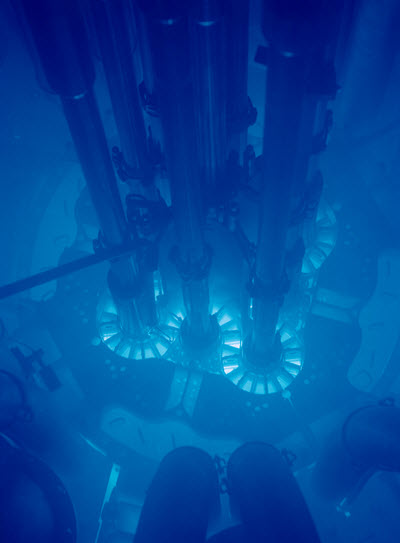
Cherenkov radiation (credit: Wikimedia Commons)
But that didn’t happen. Ergo, the neutrino weren’t really traveling faster than light, say Cohen and Glashow. So how would they lose energy? By bremsstrahlung (conversion of neutrino energy to light, as seen in Cherenkov radiation in nuclear reactors).
Neutrino physicist Dr. Ben Still’s Neutrino Blog has a lucid explanation. Also see his description of why the supernova explosion in 1987 didn’t show evidence of faster-than-light neutrinos, Supernova Neutrinos in 1983 and 1987?, and his critique of the OPERA experiment: Not Feeling Very Energetic.
Comments (5)
by BillS
BTW, I assume the OPERA people plotted speed vs. energy? If so, they would clearly be able to validate their setup at lower energy levels, don’t you think? I suspect a solution to this problem is going to have to come from the insiders, or someone else repeating the results.
by BillS
The Cohen and Glashow argument is interesting. But what if the neutrinos are really traveling faster (or very much faster) than the speed of light and the detector is picking up their energy state in the past? Just a thought.
by LarchOye
Yes, Neutrinos are known to have oscillating mass, accompanied by changes in velocity…
It doesn’t take much of a stretch to wonder if the mass might also oscillate to a negative value, at which point it would in all be travelling faster than light…
This is about where my usefulness on the subject ends though…
I find it interesting that you referred to it as “imaginary mass”, as opposed to “negative”…
Could “imaginary mass” mean that the neutrino’s mass is somehow leaving the universe or something?
by gvseostud
I believe that SN1987 did arrive before light from that event, but only by a few hours. Could it be that neutrino velocity is not a constant? David Maker is proposing that neutrinos have imaginary mass, and therefore light speed velocity in flat space, but superluminal velocity in a gravitational field.
by gvseostud
See sections 4.6, 16.5 and 16.6 of material in link below for an elaboration of David Maker’s prediction of neutrino imaginary mass and superluminal to light speed (variable) velocities, as well as a discussion of why the various generation states of neutrinos are entangled::
http://davidmaker.com/