AR goggles restore depth perception to people blind in one eye
January 21, 2013
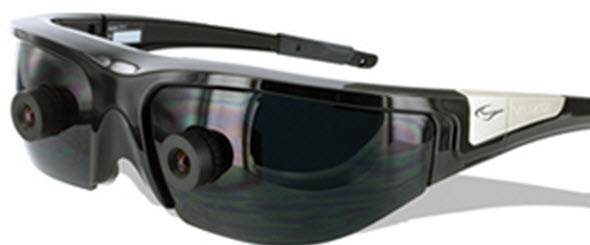
Wrap 920AR (credit: Vuzix Corporation)
People who’ve lost sight in one eye can still see with the other, but they lack binocular depth perception.
A pair of augmented reality glasses being built at the University of Yamanashi in Japan artificially introduces a feeling of depth in a person’s healthy eye, MIT Technology Review reports.
The researchers created software that makes use of the twin cameras in a Vuzix Wrap 920AR. When a person puts the glasses on, each camera scopes out the scene that each eye would see. The images are funneled into software on a computer, which combines the perspective of both cameras and creates a “defocus” effect (some objects stay in focus while others stay out of focus), resulting in a feeling of depth. That version of the scene in front of them is projected to the single healthy eye of the wearer.
Comments (15)
by phil
Been blind in one since 1978, so i know what i’m missing.
The only true miracles come from science, amen!
by swfan1963
Oh man, how to do I get on a list for test cases? I’ve been blind in one eye my whole life, and bitch often (more than I should probably) about not having depth perception.
by lpace
Pushing monoscopic depth cues to the point of seeing a 3D-like experience is nothing new. We have patents on it and have been productizing it for years. We can even do it in real time for HD 1080p. Depending upon the content of the scene (with one eye) it can look absolutely 3D, because your (two) eyes can’t converge at points in the scene, which would normally give away the optical illusion. Not true stereopsis, yet a powerful illusion. Good enough to feel a 3D effect. Our product will help you see more depth with one eye. It’s called The Darblet.
by Steve
Ipace, please send me a link to The Darblet that you can wear like glasses. All I could find was a projector for home entertainment. Thank you.
by jackie kingon
Le me know if you get on the list. My son was born with vision in one eye-he is now grown but it wuld be great if he got this. Thank you, Jackie Kingon
by Marcos Marin
and THUS you can afford having one eye punched at McDonalds.
by velikovski
I thought about a month ago that this Google Glasses can be used for people who have AMD(macular degeneration) as my mother. There should be a way to project the central sight to a place in the macula, diffrent from the central one- as this is the place where the macula is damage. Perhaps there are scientists working allready on such a solution…?
by Editor
No, Goggle Glass is not intended for that purpose, to my knowledge. See http://bit.ly/VKO7w1 for all posts on KurzweilAI related to AMD.
by Chandra Citta
Really?
by Dinoguy1000
It would be interesting to see if this could be adapted for therapeutic purposes for people who simply have a weak eye, as opposed to being blind in one eye… I would love to find out what the big deal with this whole “depth perception” thing is, with only my unaided eyes (not to mention being able to get something out of 3D video for once). =D
by Marcos Marin
Simple. Blind you weak eye.
by Whittaker
Oh of course. Thanks for mentioning.
The “lazy eye” therapy (blindfold a child’s weak eye) is very useful. The positive changes happen in the neural (CNS) area.
But as far as I remember it only works on children. I doubt whether adults’ weak eye symptoms are curable.
by Whittaker
Oops. Big mistake I just made one.
The “lazy eye” therapy involves blindfolding a child’s “good” eye (not weak eye).
The blindfoldind force the other (weak) eye to work.
For more details, see Scientific American Feb 2009 article “Childhood Recovered” by Gary Stix.
by jackie kingon
We covered my son’s good eye and his weak eye straightened out. Unfortunately we discovered that he had optic atrophy in that eye. He is now an adult and his eyes have remained coordinated but he does not see from the eye that turned in and has the optic atrophy. It was just a cosmetic procedure. But he looks great-so all is as well as can be considering.
by Dinoguy1000
I had that therapy as a child, and it helped immensely, but my eye is still weak, and it will still result in me losing my eyesight before I have any right to (discounting technological/medical progress, of course, which I have full faith will get to the point that my eyesight could be fixed before I lose it). As Whittaker says, though, that therapy doesn’t work in adults, though I recall reading an article several years ago about an alternate therapy that had some success in individuals well into their teens, IIRC.