Army Corps of Engineers using 3D printers to create dam models
January 30, 2013
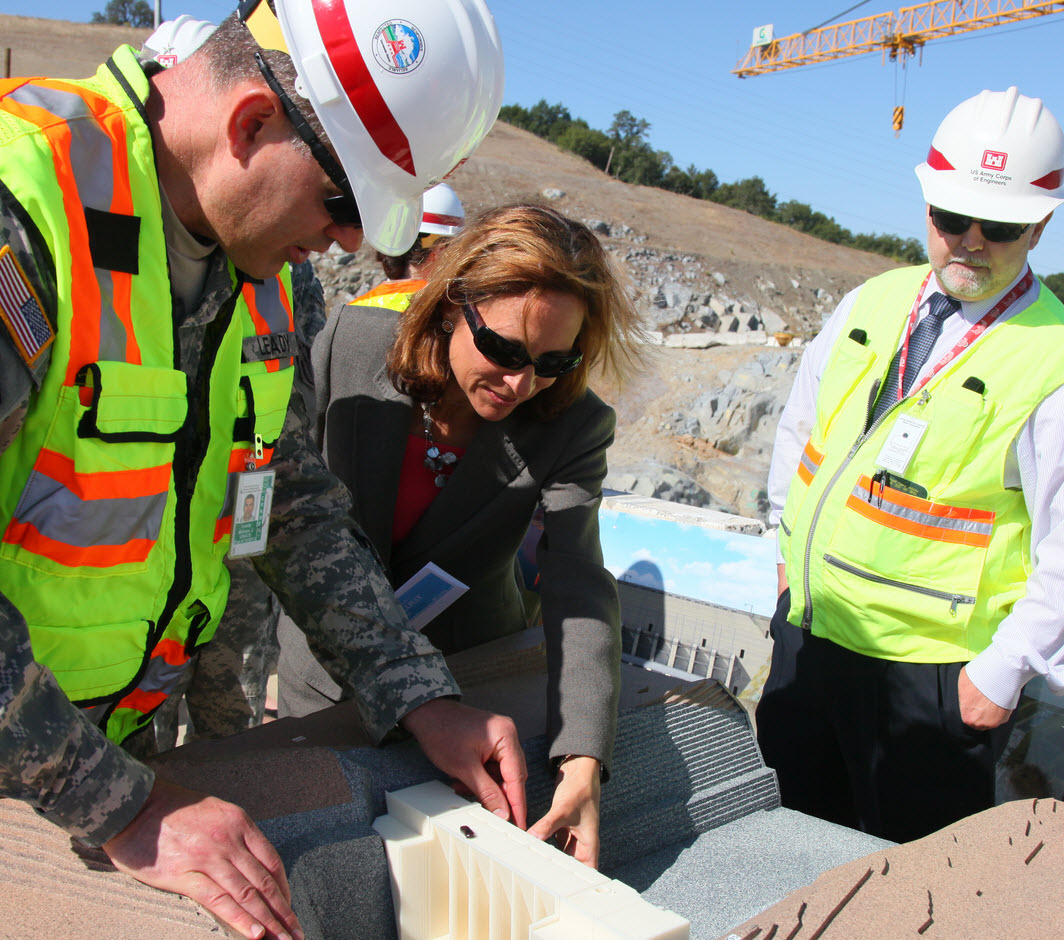
Sacramento District commander Col. Bill Leady shows off a 1/240-scale 3D-printed model of the Folsom Dam auxiliary spillway in Folsom, Calif., during a site visit in May 2012 (credit: Michael J. Nevins)
About 25 miles northeast of Sacramento, U.S. Army Corps of Engineers Sacramento District construction crews are working to complete one of the Corps’ biggest projects — a new spillway at Folsom Dam, designed to help reduce the risk of flooding throughout the Sacramento region.
With an estimated project cost of more than $750 million, it’s important to be able to show and describe how the project will work to government leaders, the public, and project staff.
So four years ago, the Corps decided to use a 3D printer to build a scale model. The 3D printer allows full-scale project components to be shrunk into a handheld model that team members can use to better visualize and conceptualize their work.
The printer uses strands of ABS plastic, material typically used for household drainage pipes, less than a tenth-of-an-inch thick to create perfectly-scaled 3D models in a matter of hours.
“When compared to a 2D drawing or rendering that only shows the outer surface of the project, a 3-D model provides a much better way to help explain what the project is and how all of its pieces will function to a non-technical audience,” said Dave Neff, technical lead for the auxiliary spillway project.
The Corps is also using a 3D printer for a project at Isabella Lake Dam, located 40 miles northeast of Bakersfield. It’s nearly 60 years old and among the Corps’ most at-risk dams. In 2006, the Sacramento District began studying how it could best modernize the dam and reduce the likelihood of dam failure, which would inundate most of Bakersfield and imperil most of its 350,000 residents.
No word on when they plan to 3D-print the actual dams …. which would take a dam big printer — Editor
Comments (10)
by WLGJR
How come some comments get posted immediately and some require “approval”?
I fail to see a pattern. Do you use some kind of complex algorithm, dear editors?
by Michael
The printer uses a type of plastic, but the dam is built with concrete and steel rebar. I think to build anything of this scale out of “printable material”, you would need something as strong as carbon nano-fiber. Unfortunately, that is also very expensive. I speculate that someday that may be cheap enough to be feasible if Kurzweil is correct about his overall singularity theory.
by Greg
I want to know when they’ll be able to print the whole dam thing in situ.
by WLGJR
You can achieve that, either printing out individual parts (or at least print out the ibeams and other skeletal structures) or perhaps you need very versatile robots that moves into the correct position and print out (using the attached 3D printers) the corresponding parts.
by MoonShyChangeling
i’m glad someone is finally using 3d printers to do something useful like this. it seems like they have been used mostly to make little toys.
by Simon
You have clearly not been paying attention. Just off the top of my head, they’ve been printing ciruit boards, robots, laboratory hardware, aircraft and weapons.
by jay
I imagine portable industrial 3d printers on site building the actual structure in real time. So much for job enabling.
by Gorden Russell
Now after this, go back and read that article from yesterday again, “First 3D ghost images from a single pixel.”
With the ghost imaging device coupled to Google’s new laser glasses, the engineer could go to the building site and scan the banks of the river and phone in the measurements. The spillway will start printing before the engineer gets back to the office.
But on the downside, I was saddened to hear how many hours it took to print out each piece. A lot more development is going to be needed before you can print out a robot in a day. Also, it looks like the motors and computer wafers will have to be trucked in.
by Publius
No, 3D printable circuit boards and motors and such are in the works.
by Gorden Russell
Thanks, Publius.