Artificial life forms evolve basic intelligence
August 5, 2010
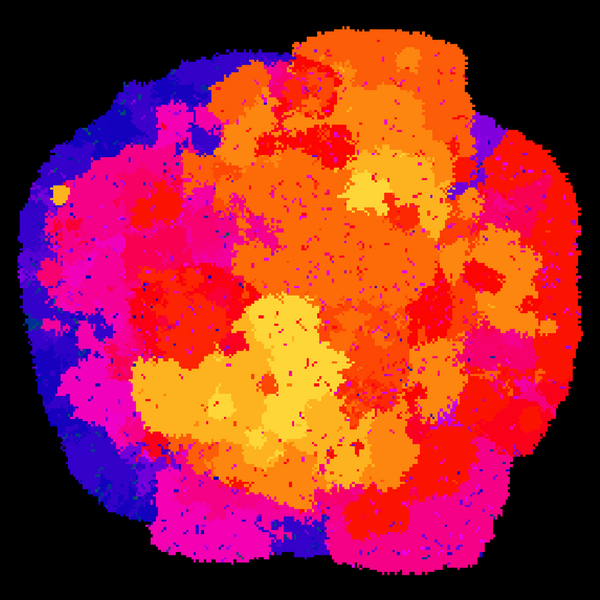
A growing population of digital organisms, started from one individual, colonizes an initially empty space (black). As it does so, the population evolves by random mutation and selection, based on each organism's resulting phenotype. Every colored square represents one digital organism, with different colors reflecting different fitness levels. The speed, control, and ease of data collection in the Avida digital evolution platform permits experiments that would be difficult or even impossible with natural organisms, such as the present study (Clune et al., doi:10.1371/journal.pcbi.1000187) on the evolution of mutation rates. (Kaben Nanlohy, Michigan State University)
Michigan State University (MSU) researchers have developed “digital organisms” called Avidians that were made to evolve memory, and could eventually be used to generate intelligent artificial life and evolve into symmetrical, organized artificial brains that share structural properties with real brains.
MSU researcher Jeff Clune works with a system called HyperNEAT, which uses principles of developmental biology to grow a large number of digital neurons from a small number of instructions.He translated the artificial neurons into code that could control a Roomba robot.
You can build complex brains from a relatively small number of computerized instructions, or “genes,” he says. Their brains have millions of connections, yet still perform a task well, and that number could be pushed higher yet. “This is a sea change for the field. Being able to evolve functional brains at this scale allows us to begin pushing the capabilities of artificial neural networks up, and opens up a path to evolving artificial brains that rival their natural counterparts.”