At CES, a preview of tomorrow’s wearable computers
January 17, 2012
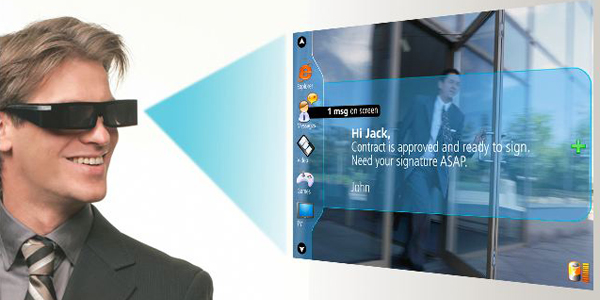
Glasses that can overlay digital data on the world around us were shown at CES.
Lumus Optics demonstrated prototype glasses that display translucent, almost opaque imagery that fills the wearer’s view like a 10-foot-wide TV two feet in front of his face.
The glasses rely on a computer or phone to provide them with imagery.
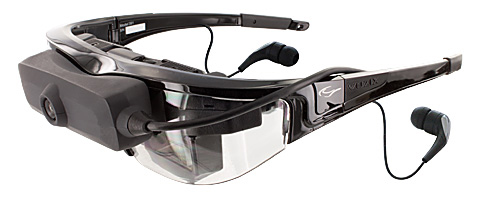
Vuzix displayed a monocular display that will go on sale later in 2012 for $5,000 to $10,000, aimed at the military and industry.
Consumer versions of both glasses are expect within two years.
Related Site Content:
- Heads-up: Lumus shows off 720p, see-through video glasses | December 16, 2011
- See-through 3D head-mounted display announced | November 10, 2011
- Google’s stealth augmented reality glasses | December 20, 2011
- Bionic glasses for poor vision | July 6, 2011
- The world’s smallest 3-D full HD display | May 24, 2011


Comments (3)
by melajara
This is here where we are measuring the lag between Kurzweil’s predictions and the more mundane reality. Those displays were advertised in The Singularity is near for general acceptance circa 2010 and in a recent defense, Kurzweil maintained that he was on target for this particular prediction. But in 2012, we are only speaking of prototypes or outrageously expensive military applications, no way mainstream acceptance. This reminds me of the GH versus DHEA debate started in 1990 when synthetic growth hormone became generally available. Now, 22 years after GH has been touted as a possible fountain of youth we still don’t know if active supplementation in older people is beneficial or not. Actually we know and we always knew: acromegalic subject are not long lived, on the contrary!
by tschaefer
It seems there are 3 technologies for augmented reality about 15 years apart. These glasses should be ubiquitous in 5 years. There are several teams working on contact lenses with similar functionality, which may be commonly available in 10 yeears. Finally, you had an article on artificial retinas, which would seem to be the cyborg solution in the long run.
I’ll probably be an early adopter of all three, but am also anticipating a further increase in pedestrian accidents. http://www.sciencedaily.com/releases/2012/01/120116200559.htm
by melajara
It’s amazing how much technology is always “5 years away”.
In the mean time, I feel older and older.
Without jumping aboard a relativist rocket, I’m afraid I won’t witness the singularity and of course, this is no solution as high velocity propulsion technology has been (and still is) in a a complete stand by for more than 40 years