Atomically thin, strong graphene-based integrated circuits
August 31, 2012
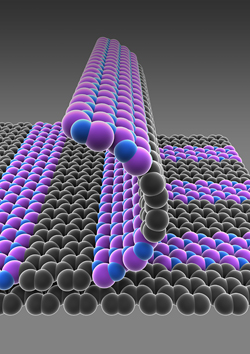
Schematic illustration of single-atom-thick films with patterned regions of conducting graphene (gray) and insulating boron nitride (purple-blue) (credit: Jiwoong Park)
To go beyond Moore’s law and reduce the size of integrated circuits down to single-atom thickness, researchers led by Jiwoong Park, assistant professor of chemistry and chemical biology at Cornell, have invented a way to pattern single-atom films of graphene and insulating boron nitride without the use of a silicon substrate.
The new “patterned regrowth” technique could lead to substrate-free circuits so thin that they could float on water or through air, but with tensile strength and top-notch electrical performance.
The technique combines graphene (single-atom-thick sheets of repeating carbon atoms) and hexagonal boron nitride, thin sheets of repeating boron and nitrogen atoms.
Patterned regrowth
Patterned regrowth, which harnesses the same basic photolithography technology used in silicon wafer processing, allows graphene and boron nitride to grow in perfectly flat, structurally smooth films — no creases or bumps. If combined with a semiconductor material, they could lead to the first atomically thin integrated circuit.
Patterned regrowth is a bit like stenciling, Park said. He and colleagues first grew graphene on copper and used photolithography to expose graphene on selected areas, depending on the desired pattern. They filled that exposed copper surface with boron nitride, the insulator, which grows on copper and “fills the gaps in very nicely.”
“In the end, it forms a very nice cloth you just peel off,” Park said.
“Devices made using this approach are likely to remain mechanically flexible and optically transparent, allowing transfer to arbitrary substrates for flexible, transparent electronics,” the researchers said in the Nature article.
The research team, which includes David A. Muller, professor of applied and engineering physics, is working to determine what material would best work with graphene-boron nitride thin films to make up the final semiconducting layer that could turn the films into actual devices.
The work was supported primarily by the Air Force Office of Scientific Research, and the National Science Foundation through the Cornell Center for Materials Research.