Autotuning wireless power transfer systems for better performance
May 18, 2012
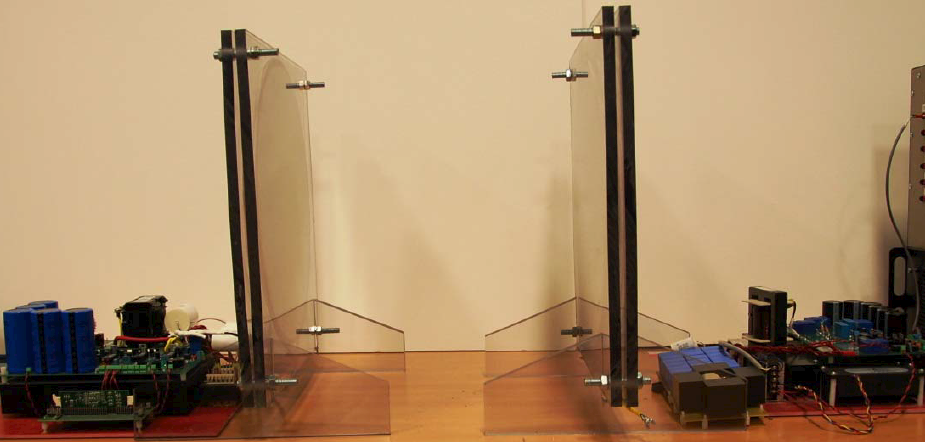
Wireless power transfer experimental setup (credit: Z. Pantic and S. Lukic)
Researchers from North Carolina State University (NC State) have developed a new way to fine-tune wireless power transfer (WPT) receivers, making the systems more efficient and functional. WPT systems hold promise for charging electric vehicles, electronic devices, and other technologies.
Researchers have previously shown that it is possible to transmit power wirelessly by using magnetic resonance, but even minor changes in how the transmitter or receiver is tuned can result in faulty power transmission when the resonant frequencies don’t match.
A new prototype developed at NC State addresses the problem by automatically and precisely re-tuning the receivers in WPT systems. The researchers focused on receivers because methods already exist that allow researchers to use electronics to precisely tune the transmitters.
“We’re optimistic that this technology moves us one step closer to realizing functional WPT systems that can be used in real-world circumstances,” says Dr. Srdjan Lukic, an assistant professor of electrical and computer engineering at NC State and co-author of a paper on the research.
How it works
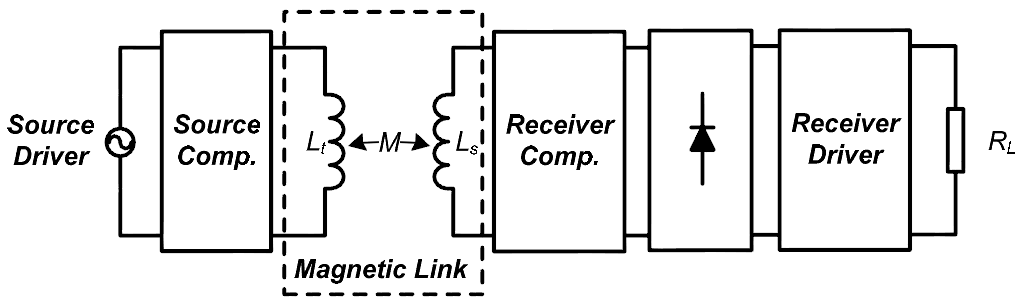
Structure of the WPT system
WPT systems work by transmitting magnetic waves on a specific frequency from a transmitter to a receiver. These magnetic waves interact with a coil in the receiver to induce an electric current. If the coil is tuned so that its resonant frequency matches the frequency of the magnetic waves, the current it produces is amplified.
However, if the receiver and the transmitter frequencies differ even slightly, the system becomes inefficient and doesn’t transfer a significant amount of power. This is a problem because many factors can affect the tuning of a receiver or transmitter, such as temperature or proximity to other magnetic objects. In other words, a hot summer day could wreak havoc on the tuning of a receiver.
The engineers developed an electronic prototype that incorporates additional circuitry into the receiver that does two things: it injects small amounts of reactive power into the receiver coil as needed to maintain its original resonant frequency; and if the transmitter’s tuning changes, the prototype can read the trace amount of current being transmitted and tune the receiver’s frequency to match. The effect is similar to autotuning vocal pitch in pop music.
“Because we are using electronics to inject reactive power into the receiver coil, we can be extremely precise when tuning the receiver,” Lukic says. “This degree of fine-tuning maximizes the efficiency of the WPT system. The next step is to try incorporating this work into technology that can be used to wirelessly charge electric vehicles.”
Z. Pantic, S. Lukic, Framework and Topology for Active Tuning of Parallel Compensated Receivers in Wireless Power Transfer Systems, IEEE Transactions on Power Electronics, 2012, DOI: 10.1109/TPEL.2012.2196055
Comments (9)
by Phil Osborn
RE: I think that this has been done before. This was essentially done in the ’60′s in my home town of Rome, GA by an electronics amateur. There were several strong local stations – WLAQ. WRGA, WROM – so he designed a vampire radio with a couple of transistors and two separate tuning circuits. One was the power source tuner, while the other was the powered circuit for whatever he wanted to listen to. Of course it was manual selection in both cases, but auto-scan/detect was available on car radios at least by the late ’50s’.
The 2nd instance I ran into was a local – Santa Ana, CA – crazy Czech engineer who had served in the Czech airforce as an engineer involved in debugging the latest Societ MIGs. He would regale me over vodka of just how unbelievably bad the Russian engineering was, how they had to fix or replace EVERYTHING! How the blueprints were wishful thinking and how you could see where someone had taken a sledge hammer to force pieces to fit on the prototypes. He took a hearing aid and essentially did the same thing as the amateur in GA, but disguised as an actual hearing aid. Then he would listen to Radio Free Europe or the BBC, etc., without anyone the wiser – and to top it off, he was listening to capitalist stations on the Marxist’s dime.
by Editor
Phil, re “this has been done before”: there’s a similarity between wireless power transfer and electromagnetic power transfer but the phenomena are distinct. EM power transfer happens all the time: whenever you turn on a radio or TV set, for example, a small amount of power (microwatts or less, depending on the distance from the transmitting antenna, transmitter power, resonance, and other factors) is coupled to the receiving device, as you have described. A neon bulb (found in electrical continuity testers) will light up near radio amateur (and other) transmitter antennas, for example. Nicola Tesla first demonstrated that in the early 20th century. In contrast, current research in wireless power transfer uses more effective nonradiative, near-field magnetic resonant induction, that is, magnetic fields instead of electromagnetic fields, and over a range of meters instead of kilometers. It was invented at MIT and announced in André Kurs et al., Wireless Power Transfer via Strongly Coupled Magnetic Resonances, Science 317, 83 (2007), DOI: 10.1126/science.1143254. Further details here: http://www.mit.edu/~soljacic/wireless_power.html.
by Phil Osborn
I am somewhat aware of the difference, as the company I work at sells some of the proximity reader devices that have become common in the secure access field. There’s some sort of resonant coupling going on with them, is my understanding. I ran into this around 1992. I think a subsidiary of Motorola – Indala?? – was doing a lot of the basic research and I talked with one of the researchers there some years before my current employer got into the field. Not my area of expertise, which has become more and more just HTML & js for the corporate website, but I did write an article on the future of the technology for “Amiga User International” around ’93, in which I rashly predicted that it would become the basis for linking virtual and real objects in Overlaid Reality – the term I entered with IEEE in place of “augmented reality” which I thought had an inappropriately normative spin built into the term. So far as I know, the problem is still the lack of range without using a LOT of power, making it impractical for the use that I envisioned. Typical access control sensors have a range of inches, and now there are several alternative technologies that can deliver on the issue of virtual/real linkages.
by Jeff
Just what all of us amateur radio operators need. Another source of RFI. Thanks Guys!
by Editor
Jeff, re RFI: yes, good question, also of concern to pacemaker and implant patients. I just sent a note to Dr. Srdjan Lukic for comments.
by Marko
I’m glad to see that tesla’s idea will live soon. Awesome guys!
by David
I believe this has already been done – and more ….
http://www.youtube.com/watch?feature=player_embedded&v=Aqf3b7hqsxw
by Editor
Re “already been done”: yes, for near-field transmission (less than a centimeter or so away), where very small currents over minutes or hours are useful (for charging a battery. for example), but for longer distances (meters) and real-time high-power transfer, relatively high currents are required, which requires high Q and precise, continuous resonant-frequency adjustments in tank circuits, but that has not been possible in multi-receiver systems, since the source operating frequency for one link cannot be adjusted, so there was no method of compensating for detuning. That’s what NC State has acomplished.
by Arch Hughes
What is the efficiency of the tuned transfer? Can the transfer be directed to a vector or a point? Thanks!