‘Big data’ and cloud computing empower smart machines to do human work, take human jobs
January 28, 2013
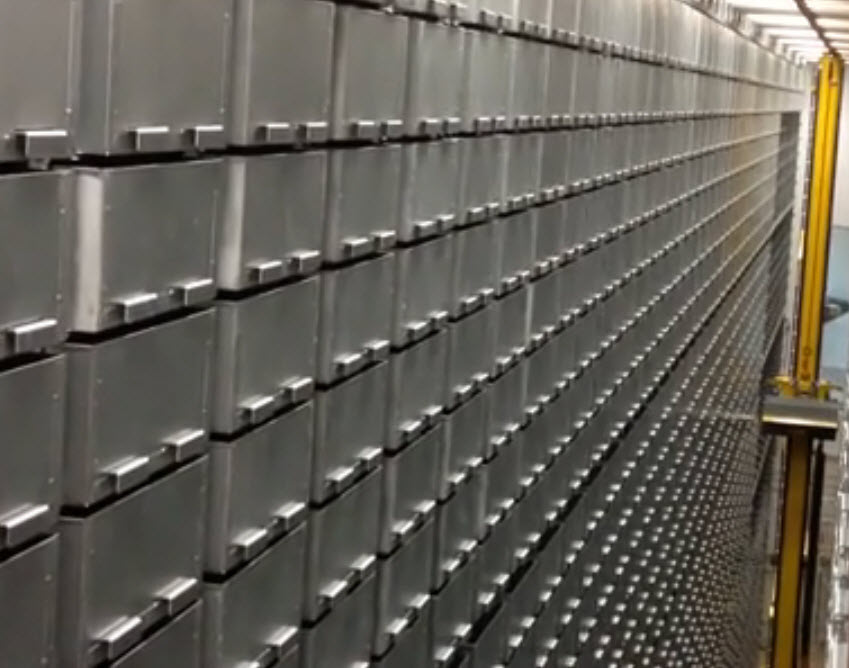
The “bookBots” in the Hunt Library on Centennial Campus at NC State University will house over 2 million volumes of books. The Hunt Library will be one of the most high-tech, innovative libraries around the world. (Credit: NC State – College of Design)
From giant corporations to university libraries to start-up businesses, employers are using rapidly improving technology to do tasks that humans used to do.
That means millions of workers are caught in a competition they can’t win against machines that keep getting more powerful, cheaper and easier to use, the Washington Post reports.
To better understand the impact of technology on jobs, The Associated Press analyzed employment data from 20 countries; and interviewed economists, technology experts, robot manufacturers, software developers, CEOs and workers who are competing with smarter machines.
The AP found that almost all the jobs disappearing are in industries that pay middle-class wages, ranging from $38,000 to $68,000. Jobs that form the backbone of the middle class in developed countries in Europe, North America and Asia.
In the United States, half of the 7.5 million jobs lost during the Great Recession paid middle-class wages, and the numbers are even more grim in the 17 European countries that use the euro as their currency. A total of 7.6 million midpay jobs disappeared in those countries from January 2008 through last June.
Those jobs are being replaced in many cases by machines and software that can do the same work better and cheaper. …
So machines are getting smarter and people are more comfortable using them. Those factors, combined with the financial pressures of the Great Recession, have led companies and government agencies to cut jobs the past five years, yet continue to operate just as well.
(More)
“bookBots” in the new Hunt Library at NC State University from NC State – College of Design on Vimeo.
Comments (44)
by FrankC
Is anything new under the sun for humans? Machines are, but processes keep recycling. Virtually all middle class Romans had slaves to work for them. That’s why the emperors had to stage games in the Coliseum for 130 days a year to keep them amused. That’s almost a three day weekend throughout the year.
by Dan Robinson
THe “right to a job” should really be the right to cotribute the larger community, and hopefully get paid equitably, so that we can, and have the motivations to, continue to contribute. Not all jobs are real contributions, especially when they prevent a machine from doing it better.
by Brian
@ChrisF: There is a place for bets like that. Check out longbets.com
There is a bet on there that in 25 years all driving will be automated and human drivers will only be allowed in specially designated areas.
by ChrisF
Thanks Brian. Interestingly it doesn’t seem as if longbets allows actual money to be exchanged, due to some strange US regulations. I’m looking for a kind of exchange where one could buy and sell futures corresponding to certain standard predictions : “Grid parity by 2020″, “AI before 2030″, that sort of thing. Here in the UK, spread-betting is quite popular but it’s limited to sports and financial markets. Does anyone know of something similar ?
by Editor
Sounds related to “idea futures” (a.k.a. Prediction Markets, Information Markets), a concept developed by Robin Hanson: http://hanson.gmu.edu/ideafutures.html, http://en.wikipedia.org/wiki/Robin_Hanson.
by Carol Hu
very interesting.
by Dan Robinson
There are things I might bet on that I don’t really want to see happen. Can I be assured of somehow gaining monetarily by preventing them?
by AeaeaActual
There may be a dangerous moment during which the so-called 1% (more like 0.001%) misunderstand what’s happening. That period will be quite short, but could prove fatal for many.
Yes, we should all become artists, though the definition of art can be quite broad (including stripping!). Machines will also be able to create art and presumably strip, though I’m not sure what that means in this case. We will like machine art; intelligent machines will probably appreciate human art, even if that art is extremely simple from the machines’ point of view. What will make human art valuable is not its decontextualized attributes, but the fact that it is _human art_, measured within that context. The author-function will continue, in this sense, to be valuable.
The machines are likely to be moral, more than most humans alive today. They are likely to be creative and to appreciate creativity in other lifeforms. Lastly, the line between us and the machines will be, as you can all appreciate, extremely thin indeed.
Buckminster Fuller famously announced that we had long passed the point when each individual had to earn a living, and we should just get busy with being curious, skill-driven, play-motivated creatures; we have long had the productive capacity to feed, clothe, water, and house everyone on Earth. This will only be more true in the future. Sadly, however, our cultural inertia has yet to catch up to this reality and dumbed-down objectivist capitalism, which now rules the Earth, will not go quietly into that good night.
Will self-aware AI happen in twelve years? Fifteen? My bet is on seventeen, just running projections on the latest data I see, but it seems we all calculate something relatively soon. Honestly, the sooner, the better.
by DrDubious
Eventually the 1% will no longer need the 99% and they will use their machines to rid the world of its parasites.
by Kristof77
Or Machines will bring down to the cost of living to a point that all food, shelter, clothing, education and entertainment will be virtual nothing and we can have our 40 hours a week back to persue whateve our hearts desire.
by snake0
I think you will find there are 168 hours in a week, not 40.
by Alex
He means working hours.
by Mr.X
@Snake: You must be one endurant worker!
by Dan Robinson
But our hearts desires may be to have more kids, thereby automatically eliminating the gain.
by Whittaker
We should be serious with the problem of the 99%.
They (income-wise I am one, intellectually I hope not) are shortsighted, easily fooled and believe in such things as Obama birth certificate conspiracy and 2012 doomsday story. Yet they are also human beings that need to be taken care of. Next ten years will be some very difficult times.
by Rob
Why is it nobody takes this to it’s logical conclusion. An effect of having machines do the work is that it lowers the cost of work. Which means things become more affordable. Prior to the Industrial Revolution it cost a lot to make a shirt. Afterwards, not so much. Plus you could support more people much better than you could previously. Something else that increased after the industrial revolution? Leisure time for the masses. Instead of having to scratch a living from sunup to sundown anymore, the mass of humanity found more time than ever for leisure. It’s no surprise that professional sports dates to the late 19th century. People needed to do something with all this new time. All this new tech means is that you can lessen the human work day and not take a hit on production. You can actually increase production, which will make things more affordable.
by Tony
I work on an assembly line and have seen robots take out a lot of jobs but I haven’t seen the cost of our product come down. Your logic works in the long term but in the short term jobs will be lost and people will suffer.
by ChrisF
Rob, you’re right that the effect of automation is that it lowers the cost of labor (drives wages to zero, in the extreme). But “stuff” will still cost money, because labor is only part of the total cost of production (think land, energy, raw materials, IP).
So imagine a world where goods are cheap, yes – but in which only a minority are able to generate an income to purchase those goods (because their labor has been rendered worthless). Not a happy picture.
If we can distribute the gains more evenly, then the future will be rosy – but I’m skeptical that this will be a smooth transition.
by Kristof77
Perhaps thought will be automated too… if a systems best outcome is the populations “happiness” then perhaps a solution will be found that could be done in a smooth transition that adviods man temptaious and corrupt ways.
by Bruce
You are correct in pointing out that the overall economy becomes stronger once the negative impacts of job loss have been absorbed. New businesses and new jobs are created because wealth is accumulated by business owners that can take advantage of the differential; however, the problem with the current situation is that the job loss is occurring at a much faster rate than new businesses can be created. There is an overall positive impact on the economy even though jobs are declining. This is why the current recovery is being called the “jobless recovery.” This problem will get worse before it gets better.
The only solution is to use this wealth to accelerate business innovation so that new jobs can be created to replace the ones that are lost. Financial incentives need to be provided for business innovators to create businesses that can absorb these new technologies and drive demand for new products and services.
by DeBee Corley
What’s the latest over/under on self aware machines?
12 years is my betting line.
by ChrisF
I’d guess a little more, perhaps 15. But sometime in the next couple of decades, for sure. I wish there were someplace where one could make bets about this kind of thing, I suspect we’d get very good odds!
by Bri
We need a score card. Jobs created as opposed to jobs lost. That way ww can know who’s wining the debate. My guess is that the new jobs created is a fraction of those lost.
by ChrisF
Yes, I’d be staggered if that wasn’t the case. Still, at least one group of people is claims that robots will be responsible for millions of new jobs… http://robohub.org/new-report-shows-that-robots-create-jobs. Oh wait, those are the exact people who stand to benefit from increased automation ! Hmm, wish I wasn’t so cynical….
by GatorALLin
May the best ideas win…. ..what if it proves a good thing that robots/computers do all the mind numbing jobs…. like vending machines… or data crunching…. leave the creative thinking to us humans (for now at least).
by trakk
I wont be suprised if after a few years computers will become advanced enough to do creative stuff too.
by The Netocrat
I would.
by ChrisF
Guess we’ll have to wait and see. Once we figure out how basic concepts are stored and manipulated in the brain, I can’t imagine that human-level creativity will remain a secret for much longer.
by trakk
Then you are in for a lot of surprises.
by godot
Yeah, trakk, like your opinion is so much better than everyone else’s.
I think Chris is exactly correct; once some key piece of knowledge is found, recombining concepts to produce creativity will be mastered by machines. Perhaps the best example of what that will be like is what happened with pattern recognition. For decades optical character readers were stuck at 98% recognition rate, then one day…poof…and we had fingerprint searches, voice search, google goggles, and self-driving cars. The same will happen with machine creativity, and then art.
by trakk
My comment reflects the same point of view.
by trakk
and FYI I don think that. I dont know how you got that impression. I am just putting my opinion out here, just like everybody else here.
by Whittaker
Depends on your definition of the word “creativity”.
In my opinion, *real* creativity are like those done by Leonardo Da Vinci and Srinivasa Ramanujan (see his biography – really fascinating). These result in real breakthrough in science, technology, engineering and mathematics. I believe that real breakthrough would be done by honest, hard workers, not people who just make up things randomly (see Toshiaki Asano’s ‘Multi-Euclidean Universe theory’, which is posted repetitively on a certain page in this website. He sounds like he is going to soon become a cult leader of a new pseudoscience sect.).
I omitted art, because I think, “Isn’t everything in the Universe just mere mathematics?”
As for such things as Picasso’s paintings or Dadaism, I want to say: “Sorry, not my cup of tea.”
by someday69
The vast majority of well’off’middle class’rep’z',,Will’change there tune’bout Social’programs’,,When it’s THEM’.n’ once the divorse’goes’,with’the big’house’,what’s left of the bank’account’s,,,they will’be’on down’street. live’in with family’or’in’there’motor’home’..suv’or car’s….just like the Other’s.,of US,’the great un’wash’d'…
,Then we will see much’more…”Compassion” in THE System…..someday…..look’s'like someday….
by godot
Right on, SomeDay! Sounds like you speak from experience.
by Khannea Suntzu
At this rate, in just a few years it will either be basic income or convulsive societal unrest. There is not middle ground. I advocate for transhumanism (and singularitarianism, extropy, technoprogressives) to embrace what is inescapable. Society at large will be forced to somehow collectivize the consequences of technological unemployment.
Preferably without resorting to state repression, fascism, “femavella’s” or final solutions.
by D.
I think the solution is clear: we should all start training as artists and strippers. But I guess that’ll only work until they have robot entertainers. Blast!
by Whittaker
“The solution to complexity is even more complexity”.
There is no end to this kind of process.
Is it possible to reach (technologically) a mental state that 1) one is super-intelligent 2) one understands all complexities of the universe (not in a esoteric way, but in a literal, computational way) 3) one understands itself (its own mind), in other words “enlightened”.
We can achieve “neuropsychological harmony” through such practices like meditation, but that is at most a exercise for health but not true, absolute, enlightenment.
Actually I believe that it is impossible for us, or any other sentient lifeforms (natural biological lifeforms and pre-singularity and post-singularity AIs), to fully understand the absolute reality.
It is somehow like a donkey trying to reach the carrot hanging in from its face. (This is not the analogy, I know).
But nevertheless, we can grow on until we use up all the resources in this universe, which is a lot of fun.
by Whittaker
“It is somehow like a donkey trying to reach the carrot hanging in from its face.” Oops. Should be “in front of”, not “in from of”.
If possible please correct my typo for me, dear Editor.
by Whittaker
(This is not the analogy, I know).
Should be “This is not the *best* analogy”.
Darn, two typos. Should start taking Ray and Terry’s cognitive products, I guess.
by godot
Correct analogy or not, this is likely the resolution of the Fermi paradox.
by trakk
yep
by Joel C.
So, in other words, a resource-based society where our basic necessities are provided for at no cost and we are free to pursue whatever fancies us. A lot like Star Trek world.
by godot
“Government-inflicted simulation.”
–Firesign Theatre