Bio-inspired catalyst to lower cost of producing hydrogen
February 1, 2013
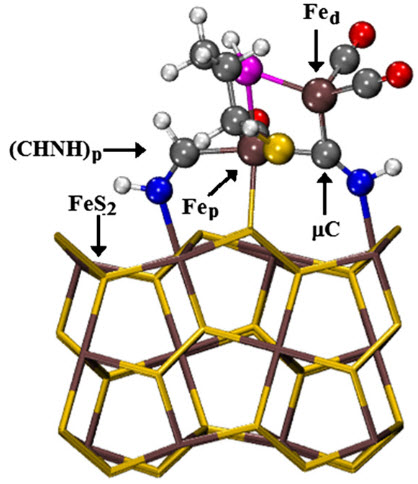
Bio-inspired iron-based catalyst for producing hydrogen. Key atoms and groups are indicated. The color convention throughout is Fe atoms, brown; S atoms, yellow; P atoms, violet; C atoms, gray; N atoms, blue; O atoms, red; and H atoms, white. (Credit: Patrick H.-L. Sit et al./PNAS)
Hydrogen has tremendous potential as an eco-friendly fuel, but it is expensive to produce. Now researchers at Princeton University and Rutgers University have moved a step closer to harnessing nature to produce hydrogen.
The team, led by Princeton chemistry professor Annabella Selloni, takes inspiration from bacteria that make hydrogen from water, using enzymes called di-iron hydrogenases.
Cheap components = cost-effective
They used computer models to figure out how to incorporate the magic of these enzymes into the design of practical synthetic catalysts that humans can use to produce hydrogen from water.
The catalysts designed so far are susceptible to poisoning by the oxygen present during the reaction.
By making changes to the catalyst to improve the stability of the structure in water, the researchers found that they had also created a catalyst that is tolerant to oxygen without sacrificing efficiency.
The artificial catalyst could also be made from abundant and cheap components, such as iron, indicating that the catalyst could be a cost-effective way of producing hydrogen.
The team conducted their research in silico — that is, using computer modeling. The goal is to learn enough about how these catalysts work to someday create working catalysts that can make vast quantities of inexpensive hydrogen for use in vehicles and electricity production.