Bioengineering cells for more efficient biofuel production
February 20, 2013
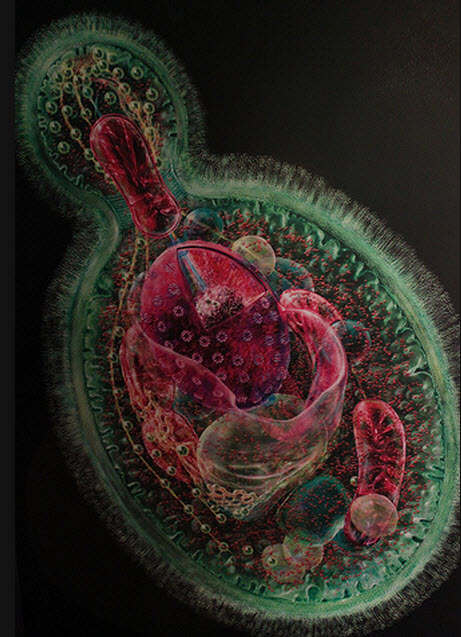
Yeast Cell —an image within an exhibit called “From Another Kingdom” at the National Botanic Garden of Wales (credit: flickr.com/col and tasha)
In the search for renewable alternatives to gasoline, heavy alcohols such as isobutanol are promising candidates.
They contain more energy than ethanol and are also more compatible with existing gasoline-based infrastructure.
For isobutanol to become practical, however, scientists need a way to reliably produce huge quantities of it from renewable sources.
MIT chemical engineers and biologists have now devised a way to dramatically boost isobutanol production in yeast, which naturally make it in small amounts. They engineered yeast so that isobutanol synthesis takes place entirely within mitochondria, cell structures that generate energy and also host many biosynthetic pathways. Using this approach, they were able to boost isobutanol production by about 260 percent.
Though still short of the scale needed for industrial production, the advance suggests that this is a promising approach to engineering not only isobutanol but other useful chemicals as well, says Gregory Stephanopoulos, an MIT professor of chemical engineering and one of the senior authors of a paper describing the work in the Feb. 17 online edition of Nature Biotechnology.
“It’s not specific to isobutanol,” Stephanopoulos says. “It’s opening up the opportunity to make a lot of biochemicals inside an organelle that may be much better suited for this purpose compared to the cytosol of the yeast cells.”
Stephanopoulos collaborated with Gerald Fink, an MIT professor of biology and member of the Whitehead Institute, on this research. The lead author of the paper is Jose Avalos, a postdoc at the Whitehead Institute and MIT.
Yeast typically produce isobutanol in a series of reactions that take place in two different cell locations. The synthesis begins with pyruvate, a plentiful molecule generated by the breakdown of sugars such as glucose. Pyruvate is transported into the mitochondria, where it can enter many different metabolic pathways, including one that results in production of valine, an amino acid. Alpha-ketoisovalerate (alpha-KIV), a precursor in the valine and isobutanol biosynthetic pathways, is made in the mitochondria in the first phase of isobutanol production.
Valine and alpha-KIV can be transported out to the cytoplasm, where they are converted by a set of enzymes into isobutanol. Other researchers have tried to express all the enzymes needed for isobutanol biosynthesis in the cytoplasm. However, it’s difficult to get some of those enzymes to function in the cytoplasm as well as they do in the mitochondria.
The MIT researchers took the opposite approach: They moved the second phase, which naturally occurs in the cytoplasm, into the mitochondria. They achieved this by engineering the metabolic pathway’s enzymes to express a tag normally found on a mitochondrial protein, directing the cell to send them into the mitochondria.
This enzyme relocation boosted the production of isobutanol by 260 percent, and yields of two related alcohols, isopentanol and 2-methyl-1-butanol, went up even more — 370 and 500 percent, respectively.
There are likely several explanations for the dramatic increase, the researchers say. One strong possibility, though difficult to prove experimentally, is that clustering the enzymes together makes it more likely that the reactions will occur, Avalos says.
Another possible explanation is that moving the second half of the pathway into the mitochondria makes it easier for the enzymes to snatch up the limited supply of precursors before they can enter another metabolic pathway.
“Enzymes from the second phase, which are naturally out here in the cytoplasm, have to wait to see what comes out of the mitochondria and try to transform that. But when you bring them into the mitochondria, they’re better at competing with the pathways in there,” Avalos says.
The findings could have many applications in metabolic engineering. There are many situations where it could be advantageous to confine all of the steps of a reaction in a small space, which may not only boost efficiency but also prevent harmful intermediates from drifting away and damaging the cell.
The researchers are now trying to further boost isobutanol yields and reduce production of ethanol, which is still the major product of sugar breakdown in yeast.
“Knocking out the ethanol pathway is an important step in making this yeast suitable for production of isobutanol,” Stephanopoulos says. “Then we need to introduce isobutanol synthesis, replacing one with the other, to maintain everything balanced within the cell.”
“So far, they have done a good job showing that this idea works,” says James Liao, a professor of chemical and biomolecular engineering at UCLA, who was not part of the research team. “The next step is to see if this trend continues at a large scale and produces a high enough yield for commercial use.”
The research was funded by the National Institutes of Health and Shell Global Solutions.