Biologists engineer algae to make complex anti-cancer ‘designer’ drug
December 13, 2012
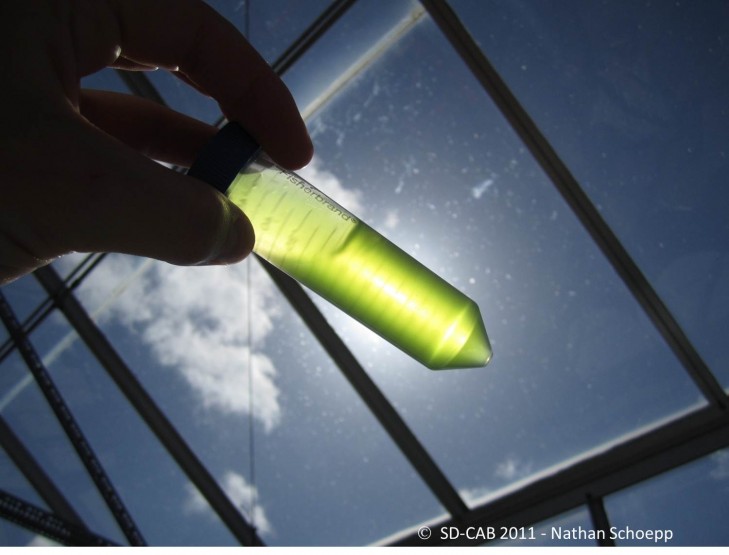
Chlamydomonas reinhardtii, a green alga used widely in biology laboratories, can produce many kinds of “designer proteins” (credit: Nathan Schoepp/University of California – San Diego)
Biologists at UC San Diego have succeeded in genetically engineering algae to produce what has been a complex and expensive human therapeutic drug used to treat cancer.
Their achievement opens the door for making these and other “designer” proteins in larger quantities and much more cheaply than can now be made from mammalian cells.
“Because we can make the exact same drug in algae, we have the opportunity to drive down the price down dramatically,” said Stephen Mayfield, a professor of biology at UC San Diego and director of the San Diego Center for Algae Biotechnology (SD-CAB), a consortium of research institutions that is also working to develop new biofuels from algae.
Their method could even be used to make novel complex designer drugs that could be used to treat cancer or other human diseases in new ways.
“You can’t make these drugs in bacteria, because bacteria are incapable of folding these proteins into these complex, three-dimensional shapes,” said Mayfield. “And you can’t make these proteins in mammalian cells because the toxin would kill them.”
The advance is the culmination of seven years of work in Mayfield’s laboratory to demonstrate that Chlamydomonas reinhardtii, a green alga used widely in biology laboratories as a genetic model organism, can produce a wide range of human therapeutic proteins in greater quantity and more cheaply than bacteria or mammalian cells.
In May of this year, Mayfield’s group working with another team headed by Joseph Vinetz from UC San Diego’s School of Medicine, engineered algae to produce an even more complex protein — a new kind of vaccine that preliminary experiments suggest could protect billions of people from malaria.
“What the development of the malarial vaccine showed us was that algae could produce proteins that were really complex structures, containing lots of disulfide bonds that would still fold into the correct three-dimensional structures,” said Mayfield. “Antibodies were the first sophisticated proteins we made. But the malarial vaccine is complex, with disulfide bonds that are pretty unusual. So once we made that, we were convinced we could make just about anything in algae.”
In their latest development, the scientists genetically engineered algae to produce a complex, three-dimensional protein with two “domains” — one of which contains an antibody, which can home in on and attach to a cancer cell and another domain that contains a toxin that kills the bound cancer cells. Such “fusion proteins” are presently created by pharmaceutical companies in a complex, two-step process by first developing the antibody domain in a Chinese hamster, or CHO, cell. The antibody is purified, then chemically attached to a toxin outside of the cell. Then the final protein is re-purified.
“Can we string together four or five domains and produce a designer protein in algae with multiple functions that doesn’t exist in nature? I think we can?” he added. “Suppose I want to couple a receptor protein with a series of activator proteins so that I could stimulate bone production or the production of neurons? At some point you can start thinking about medicine the same way we think about assembling a computer, combining different modules with specific purposes. We can produce a protein that has one domain that targets the kind of cell you want to impact, and another domain that specifies what you want the cell to do.”
The research project was supported by grants from the National Science Foundation and The Skaggs Family Foundation.