Bionic glasses for poor vision
July 6, 2011
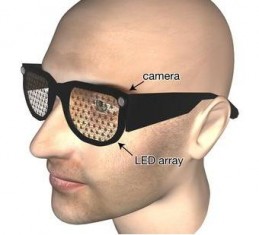
Bionic glasses include video cameras, position detectors, face recognition and tracking software, and depth sensors (credit: Oxford University)
Bionic glasses using video cameras, position detectors, facial recognition and tracking software, and depth sensors have been developed by Oxford University researchers.
“We want to be able to enhance vision in those who’ve lost it or who have little left or almost none,” explains Dr Stephen Hicks of the Department of Clinical Neurology at Oxford University. “The glasses should allow people to be more independent — finding their own directions and signposts, and spotting warning signals,” he says.
The glasses would be appropriate for common types of visual impairment, such as age-related macular degeneration and diabetic retinopathy. (NHS Choices estimates around 30% of people who are over 75 have early signs of age-related macular degeneration, and about 7% have more advanced forms.)
The researchers plan to convert newspaper headlines using optical character recognition into audible words. Barcode and price tag readers could also be useful additions, the researchers said.
The bionic glasses are being exhibited at this year’s Royal Society Summer Science Exhibition.
Comments (3)
by Editor
Yes, the idea is to have an audio feed.
by Porter
These sound really cool. do the have a headphone or something that will tell the person who they are talking to by the facial recognition software? So these glasses will convert Newspapers, Books and other documents into an audio source and basically read it to you? I think this is a great idea.
by Anumakonda
Good post on Bionic Glasses
By wearing Bionic Glasses it is possible to enhance vision in those who’ve lost it or who have little left or almost none,’ ‘The glasses should allow people to be more independent – finding their own directions and signposts, and spotting warning signals,’ Technology developed for mobile phones and computer gaming – such as video cameras, position detectors, face recognition and tracking software, and depth sensors – is now readily and cheaply available. So Oxford researchers have been looking at ways that this technology can be combined into a normal-looking pair of glasses to help those who might have just a small area of vision left, have cloudy or blurry vision, or can’t process detailed images.
The glasses should be appropriate for common types of visual impairment such as age-related macular degeneration and diabetic retinopathy. NHS Choices estimates around 30% of people who are over 75 have early signs of age-related macular degeneration, and about 7% have more advanced forms.
Dr.A.Jagadeesh Nellore(AP),India
E-mail: anumakonda.jagadeesh@gmail.com