Birth of a planet
September 3, 2012
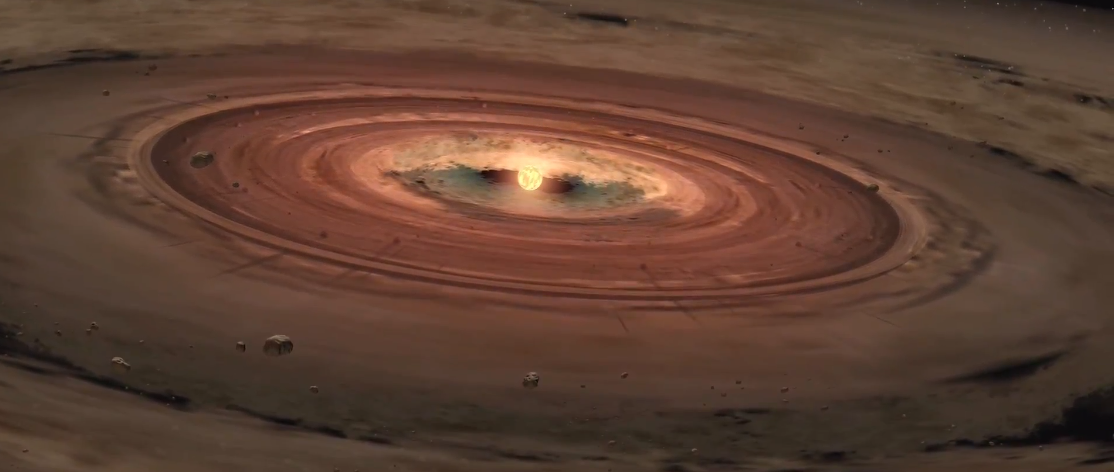
Artist’s concept of formation of a planet, based on University of Texas at Austin models (credit: NASA/JPL-Caltech)
Collaborating with Greg Abrams of Texas Advanced Computing Center (TACC), Sally Dodson-Robinson and her team of researches at the University of Texas at Austin have developed advanced simulations to visualize how planets are formed over a timescale of millions of years.
They are modeling and simulating prototypical disks, and comparing the results to the Earth and the planets of our own solar system. The considerable computation involved was facilitated by the Ranger supercomputer at TACC.
Over the past few decades, the hunt for extrasolar planets — planets outside our own solar system — has yielded incredible discoveries. And now planetary researchers have a new tool: simulated models of how planets are born.
The leftover gas and dust form a disk around the star, and the particulates inside the disk begin to collide and coalesce over millions of years, forming larger and larger objects, until a planet eventually takes shape.
Comments (7)
by Peter Kinnon
While such simulations are interesting they suffer from the same kind of limitation as, for instance, the Drake equation – inadequacy of reliable input data.
We must always remember the IT mantra of GIGO : garbage in – garbage out.
by Editor
The data is cited in their papers. I just added the most recent one (http://arxiv.org/pdf/1204.2275v1.pdf) to the news item. See the link from astro-ph on http://www.as.utexas.edu/astronomy/people/dodson-robinson/ for the full set of papers.
by Dan Robinson
This is news?? What other scenarios came before? If a new star has a lot of debris around it, how could it not form a planetary system?
by asiwel
No, not really news, but an excellent piece of video scientific reporting – a science infomerical, very well done – that seems likely to be enjoyable and interesting even for planetary scientists, not to mention high school students and the general public.
by Editor
Agreed. I just rewrote the story to make the actual news clear: that they have developed advanced simulations to visualize the prototypical disks. (Note to self: get more sleep.)
by Ian Clarke
Fascinating. Ever since watching Carl Sagan’s Cosmos I’ve wanted to take a 3D VR tour of the universe, choosing which direction to take on a whim. With these simulations, one day you’ll hopefully be able to choose which timeframe on a whim also. Or just let it all unfold before your eyes.
by jack lewis
Well that said “Nothing”