Black holes growing faster than expected
February 14, 2013
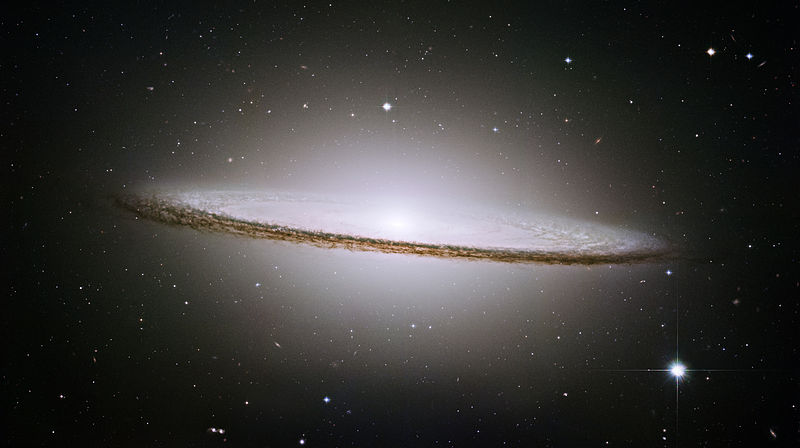
Sombrero galaxy (credit: NASA/ESA)
Black holes are growing faster than previously thought possible, according to new research published Wednesday in the Astrophysical Journal.
Even the black hole in our own Milky Way Galaxy, which otherwise appears very quiet, has probably been consuming the equivalent of one Sun every 3000 years.
Until recently, astronomers thought that black holes grow mostly when galaxies crash into each other, at which time a large concentration of gas forms around the black hole and gets very hot, shining very brightly in what is known as an active galactic nucleus.
This theory held that black holes in the centers of ordinary spiral galaxies like our own Milky Way cannot grow much.
The study, led by University of Central Lancashire (UCLan) astronomer Dr Victor Debattista, used computer simulations to show that black holes in spiral galaxies must grow by large amounts without the need for collisions.
Closer to home, astronomers have recently discovered a gas cloud near the center of the Milky Way that later this year, we will see ripped apart by the central black hole. Over the next 10 years, the black hole is predicted to be seen having swallowed up to as much as 15 times the mass of the Earth from this cloud.
The team disproved the previous theory — that black holes are unable to grow while the galaxy itself grows — by using computer simulations to compare the masses of black holes in spiral galaxies with those of elliptical galaxies. (Black-hole masses can be accurately predicted from the speed of stars in the galaxies they live in.)
The team’s comparison of spiral and elliptical galaxies found that there is no mismatch between how big their black holes are. For this to have happened, black holes had to have been growing along with the galaxy.
The black hole that has grown the most can be found in the Sombrero galaxy.
The researchers estimate that this black hole has been swallowing the equivalent of one Sun every 20 years and is now over 500 million times as heavy as our Sun.
The new study provides the theoretical basis for understanding the emerging picture that galaxy collisions are a relatively small contribution to the growth of black holes, contrary to previous assumptions.
References:
- Victor P. Debattista, Stelios Kazantzidis, Frank C. van den Bosch, DISK ASSEMBLY AND THE M BH-σ e RELATION OF SUPERMASSIVE BLACK HOLES, Astrophysical Journal, 2013, DOI: 10.1088/0004-637X/765/1/23
- Victor P. Debattista, Stelios Kazantzidis, Frank C. van den Bosch, Disk Assembly and the M_BH-sigma Relation of Supermassive Black Holes, arXiv, 2013, arxiv.org/abs/1301.2669
Comments (19)
by yas
Maybe, we can expect that black holes and supermassive black holes grow by all of these: endless supplied gas cloud (either poor or rich supply), colliding with other black holes and whatever matters or debris nearing them.
by Jee
where do all the stars go?
by Marcos Marin
White dwarfs.. for the most part (main sequence)… to join the small fraction of baryonic dark matter aka MACHO’s as compared to WIMP’s (I’m NOT making this up, lol)
by paolo labianco
Well I believe our thoughts generate the reality,so if you think hard enough you will succeed in having a BIG BAD BLACK HOLE eating us all ALIVE!!!
by Bri
Get back to us in a few years and let us know how it’s going.
by WLGJR
Could this new discovery shed light on how we can build a *Blackhole Brain*?
http://www.orionsarm.com/eg-article/462d8f8f58231
by eldras
ARGGGG! I built an Andersen shelter for the coming Russian invasions and bombs,
Stocked up with food in the 60′s because the ice age was coming,
Got ready for apocalypse because of the prpphesies of Nostradmaus in the 90′s.
Turned my systems of to prevent the millennium bug in 2000.
Didn’t have children because the earth couldn’t feed 5 billion people.
Worried about the ozone layer.
Shivered nervously about global warming until the southern ice caps started growing.
Gathered with my food supplies on the mountain last december for the Mayan prophesy was due, clutching “The Singularity Is Near” and a crucifix.
-Do I have to worry about black holes eating everything ?
Tell me??
by Marcos Marin
only if you live long enough to live forever =)
by Knot
I used to worry about a lot of things when I was younger.
Rarely do I find myself worrying nowadays, though. And that’s just as well, since it’s not good for anything. What measures will you take personally to secure yourself against growing black holes? Remember that space is very vast, and we’re 1600 light years away from the nearest one (that we know of). We’ll be post-singularity before we need to deal with it.
All you should do is have your heart-healthy glass of wine, and definitely not worry.
by Knot
In my curiosity, I googled that black hole, and wikipedia revealed the following:
“later observations showed it to be at least 15 times farther away.”
So that makes it even less of a thing to worry about ;)
by Marcos Marin
If you want to worry about “black holes”, you can worry about the undetectable (until too late), tiny (maybe even smaller than the sun), erratic ones, floating around.
Call them the boogeymen, for completeness.
by Bri
@Eldras: Nahhhh! The only thing to worry about is the ultimate heat death of the universe. My suggestion, a very large space heater!!
by eldras
Bri
Doesn’t M-theory mean heat death of the universe is not a concerns?
Since we time travel, since our universe bubbled off membranes we should be able to get back there?
I’m not sure a large space heater wouldn’t work.
by Bri
I guess it’s another of those unfounded fears. If we bubbled off the brane in must be much larger than our universe. They gotta have some super massive space heaters over there. I’m particularly fond of the parabolic type that’s glows red. Maybe they’ve got one a few lightyears across!
by WLGJR
One way to survive into the era of the cooled down universe is to become a Dyson’s Eternal Intelligence.
But this one is not really *eternal*, as its mental function eventually become so slow, and the hibernation periods become so long, that it can be considered no longer living.
by Ian
Goddamn underground monsters.
by Brad
If the sun turned into a black hole Earth’s orbit wouldn’t change at all.
by dacian
ok As far as I understood earth and other planets produce a magnetic field by having a big iron melted ball in the core that rotates or anyhow there are layers of melted matter that rotates.
I have no problems with that but my question is what creates a magnetic field in a black hole? I mean this thing should be so densely pack that one can’t have moving things inside? the only thing that it should produce should be the gravitational pull but the why not all galaxies are spherical?
thanks for any clarification.
by Marcos Marin
This article says nothing of magnetism but if you really wanna know, magnetism being an electromagnetic wave will gradually lose intensity close to such a gravitational well, just as it is “black” because no light is escaping. (Thus the article couldnt talk about it even if it wanted to)
However, due to time dilation this would take an infinitely long time from our perspective even as all the matter has already been ripped apart past the horizon. Thus you can never see any “packing” even though it’s worse than packed, it is “degenerate”.
Magnetism, say from a hydrogen cloud if it was packed enough to become metallic hydrogen, would “dim” (technically “red shifted”) forever as it falls into the well.
But dont worry, this is all fiction because human models break down quickly after, they simply do not have a clue what this is.