Braille-like texting app speeds up typing on smartphones
February 21, 2012
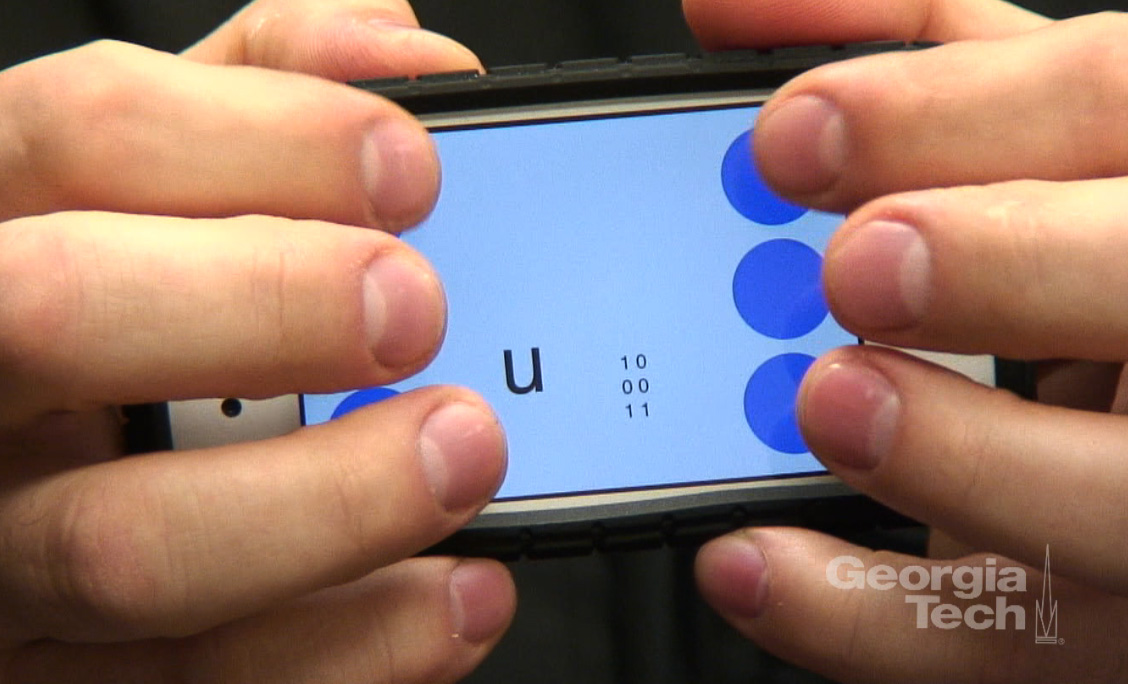
BrailleTouch (credit: Georgia Tech)
Ever need to text a note under the table during a meeting or during class without anyone knowing it?
Georgia Tech researchers have a solution: a free open-source iPhone app called BrailleTouch.
No, it’s not a solution for texting while driving.
“Research has shown that chorded, or gesture-based, texting is a viable solution for eyes-free written communication in the future,” says Mario Romero, Postdoctoral Fellow in the School of Interactive Computing (IC) and the project’s principal investigator.
BrailleTouch incorporates the Braille writing system used by the visually impaired. Using six fingers, it lets you type at up to 32 words per minute with 92 percent accuracy — at least six times faster than other research prototypes for eyes-free texting.
Universal texting app
Romero thinks BrailleTouch could be a universal eyes-free mobile texting app that replaces soft QWERTY keyboards and other texting technologies. For the blind, it replaces expensive proprietary Braille keyboard devices, which typically cost thousands of dollars, he says.
The six-key configuration allows the keyboard to fit on the screen and lets you keep your fingers in a relatively fixed position while texting. You hold the device with the screen facing away from you, cradling the device with your palms or pinkies and thumbs so you can type with a majority of your fingers. This is identical to typing Braille on a standard keyboard.
The research group has developed iPhone and iPad versions of BrailleTouch (not yet available in iTunes) and is currently working on Android versions. The app recently won the MobileHCI 2011 competition for design at the MobileHCI conference in Stockholm, Sweden.