Brain connectivity predicts reading skills
October 10, 2012
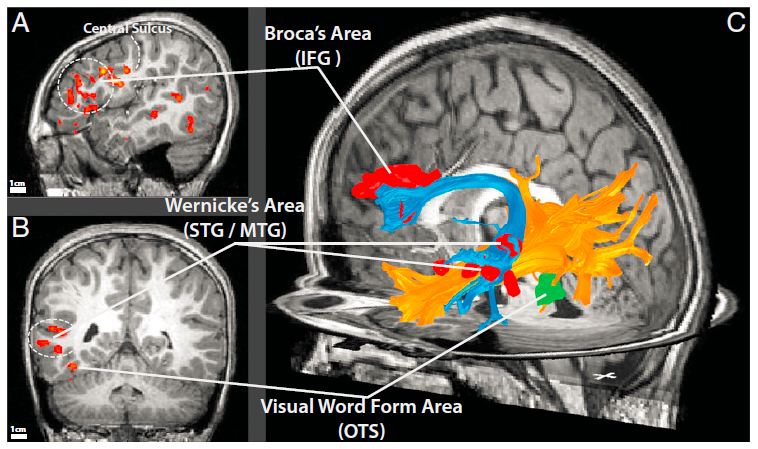
Essential cortical circuits and white-matter connections for reading. (A and B) Blood oxygen level-dependent responses in a 10-y-old engaged in a rhyming task. In alternating 12-s blocks the subject judged if a pair of written words rhyme or whether two line patterns are the same. The subject’s gray matter was segmented, and regions within the cortex with reliable task-related modulations (P < 0.001, uncorrected) were identified (colored overlay). A sagittal and coronal plane are shown to illustrate the phonological processing-related activations in the inferior frontal gyrus (IFG; Broca’s area) and superior/ middle temporal gyrus (STG/MTG; Wernicke’s area) and the orthographic processing-related activation in the occipito-temporal sulcus (OTS). (C) Responsive voxels from Broca’s area and Wernicke’s area were rendered in 3D and displayed as surfaces within the brain volume (red). Two large fascicles, estimated with deterministic fiber tractography, are shown also. The arcuate fasciculus (blue) may carry phonological signals from the posterior temporal lobe to the inferior frontal lobe. The VWFA activation is rendered as a green surface. The ILF (orange) may carry signals from the VWFA to the anterior and medial temporal lobe. (Credit: Yeatman, J. D., Dougherty, R. F., Ben-Shachar, M., Wandell, B. A./Proceedings of the National Academy of Sciences)
The growth pattern of long-range connections in the brain predicts how a child’s reading skills will develop, according to research published in Proceedings of the National Academy of Sciences, Nature News reports.
Literacy requires the integration of activity in brain areas involved in vision, hearing and language. These areas are distributed throughout the brain, so efficient communication between them is essential for proficient reading.
Jason Yeatman, a neuroscientist at Stanford University in California, and his colleagues studied how the development of reading ability relates to growth in the brain’s white-matter tracts, the bundles of nerve fibers that connect distant regions of the brain.
They tested how the reading skills of 55 children aged between 7 and 12 years old developed over a three-year period. There were big differences in reading ability between the children, and these differences persisted — the children who were weak readers relative to their peers at the beginning of the study were still weak three years later.
The growth of white-matter tracts is governed by pruning, the process that eliminates extraneous nerve fibres and neuronal connections; and myelination, in which individual nerve fibres in the tracts are enveloped by a fatty, insulating tissue that increases the speed of transmission. Both processes are influenced by experience — underused nerve fibres are pruned, whereas others are myelinated — so they occur at different rates and times in different people.
Yeatman says that individual children might benefit from reading lessons that are tailored to their patterns of brain development. In the future, it may be possible to determine exactly when pruning is taking place — children may find it easiest to learn to read at this stage of development, when there is greater potential for remodelling in the brain. “We’d really like to find a way of predicting who’s going to struggle with reading before they start struggling,” he says.
Comments (6)
by Cybernettr
As we learn more an more how the brain works, the fallacy of trying to raise all children to exactly the same level of academic performance, as both sides of the political spectrum are trying to do now, becomes more and more obvious. Much as we may dislike the fact, not all children are the same in terms of native reading ability, memory and intelligence. Surely the goal should be to help all children to reach their individual potentials, not hold them all to some arbitrary yardstick.
by melajara
This is an interesting research. Unfortunately it doesn’t address a question very important for the actual efficacy of reading.
There are currently two main approaches for teaching the bases of reading acquisition.
The syllabic one, is concentrating on the components of each words segmented in syllables as they appear when a word is voiced.
On the contrary, the global one attempts to train young aspiring readers to recognize words through their graphical imprinting, in toto, without segmenting them further down.
The first approach tends to produce readers more attentive to orthography and with a rich vocabulary. However, it has the very unfortunate effect to tie the reading experience with the auditory circuit, hampering further down the possibility of speed reading where the meaning of a text is acquired from image recognition through understanding without activating the auditory circuit. In extreme cases, we have even glottal involuntary movements triggered in support of reading slowing further down the reading.
But all is not rosy with the global approach. As mentioned, it is promoting a vaguer experience of the text and, maybe, a less diversified vocabulary, at least in performance which is quite understandable as reading is not reinforcing speaking abilities through exercising the common auditory regions. But on the other hand you gain speed, and more leverage for even more speed when you are naturally developing your reading skills toward the kind of procedures advocated in speed reading courses which is very difficult to do for “phonic” readers.
We are in an age where information has to be collected very quickly. So going from image scanning through understanding without the slow process of underlying sub-vocalization is an immense advantage in our society.
I’m very aware of this important dichotomy in the reading experience as I’m an phonic reader when my mother is an “eideitic” reader. Give her a newspaper and you’ll believe she’s just browsing the pages, waiting to find an interesting article to pause and read it. But no, she’s actually able to read everything at the pace I’m only able to browse, very infuriating.
But wait, give her an intricate reading, e.g. some abstruse philosophy book and she will considerably slow down in proportion of the complexity of the arguments in the text. And even for a “normal” text, she will summarize it but not be able to remember the details of the wording or quote a sentence. To be able to do so, she has to concentrate and slow down.
This is fascinating but unfortunately a relatively untouched subject. Besides, it could have, this is an hypothesis, a strong influence on higher maths abilities. I suspect the “eideitic” reader should have a strong advantage when deciphering complex math expressions over the “phonic” one, forced to linearize the perception of a formula through the sequential utterance of internalized sounds. This hypothesis should be testable with the apparatus mentioned in this article.
All in all, I’ll love to register in this experiment with my mother to compare our brain activation patterns when reading Kant then the Daily Mirror ;-)
by JC
I’d wager that reading TO very young children will soon be shown to stabilize these long region to region connections through the pruning process. Hearing the parent’s voice, seeing the book images, touching the pages and pictures, language practice with the parent helping them mimic the sounds over and over, and the oxytocin between them which seems to help learning and memory. Read to those kids!
by Genius
Do the scientists findings imply the presence of a critical period? If the child is a weak Reader, and does not receive the appropriate training at a young age, can he or she forge a strong neural network for reading as an adult?
by Bri
When I was seven, my mother showed me a book by a neurosurgeon, who was a talented artist. It had very realistic watercolors of the brain during surgery. She saw how interested I was and got me an age specific book on the body. I was furious with her for giving me such watered down information. When I eat food, I have to read new info. All my life I’ve said to people, I’m hungry, I have feed my body and feed my brain! Trying to understand adult language at an early age, really helped my reading comprehension.
by Bennie Beaver
I’ve long wondered whether individual brains develop at different rates; whereas, schools teach children as though they should be at the same learning stage. Also, I have wondered how a slower rate of development correlates to living longer, such as centenarians…as do those individual’s biology burn at a slower rate, so they live longer…like my family. Some have said that Einstein was a little slower to develop in areas…true or not.
Regardless, it’s not surprising that individuals develop various faculties at different rates. And true, some individuals may have faulty genes regardless.