Full-brain waves challenge area-specific view of brain activity
March 21, 2013
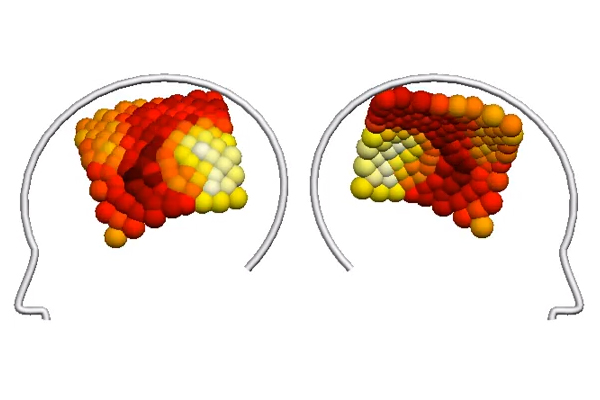
A still-shot of a wave of brain activity measured by electrical signals in the outside (left view) and inside (right view) surface of the brain. The color scale shows the peak of the wave as hot colors and the trough as dark colors. (Credit: David Alexander/KU Leuven)
Our understanding of brain activity has traditionally been linked to brain areas — when we speak, the speech area of the brain is active.
New research by an international team of psychologists shows that this view may be wrong. The entire cortex, not just the area responsible for a certain function, is activated when a given task is initiated.
Furthermore, activity occurs in a pattern: waves of activity roll from one side of the brain to the other.
The research was led by David Alexander and Cees van Leeuwen (Laboratory for Perceptual Dynamics).
The brain can be studied on various scales, researcher David Alexander explains: “You have the neurons, the circuits between the neurons, the Brodmann areas — brain areas that correspond to a certain function — and the entire cortex.
Traditionally, scientists looked at local activity when studying brain activity, for example, activity in the Brodmann areas. To do this, you take EEG’s (electroencephalograms) to measure the brain’s electrical activity while a subject performs a task and then you try to trace that activity back to one or more brain areas.”
Activity waves
In this study, the psychologists explore uncharted territory: “We are examining the activity in the cerebral cortex as a whole. The brain is a non-stop, always-active system. When we perceive something, the information does not end up in a specific part of our brain. Rather, it is added to the brain’s existing activity.
If we measure the electrochemical activity of the whole cortex, we find wave-like patterns. This shows that brain activity is not local but rather that activity constantly moves from one part of the brain to another. The local activity in the Brodmann areas only appears when you average over many such waves.”
Each activity wave in the cerebral cortex is unique. “When someone repeats the same action, such as drumming their fingers, the motor centet in the brain is stimulated. But with each individual action, you still get a different wave across the cortex as a whole.
Perhaps the person was more engaged in the action the first time than he was the second time, or perhaps he had something else on his mind or had a different intention for the action.
The direction of the waves is also meaningful. It is already clear, for example, that activity waves related to orienting move differently in children — more prominently from back to front — than in adults. With further research, we hope to unravel what these different wave trajectories mean.”
Comments (10)
by Dennis Balson
We could certainly construct machines that would not be conscious, but would be more intelligent than human minds provided that we had the right factual information to feed it.
by statistician
Sounds like maybe the brain is scanning itself to see if “it” gets new information from aniother local site. I.e., if sites are specialized, then it is of evolutionary advantage to scan other speicalized processing units–just in case something else is coming into play.
by Vin
It is definitely fun to wildly speculate. Some kind of cascading re-weighting of the connectome, like ripples in a pond from a stone, with highest activity or focus at the more specialist Brodmann areas? And reflective bouncing around at impedance mismatch boundaries or the skull itself? Well I guess with metaphor since I ain’t no specialist. But I’d add an electronic engineer and an AI specialist to that team of psychologists. Clever so to speak of the brain to leverage its existing infrastructure to power up its ability to encode repeating actions as distinctly separate events. Must be an evolutionary advantage. Context sensitive causal influence of an organisational hierarchy in action.
by tedhowardnz
Bill Uttal has been on this thesis for a long time.
Ginger Campbell runs a great little podcast – http://brainsciencepodcast.com/
and her interview with Bill is well worth listening to (as are all the others) – http://www.brainsciencepodcast.com/bsp/mind-and-brain-with-william-uttal-bsp-83.html – great to have in the phone for a long drive.
by silentrage
“This shows that brain activity is not local”
Go deeper. :)
by Ian Clarke
Waves, eh? Assuming Ray’s view of the cortex is correct, and it does consist of hierarchical pattern recognisers, I wonder if these waves wash over the entire cortex to ensure the relevant pattern recognisers get fired up (by initially firing them all up) – waves of energy supplying our brain power. Not the most efficient of processes, granted. But then, our bodies are littered with such anomalies.
by melajara
Thought is reverberating everywhere across the cortex (probably a key factor for apperception) but with a damping factor (or one would be mad quasi immediately!) .
“activity waves related to orienting move differently in children — more prominently from back to front — than in adults”
Very interesting observation, this is to be linked IMHO to the progressive building up of higher level representative abilities (e.g. mental images, intuition, day dreaming).
by MikeB
LOL you have to love it. These past weeks there have been a spate of stories focusing on the mapping of brain activity, each one touting the precision of the mapping bla bla bla. The brain is an electrical and chemically soaked sponge; why the persistent belief that it can be neatly compartmentalized into mutually isolated regions?
by Dennis Balson
Pprotoconsciousness exists in every brain, but when thoughts commence then the ‘proto ‘ (first) entity is not recognized because only mental activity is valued. The brain is merely a vehicle for consciousness, but without energy the vehicle cannot function. Brain cells operate by means of electrical impulses,which cause the protoconsciousness to come into being. Once mental activity commences then that is a different form of consciousness.
by Pete
Your notion sounds a little bit like the concept of “panpsychism”.
I wonder how we may create machines that are “intelligent” but are not “conscious”.
I believe we can find a way to circumvent the problem (for scholars in the ethics) of consciousness, and create human-equivalent of even super-human AIs that are not conscious.