Breaking the million-core supercomputer barrier
January 30, 2013
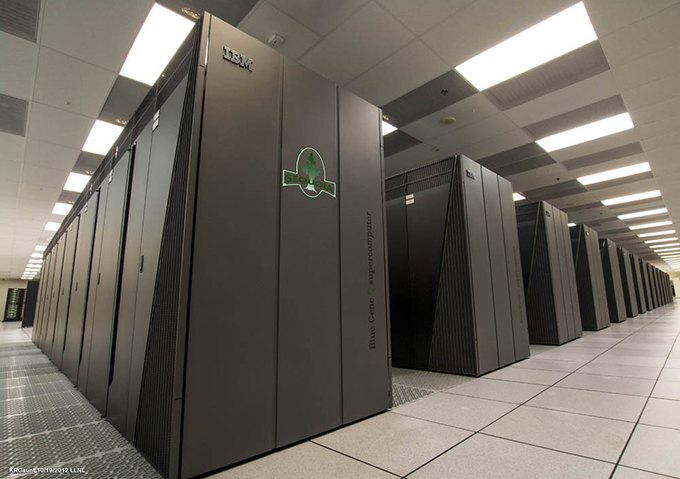
A floor view of the newly installed Sequoia supercomputer at the Lawrence Livermore National Laboratories (credit: Lawrence Livermore National Laboratories)
Stanford Engineering‘s Center for Turbulence Research (CTR) has set a new record in computational science by successfully using a supercomputer with more than 1.5 million computing cores to solve a complex fluid dynamics problem: the prediction of noise generated by a supersonic jet engine.
Joseph Nichols, a research associate in the center, worked on the newly installed Sequoia IBM Bluegene/Q system at Lawrence Livermore National Laboratories (LLNL) funded by the Advanced Simulation and Computing (ASC) Program of the National Nuclear Security Administration (NNSA).
Because of Sequoia’s impressive numbers of cores, Nichols was able to show for the first time that million-core fluid dynamics simulations are possible — and also to contribute to research aimed at designing quieter aircraft engines.
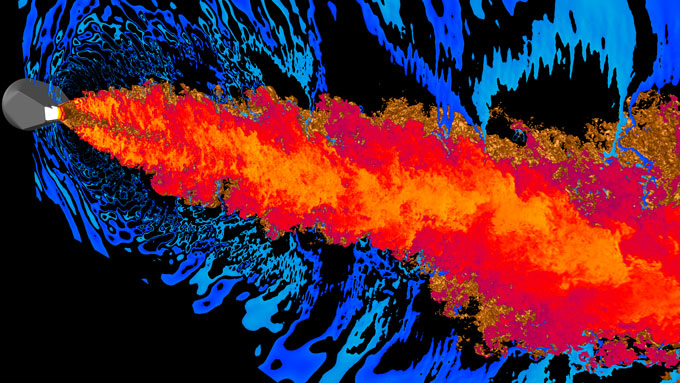
An image from the jet noise simulation. A new design for an engine nozzle is shown in gray at left. Exhaust tempertures are in red/orange. The sound field is blue/cyan. Chevrons along the nozzle rim enhance turbulent mixing to reduce noise. (Credit: Center for Turbulence Research, Stanford University)
The physics of noise
The exhausts of high-performance aircraft at takeoff and landing are among the most powerful human-made sources of noise.
For ground crews, even for those wearing the most advanced hearing protection available, this creates an acoustically hazardous environment. To the communities surrounding airports, such noise is a major annoyance and a drag on property values.
Understandably, engineers are keen to design new and better aircraft engines that are quieter than their predecessors. New nozzle shapes, for instance, can reduce jet noise at its source, resulting in quieter aircraft.
Predictive simulations
Predictive simulations — advanced computer models — aid in such designs. These complex simulations allow scientists to peer inside and measure processes occurring within the harsh exhaust environment that is otherwise inaccessible to experimental equipment. The data gleaned from these simulations are driving computation-based scientific discovery as researchers uncover the physics of noise.
“Computational fluid dynamics (CFD) simulations, like the one Nichols solved, are incredibly complex. Only recently, with the advent of massive supercomputers boasting hundreds of thousands of computing cores, have engineers been able to model jet engines and the noise they produce with accuracy and speed,” said Parviz Moin, the Franklin M. and Caroline P. Johnson Professor in the School of Engineering and Director of CTR.
CFD simulations test all aspects of a supercomputer. The waves propagating throughout the simulation require a carefully orchestrated balance between computation, memory and communication. Supercomputers like Sequoia divvy up the complex math into smaller parts so they can be computed simultaneously. The more cores you have, the faster and more complex the calculations can be.
And yet, despite the additional computing horsepower, the difficulty of the calculations only becomes more challenging with more cores. At the one-million-core level, previously innocuous parts of the computer code can suddenly become bottlenecks.
“These runs represent at least an order-of-magnitude increase in computational power over the largest simulations performed at the Center for Turbulence Research previously,” said Nichols “The implications for predictive science are mind-boggling.”
The CFD code utilizes unstructured meshes to simulate turbulent flow in the presence of complicated geometry.
In addition to jet noise simulations, Stanford researchers in the Predictive Science Academic Alliance Program (PSAAP), sponsored by the Department of Energy, are using the code to investigate advanced-concept scramjet propulsion systems used in hypersonic flight (with video) — flight at many times the speed of sound — and to simulate the turbulent flow over an entire airplane wing.
Comments (15)
by Timothy
Jet engine noise is indeed a serious issue for workers who must be close by while they are running. I used to stand “fire watch” on a jet engine test stand. I wore ear plugs plus ear muffs (which I had stuffed with extra foam), and the noise was still unbelievable, almost intolerable. Most people have never been exposed to anything nearly that loud and continuous, so it’s hard to imagine. It hits like a physical force, like being pummeled. Any research to decrease that exposure is worthwhile. In addition, quiter machines tend to be more efficient–that noise is just lost energy.
by tim the realist
Sure, why not? Sim earth on steroids. Let me know when your code is ready and i’ll run it for you.
by Bri
I think they should use computers of this type to model economic activity. Even if it’s a simulation instead of an acurate reproduction of the world economy, we would be able to anticipate what the effects of say robotics would have on jobs and manufacturing. The simulations would take a lot of the guess work out of economic policy. In the same way that we use weather forecasts it would helped all the conjecture as to what might happen given a set of altered variables.
by GAUSS
Agreed. As of yet, nobody has any good/realistic/exhaustive models of how robotics will truly affect the economy.
by WLGJR
We at least know that there will certainly be alot of unemployment.
As for simulating the world economy in the 2030s and later, I don’t think that will produce very accurate models because by then individual computers will become very close (in capacity) to the Sequoia itself, through exponential growth, and unexpectable changes in such a society in which individuals having access to supercomputers (and even themselves cyborgized with supercomputers) will happen very rapidly.
We should keep in mind that unpredicability is a definition of “Singularity”.
by Dan
There won’t necessarily be a lot of unemployment. People have been saying for years that robots/robotics are taking away jobs, but creating, maintaining and innovating new technologies seems to be creating new jobs.
by Knot
@Dan
The potentially worrying scenario is when robotics/AI becomes sufficiently advanced that robots do a better job at anything, including maintaining robots, programming, and regulating. Currently their functionality is still so limited that the new, complex needs that are created by their own existence create new jobs for us. This will probably not always be the case.
I’m not too worried myself, though. If there is one thing humanity has shown to excel at, it’s adapting to new circumstances – if unemployment and ubiquitous technology are in our future, we’ll learn how to cope with it (though it may prove to be a somewhat bumpy ride).
by Tom
Agree with the first part, but not necessarily the second.
New job creation of the type discussed will continue only until machine intelligence surpasses human intelligence.
At that point
a) why would anyone (or any machine) employ humans to do a worse job than a better and/or cheaper machine could do
b) humans will not be smart enough to do most of the jobs anyway – this is already true of most humans wrt most current jobs by type, though not yet by number.
But, I am worried about human adaptability, as it will be much lower and slower than machine adaptability, unless we ourselves become the machines, i.e.integrate their advantages immediately those advantages appear. Otherwise, we will be left behind, and we all know what happens to species that don’t adapt or adapt more slowly than other species. Lets not delude ourselves that we’re not creating (one or more) new species here, albeit artificial.
by trakk
Sooner or later the things people keep saying for years….will eventually come true.
by Gabor
I don’t think politicians are particularly interested as they mainly rely on misinformation to sell their agenda. Maybe we should send a copy of Watson to Congress and the WH?!?
by WLGJR
With accurate, computer aided simulation, they can formulate better agenda and propaganda and betterly decieve people. Any politicians with enough intelligence should know this and take advantage of this technology.
But on the down side, just like how drugs that are claimed to be working because they are tested in simulation (simulated human body) but do not work well (and sometimes even have fatal results) on real human bodies, I think we need to be careful with computer simulations (better understanding of physics and implement them into supercomputers, more proofreading and bug ironing-out are required).
by melajara
I don’t think so as after Watson I the Jeopardist, Watson II, the physician, I’m envisionning Watson III, the lawyer/attorney/judge/constitutionalist and Watson IV THE POLITICIAN!
But for a chance for this agenda to actually happen, each Watson has to be (secretely) nurtured as politicians wouldn’t allow to be made obsolete in less than 10 years from now!
by godot
What makes you think they’re not? “They” just don’t have the same lofty goals you do. The Rothschilds were one of Cray’s biggest investors.
by WLGJR
Explain how is Bri’s goal lofty and how is Rothschilds’ goal not lofty?
by godot
Touché and mea culpa! You are absolutely correct, W1GJR; I cannot know the true intentions of anyone other than myself. Brevity is often the enemy of clarity, and I was trying to be brief via instantiation. From the entirety of his writings here, Bri appears to be an idealist with only the best of intentions for all mankind. But I did not intend to make a statement based on assumption, nor did I intend to cast aspersions on the good name of one of the most powerful families in the world. Please forgive me.
That said, with less brevity I will say that I have read news reports of a government grant, given to the EE department of a large midwestern university, to be used to construct a predictive model of the economy. And I know of a number of startups based on using computer modeling as a tool in trading financial instruments. Were I to guess that the intention of the founders was to make money, I would, again, only be speculating. But I can say with certainty that the utility function with which the developers evaluated the efficacy of their models was, in all cases, based on making a profit.
My observation is that the “scarcity model” seems to be a deeply-entrenched component of the human condition which is reinforced by our being the result of billions of years of evolution based on the competition for resources. From a mathematical standpoint, I do not believe that stochastic ‘selection of the fittest’ based on competition is the only mechanism which generates successful evolution. Said another way (with a nod to the great William Calvin), Calvin’s ‘Darwin machine’ may not be the only set of rules which will produce a progressively better fit to the environment. In an important way, this can be the difference between proactively designing a selection mechanism, or passively allowing the existing accidental one to continue driving evolution. (As Keith Henson of “Great Mambo Chicken and the Transhuman Condition” says, “Nature evolved the bird; man designed the 747.”) Unfortunately, competitive selection mechanisms are the only examples we have inherited on this planet, so it will require true visionaries to imagine a better way. (By this, I mean, in a Buddhist way, an evolutionary mechanism which generates as a side-effect greater aggregate joy and less aggregate pain.) Perhaps the foible of embodying competitive selection can be corrected as humans are uploaded into the post-synchronicity world.
Are we up to the challenge?