Building powered by algae growing on its facade
October 24, 2012
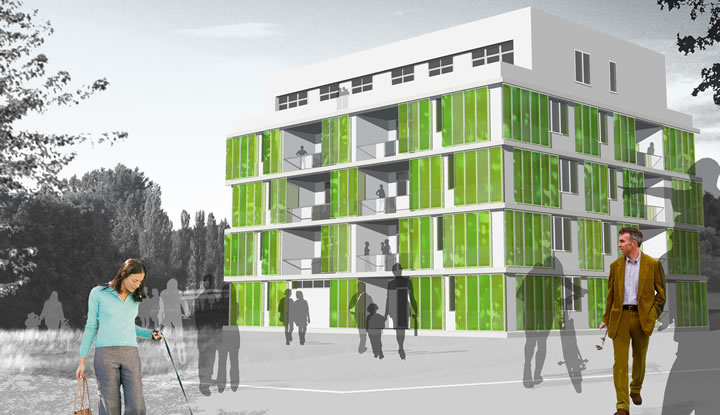
The very first building in the world with a shading system consisting of live micro-algae is being built in the suburb of Wilhemsburg in Hamburg. The “algae house” will be complete in 2013 and will comprise approximately 200 square meters of such elements. (Credit: Arup Germany GmbH)
The BIQ house in Germany features a “bio-adaptive façade” that uses microalgae to generate renewable energy and provide shade, PSFK reports.
Designed for the International Building Exhibition in Hamburg, the zero-energy house will be the first real-life test for the new façade system.
Algae in the bio-reactor façades grow faster in bright sunlight to provide more shade. The bio-reactors power the building by capturing solar thermal heat and producing biomass that can be harvested.
The BIQ house was designed by Splitterwerk Architects, in collaboration with Colt International, Arup, and SSC. Arup’s Europe Research Leader, Jan Wurm, said:
To use bio-chemical processes for adaptive shading is a really innovative and sustainable solution so it is great to see it being tested in a real-life scenario. As well as generating renewable energy and providing shade to keep the inside of the building cooler on sunny days, it also creates a visually interesting look that architects and building owners will like.
The building is due to be completed in March 2013, and it will allow scientists, engineers, and builders the opportunity to assess the full potential of the system as a green alternative.
Comments (8)
by Jean Dardenne
Many questions :
-What kind of algae ?
-What protection against predators : virus, amibs, zooplancton … ?
-Where do nutrients come from ? C, N, P, K …?
-Oxygen removal ?
Good courage and good luck !
by Engineer
Bioreactors produce part of their own heat, but I guess there may be periods which require suplementary heat. Sunlight speeds the process and allows the algae to grow and turn the nutrients into high yeilding biomass. Algae are then harvested and processed to produce liquid biofuel which will provide part of the building’s heating requirement. I’d be very keen to find out what proportion that actually will become! Go Arup!
by Ian
Sounds like the biomass has to be burned, perhaps as a vegetable oil?
by Kevin Haskell
Mold is such a lovely look on buildings. :)
by James Guilford
Bio-reactor: just a fancy word for a living plant. So what happens in the winter when the plant freezes? …and how do you harvest the “biomass,” and how often, and how much energy does that take, and how much energy does it take to turn that biomass into energy? Sounds like a lot of hype to me, but I’m willing for it to be real.
by Cam
Are they suggesting the building would get 100 percent of its energy from the bio-facades?
by Gorden Russell
This is the future we read about as kids back in the ’50s.
“The bio-reactors power the building by capturing solar thermal heat and producing biomass that can be harvested.”
Bio-reactors! Don’t you just love that word? That’s like something Heinlein would have written back in the day.
by Bri
Here comes the ghost busters again. “He slimed me”.