Can cloud computing boost GDP?
November 15, 2012
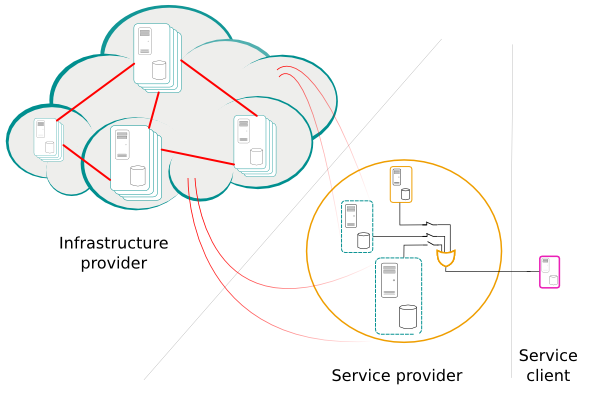
Cloud computing (credit: Davide Lamanna/Wikimedia Commons)
Gross domestic product (GDP) can be boosted by cloud computing, the system in which remote computers on the Internet are used to store, manage and process data rather than the users’ local machines, according to a report to be published in the International Journal of Technology, Policy and Management.
The report suggests that governments should collaborate to boost the adoption of cloud computing internationally.
Marco Iansiti of Harvard Business School and Gregory Richards of Cambridge-based Keystone Strategy, LLC, have found that cloud computing is likely to extend economic growth by increasing the efficiency of information technology in developed economies and could foster growth in those economies where IT penetration is not yet fully mature.
Additional 0.83% of GDP growth every year
They point out that during the coming decade, cloud computing will give individuals and enterprises access to a vast processing power at a low cost that has not been possible before. The team has now developed a model to link IT capital investment to economic growth and applied their model to 45 countries.
Researchers project that U.S. IT capital stock will increase from $2.3 trillion in 2010 to $3.76 trillion in 2020, 64% growth. If the impact of IT on GDP remains the same as in the recent years, that growth will translate into additional 0.83% of GDP growth every year. As a benchmark, Federal Reserve Board puts yearly GDP growth between 2.5 to 2.8% for the period. This implies that the productivity growth enabled by cloud computing will contribute almost one third of total US GDP growth in the coming decade.
For developing countries, researchers expect even larger gains, because in these countries the adoption of IT there is less mature: the factor share of IT capital in these countries is only 3%, as opposed to 11.7% in the developed one.
“Our findings should have bearing on policy discussions as governments across the world (including both the U.S. and the EU) consider and implement policies concerning the regulation of cloud computing. These regulations and decisions span a vast array of issues that, as we demonstrated, can have enormous impact on a country’s ability to grow and remain competitive,” the team concludes.
Cloud security questions
However, a study by researchers at computer security company RSA has shown that it is possible for software hosted by a cloud-computing provider to steal secrets from software hosted on the same cloud, MIT Technology Review reports. In their experiment, they ran malicious software on hardware designed to mimic the equipment used by cloud companies such as Amazon. They were able to steal an encryption key used to secure e-mails from the software belonging to another user.
“The attack demonstrated is so complex that it is unlikely to be a danger to customers of any cloud platform today, says RSA, but the experiment answers a longstanding question about whether such attacks are even possible. The proof suggests that some very valuable data should not be entrusted to the cloud at all, says Ari Juels, chief scientist at RSA and director of the company’s research labs. “
Comments (12)
by Gorden Russell
Right you are, Khannea. Have you noticed that even while unemployment has hovered around 8% for a long time, industry has been posting record profits due to a more efficient work force. That means that new tech allows fewer people to do more work.
I heard the Republican National Committee talking on the radio earlier this morning. They were bemoaning that one reason they lost the election is that they can’t reach the 18-to29-year-old voters. But then the speaker had to crack, “These people are all living in their parent’s basements and they think that’s fine.” Then he went on to rant that this was socialism.
No. It’s unemployment. These young people all want their own jobs so they can move out into their own apartments. It’s automation and robotization that are keeping them out of work, not “their own puny will.”
(I quote Poe, because unemployment is a horror story when you are living it.) (The quote is from “The Tomb of Ligeia.”) (Living in your parent’s basement can feel like you are entombed alive, as in “The House of Usher.”)
by ErikSMeyer
It’s “The Cask of Amontillado” you’re thinking of here, not the “House of Usher.”
Real unemployment, if you take into account people who have involuntarily dropped out of the workforce (not to mention the vast number who are underemployed [employed in positions far below the level of their presumed competence/education]) is more like 18%, and has been since 2008.
It is not technology that is causing this (automation/decrease in costs of communication, per se) it is:
1. Globalization of the labor supply through “free trade” based labor arbitrage to places like China and Malaysia (outsourcing)
2. Mass immigration (insourcing); a million visas are given out a year, for many reasons, among them the desire to flood the labor market across all specializations to suppress wages/benefits/destroy job security
This has all led to a massive transfer from labor to capital, perpetrated since these policies really started having effect (the early 1970s; real median per capita income has been stagnant since that time).
There is a lot of money to be made by shills for capital rationalizing these policies, so any criticism of them is inevitably met by vituperation from that corner (and its unwitting dupes).
As for this particular study, its a good example of the fallacy of precision (additional cloud computing based GDP growth will average .83%… .83, not .85 or .81… what nonsense; it is simply impossible to estimate such things with any precision at all, because estimates are dependent upon too many assumptions, the contributing factors are too complex/unknowable, magnitude/presence of various effects are also unknown, etc.)
This sounds like propaganda for the cloud computing enthusiasts/happy talk about technology. To be honest, it’s probably just techno-enthusiasm produced by academics who need to publish in this area to advance their careers (which is to say, the biases are probably more inherent in the nature of writing on the subject than the direct product of discernible industry influence [unlike immigration/trade policy], which would certainly be more interesting to discuss than the bourgeois careerism of a bunch of professors).
by Joe D. Bradshaw
I can’t agree with all you say, but I’d like to pass on that it’s well written. You would probably be very good with discussion/debate. Any sites you belong to that further expound on your ideology?
by Gorden Russell
Thank you, ErikSMeyer, you have made a great number of very important points.
by asiwel
Just a quick point, mass immigration (insourcing, as you say), can’t increase the percentage of unemployment … if those new people are coming for jobs and are in fact employed. It can increase the total number of possible workers and even the number of unemployed workers (up to the point of balancing out), but it can not increase the percentage of unemployed people which is equal to 1.0 – (#employed)/(#total).
by GAUSS
Our economic models have not evolved in step with technology. In order to really get maximum (universal) benefit from technology, financial models and economic policy has to keep pace or even stay one step ahead of technology. We have a great opportunity to lead the way in progress both in technology and policies surrounding it, but unfortunately many of our deeper models are nothing short of archaic.
I’ll keep saying what I’ve been saying all along: money will not have the same meaning as we change into a technologically-driven society (something which we already are in many ways). New monetary systems are desperately needed.
by Gorden Russell
Here! Here! GAUSS! You are perfectly right. Economic models really haven’t evolved along with technology. That’s why I keep hammering at the idea of levying Unemployment Insurance and Social Security taxes on robots when they throw a worker out on the street. This idea has got to become a meme.
I mentioned this at Space.com when discussing how quickly robots will spread when they can operate 3-D printers that produce more printers and robots. One commenter accused me of being a “Luddist” (he meant Luddite) and another laughed at me, stating that he had studied Cloward and Piven.
I hadn’t heard of these two, so searched them out and found:
Cloward–Piven strategy
From Wikipedia, the free encyclopedia
The Cloward–Piven strategy is a political strategy outlined in 1966 by American sociologists and political activists Richard Cloward (1926–2001) and Frances Fox Piven (b. 1932) that called for overloading the U.S. public welfare system in order to precipitate a crisis that would lead to a replacement of the welfare system with a national system of “a guaranteed annual income and thus an end to poverty”.
There is a lot more to that entry and it is worth reading.
Unemployment driven by automation and robotization will in time bring about the crisis foretold by Cloward and Piven.
by de Broglie
Gordon, what would happen if a factory line were made more efficient simply by adjusting timing and ergonomic designs. That is to say all gains in productivity are attributable to work process flow etc. and not by machines and equipment. Would you consider the new work process flow a new machine. In some ways the organization of work is a machine. In practice it seems that discerning between jobs lost due to equipment efficiency and lost jobs due to organizational change is quite hard and in some ways impossible. Secondly, your scheme would be easier if FICA was tied into a national consumption tax. If it was tied into a corporate tax, the corporations would move official headquarters off shore.
by Gorden Russell
Also, GAUSS, you hit the nail on the head in saying that money will have to change. Sometime near the Sing we will have those self-assembling photovoltaic carbon nanocells that will grow things just the way that plants do, by taking carbon dioxide out of the air. Then the only valuable property will be intellectual property and the real estate needed to set up a large enough solar array to grow everything you need.
But not all designs for growing consumer goods will be open-sourced. Big name designers will still want to be paid for their designs, even if you grow that fancy Gucci purse or Armani suit at home. Sure, when billions of people can buy them, the price will be driven down to that of a bar of soap. But some money will still have to come from somewhere.
But this will lead to a great flowering of creativity as millions of people start making their own designs with their household CAD/CAMs.
by GAUSS
Thanks for the references and info, Gorden.
by Khannea Suntzu
Oh yes the mean GDP will go up, sadly income of the 99% will probably go sharply down. That seems to be a recurrent pattern with accelerating technologies.
by gaoptimize
When I hear things like this, it makes me wonder if the people that do these studies are really using computers for serious applications that either access or generate a large amount of data. The latency for anything off the local machine, or at least the LAN (<<1ms, ping your colleague's machine or server) is a smal fraction of the typical Internet latency (~20ms to ~100ms). In truth, the cloud is good for file storage and low intensity, small data applications.
I'd like to know who paid for this study ( http://searchcloudcomputing.techtarget.com/photostory/2240149038/Top-10-cloud-providers-of-2012/1/ ).