Chemical brain preservation: how to live ‘forever’ — a personal view
September 16, 2012 by John Smart
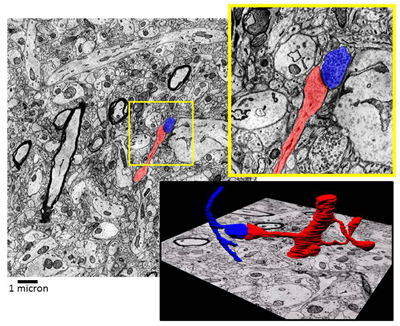
Neuroscientists today can preserve small volumes (<1mm³) of animal brain tissue immediately after death with incredible precision — the features and structure of every synapse within these volumes is well-protected down to the nanometer scale, using an inexpensive, room-temperature process of chemical fixation and plastic embedding, or “plastination.” This image is an example of plastination and local circuit tracing, occurring in leading neuroscience labs around the world today. (Credit: Brain Preservation Foundation)
Here’s my 45 minute talk on Chemical Brain Preservation at World Future Society 2012. Given the progress we’ve seen in the relevant science and technologies it’s a topic I’m presently very optimistic about. I had a great audience with lots of questions at the end, but in the interest of brevity I’m just uploading the talk. Let me know your thoughts in the comments, thanks!
A number of neuroscientists, working today with simple model organisms, are investigating the hypothesis that chemical brain preservation may inexpensively preserve the organism’s memories and mental states after death. Chemically preserved brains can be stored at room temperature in cemeteries, contract storage, even private homes.
Our 501c3 nonprofit organization, the Brain Preservation Foundation, is offering a $100,000 prize to the first scientific team to demonstrate that the entire synaptic connectivity (“connectome”) of mammalian brains can be perfectly preserved using either chemical preservation or more expensive cryopreservation techniques.
Such preserved brains may be “read” in the future, analogous to the way a computer hard drive is read today, so that either memories or the complete identities of the preserved individuals can be restored or “uploaded” in computer form.
Chemical preservation techniques are already being used to scan and upload the connectomes of very small animal brains (C. elegans and OpenWorm, zebrafish, soon flies). Though these scans are not yet sufficiently complex to extract memories from the uploaded organisms, give them a little more time, we’re very close now to cracking long-term memory. We just need to know a bit more about this process at the protein/receptor/gene level: http://en.wikipedia.org/wiki/Long-term_potentiation
Amazingly, if information technologies continue to improve at historical rates, a person whose brain is chemically preserved in 2020 might have their memories read or even fully return to the world in a computer form not centuries but just a few decades from now, while their children and loved ones are still alive. Given progress in electron microscopy and connectomics research to date, we can even forsee how this may be done as a fully automated and inexpensive process.
Today, only 1% of people in developed societies are interested in living beyond their biological death (see When I’m 164, David Ewing Duncan, 2012). With chemical brain preservation, this 1% may soon have a validated, low-cost method that will allow them to do just that. Once it becomes a real option, and recovery of simple memories has been demonstrated in model organisms, this 1% may grow larger as well.
I am particularly excited by chemical brain preservation’s ability to improve the social contract: what benefits we may reasonably expect from the universe and society when we choose to live a good and moral life. I believe that having the option of chemical brain preservation at death, if the science is validated, may help all our societies become significantly more science-, future-, progress-, preservation-, sustainability-, truth and justice-, and community-oriented in coming years.
Would you choose chemical brain preservation at death if it was widely available, validated, and inexpensive? If not, why not? Would you do it to donate your brain to science? Your memories to your children or others who might want them? Would you be willing to come back in person, if that turns out to be possible? If it is sufficiently inexpensive, would it be best to preserve your brain at death, and let future society decide if either your memories or your identity are “worth” reanimating?
Please let me know what you think in the comments, thank you.
Comments (78)
by Bruce Zimov
I strongly support the effort. Here are some ramblings that put the whole thing in a universal context. Temporal Becoming sometimes throws a wrench in theory. Einstein expressed this in his conversation with Carnap. It is true that an ideal abstract physics can obtain in mathematical terms parameterized by t, even with a branching future, and quantum probabilities. What is amazing about QM is that it is a sufficient condition for structure, the Periodic table. Anyways, consciousness on an arbitrary substrate would also have a t parameterized math description, but that ideal instance is not concious. That is a category mistake because t is not equal to temporal becoming. With temporal becoming, the instances take on reality, even if presentist in Bourne’s sense. It appears that Parfit is correct. So, is the philosophy of math Platonist? See defense of structuralism. If not, our conventions are not the whole story. They are at least a reflection of the truth. “Our math” vs true math, if a minimal set of universals are admitted. Sensibility is challenged, if even by only the square root of -1. The square root of -1 is important physically. Basically, it represents periodicity paradoxically. Two operations conflict. One may wonder how often that happens, and make a branch of math out of it. We think we are seeing randomness, but in QM it is obviously pseudo-random. That is what the Bell violations are. Sentience in robots will lead to a robot that thinks it is saved, even if no one else does. If brains were plasticized, even before nanometer standards are met, eventually the future society would either reanimate us, eat us, or worse. If reanimated, we may be integrated in a hive, or not. We may relive our lives, good and bad, depending on the life. But plastinization is being held to too high a standard, discounts future technology, and 55 million dead brains from normal people stack up on the dead pile with that amount of aborted babies. BTW, nothing says you have to throw away the fetus, you can plasticize its brain.
by Rodrigo Nunes Cal
Hello!I am brazilian person who elaborated an interesting blog related with science and technology!! The blog has many important articles about it! I’d like that you access it and inform the link to other people, like professors and students! Many people around the world have accessed it!! Furthermore, I’d like to congratulate you for your excellent work!! The link of my work experience is http://buscatextual.cnpq.br/buscatextual/visualizacv.do?id=K4240145A2 The link of my blog is http://rodrigoncal.wordpress.com My objectives are drafted in this link http://rodrigoncal.wordpress.com/objectives-objetivos/ Best Regards, Rodrigo Nunes Cal
by John M. Smart
Lively comments guys! I’ve written a followup post, Preserving the Self for Later Emulation: What Brain Features Do We Need? that you may enjoy. It speaks to issues regarding electrical vs. chemical features of the brain raised above by some.
http://eversmarterworld.wordpress.com/2012/09/24/preserving-the-self-for-later-emulation-what-brain-features-do-we-need/
With regard to those who are concerned about duplications of self, and whether uploads truly are “you”, you can find a post at our Brain Preservation Foundation that addresses that (and other objections around brain preservation’s value)
http://www.brainpreservation.org/content/overcoming-objections
As Giulio says above, our body is copying us all the time. That’s what protein turnover is, if you get technical about it. But does it so incrementally that we don’t notice it. In my opinion the more we learn about life and information, the more amazing the universe seems, and the more our options seem to grow. It’s a great time to be a transhumanist, I think. Cheers, JS
by donjoe
A summary of possible objections and my replies:
1. It’s just a copy, it’s not me.
A: You’re already just an imperfect copy of who you were yesterday.
1.1. But I have continuity of perception.
A: No you don’t, you slept and thus became unconscious last night, yet your brain kept changing. Furthermore, even while awake you’re only ever really aware of a fraction of all the changes happening in your brain and thus in your personality.
2. What about the electrical signals? Aren’t they an essential part of the personality, one that would be lost?
A: They may very well be. This is the most serious problem I’ve seen raised here and I don’t have an answer.
3. The body is important too, you can’t just copy the brain.
A: It has its role, but it can’t be at the same level of importance as the brain. Yes, it influences your thoughts and behaviour, but you can adapt to a different body without turning into someone else – we’re already doing it everytime we play RPGs: we learn to see ourselves as having completely different bodies and capabilities yet we don’t feel like our identities are being destroyed. So I don’t think the body-change thing is such a big problem. Even if you can claim that role-playing an avatar that’s very different from your current body DOES change your personality, frankly I’d rather continue my life as a personality-changing RL RPG than have to disappear completely.
4. What if more copies are made?
4.1. Which one is “really you”?
A: They’re all you, but their new lives will be “what your life would have been had you been under the same environmental influences that make you now say that copy X is distinct from the others”. They’re multiple versions of you. You can think of them as a selection of the multiple branching yous of the Many-Worlds Interpretation brought together in the same universe.
4.2. What if more copies are made without my consent due to hacking / data theft etc.?
A: This is a real ethical problem which I think deserves more attention. There’s a real risk of this kind of technology turning human personalities into a commodity, destroying identities (e.g. some other incarnation is set free to run around and successfully pretend it’s you => you lose all your identity-based rights etc.).
by S0ulman
thank you for your very interesting reply, much appreciated.
by S0ulman
Another question: Can we as an individual really be reduced to our brain? I think there is more to it – what makes us “us” are our brains AND our body. I think today’s AI research widely accepted that it requires an embodiment and that the embodiment actually has a great influence on how such (very early AI attempts) express and experience. My point is – a preserved brain coming alive in a different body or in a virtual body may be not a very satisfying or even nice experience…. What do you think on this?
by S0ulman
I would love to do it.To be able to live significantly longer respectively become alive again would be fantastic. However I have a general question: Looking at the latest press releases from the BlueBrain project my understanding was that surprisingly the way the synapses connect and the way neurons form are only partly “intentionally” but to a great deal conincidently. Could it be that what constitutes us as an individual is to a much lesser extent of what we assumed in the spacial arrangement of the neurons/connections, but rather in the actual wave of signals carried by approx. 100 bill neurons multiplied with approx. 2000 dendrit -connections? If so then this would imho imply that once you are dead (the wave carried by the hardware “brain” halts respectively ceases to exist as the wave will be completely flat/inactive) a lot of information would actually be lost forever. Or to give a different view of the question – how solid is our knowledge that our memory, our personality etc. is in the spacial arrangement of nerve cells and its dendrites? Obviously english is not my mother tongue and I hope I nevertheless could make myself understandable with my question. T
by Chuck
I’ve always said that if given the opportunity, I would want to live forever. Death scares me, not just because of the pain involved, but because I don’t want to miss the amazing things to come. Anyone who says they aren’t afraid to die is either lying or believes in a greater afterlife (I don’t). There is still so much I want to do and learn and see. I want to see the distant future. So yes, I would preserve my brain, if possible.
by John
“Today, only 1% of people in developed societies are interested in living beyond their biological death”
That’s what sin does to unbelievers. The desire to die. Because they are miserable, depressed little creatures. Sin is the opposite of life, it’s death.
The Lord shall do them a favor by wiping them out, they wouldn’t enjoy the purity of heaven. Right now, they are walking dead, like zombies.
by joedbradshaw
Yes, we atheists are all terrified of the invisible man in the sky. There’s really no difference between your God and the Sun God, Moon God, Voodoo… Superstition brought about by ignorance. It surprises me someone like you would read a “scientific” site, after all, the earth is only 6,000 years old, right?
by Editor
“really no difference between your God and the Sun God…”: bit difference — the Sun god was more credible because it was based on observations of a physical entity and repeatable, falsifiable measurements (time of day, insolation level, skin darkening, etc.).
by B. DiPaolo
Could you PLEASE leave your superstitious mumbo-jumbo nonsense off of a site devoted to science?
by davidgibbs
I like the AI in the new Destined for Oblivion, the people in the book can enter that computer and remain in it for ages to learn and advance they knowledge and train physically. Then they can get out, immortal, thanks to Nanites. It’s a great book written by an Alcor member. I think the idea of Nanites to stop aging is likely the only way.
by Sophy Laughing
I would do it in a heartbeat…or rather, lack thereof. Whether or not there’s an essence that remains independent of the original biological configuration is unknown. If not, oh well, the alternative is death. This is a metaphysical question for many as many people of the world today believe they will go to “Heaven” when they die and would not want to extend their biological or otherwise mechanism. Some people lose interest in living after having lived long lives to the point of exhaustion, mental and physical. I see why they might not choose to go for it. The ethical questions surrounding who gets to decide if you’re “reanimated” is a bit bothersome. I’d like to think I could sign a document, have a serum embedded in my brain or jar (in case that document gets lost or there is a change of protocol) that simply states: REANIMATE ME, FIRST! :D
by philippe chambon
Brain preservation is necessary today in order to achieve immortality by uploading the mind in a computer in the future . So, we expect that, as transhumanists say,our entire consciousness and personal identity will be preserved forever by these methods. As Kurzweil say, we hope that” the singularity is near” us.
by Bri
I don’t argue against the science or motivations. It can also be used to access lost loved ones, in terms of replicating their past experiences. I think it would be feasible to induce spirit transfer into a outside substrate. If I make an exact copy of myself, atom for atom, I don’t think I would be in both, or say multiple copies. This leads me to believe that a future copy won’t contain my present sense of I. Maybe further in the future that I that I experience might be also reserectable. This is still fairly far of in the future. There is much that we don’t know. I encourage all research on the subject.
by Vin
I think its more about a knowledge based system in the early iteration of preservation rather than an atomic-level clone, like if I wanted to ask an ancestor something after they had died or have their counsel or point of view on something.
by egore
What happens if someone learns how to recreate a Hitler intelligence and recreates in to the most advanced Mechanisms? Does that mean we would have to live under the thumb of such a manifestation?
by gaoptimize
He’d be just one of many sociopaths/psycopaths we have today, moving up the banking and political ladder. He likely wouldn’t get that far competing with the likes of Dimon, Bernanke, Paulson, etc.
by Smita
The issue is, can consciousness be uploaded? Perhaps our memories can, but can Me be uploaded to think and react to new situations as “I” would?
by tim the realist
what if we had these processes called food and waste and metabolism and we slowly repalced every molecule in your body over some period of time. Would it still be you?
by Gabriel
Well, the question is subjective, but I would readily say yes….I speak only for myself, but I see myself as more then the sum of all parts. Those molecules may be important, but they certainly don’t define me and I probably wouldn’t even notice them missing once I start replacing them, even more so other people.
by srgg6701
I suppose you would if a structure of “you” would be saved. It doesn’t matter what you made of, the only thing defines who you are is relation between all sides of your personality. That is your experience and some algorithms ruling your mind and your way of thinking.
by alex ivanov
Let’s pick into the future 20 years from now. A person is terminally ill and dying in a hospital. Doctors have done everything to save him but nothing worked. Death is inevitable. Then a scientist comes and says you can preserve this patient and revive him later when the medicine advances and finds a cure for his disease. If you don’t do that then you will be accountable for his death and go to jail. What do you think doctors will do?
by alex ivanov
We will be together forever. Death is not an option.
by Gabriel
Only 1% are interested in living forever?….I’m not even sure what to say about that.
I mean, yes, their are a whole list of questions to ask even if immortality became a practical option, but in principle, this should be a number vastly higher then 1%.
Maybe it’s just because I have a certain viewpoint on these things, but something about that just seems too hard to believe….1%? Just one? How is that even possible?
by Bob
I believe this is the biggest chance to live beyond physical death for people who are today already too old or fragile to benefit from age reversal therapies. (see the website http://www.fightaging.org)
It is amazing to read that 99% of everyone still don’t want their brains and personality to be preserved!
I think it has to do with wrong ideas about how life after “death” would be like. It will not be in de old fragile and ill state in which a person dies of aging, but it will be with a (virtua?)l body that can not even become ill.
If a persons mind can be stored and revived in about 2045, he or she will have the wonderful oppurrtunity to take advantage of expanding (with nanobots) all the limits of our brains, we will be infinitely more smarter, creative, etc.. Who would say “NO” to make this jump to an era with such perspectives??
by Michael McAnally
Sure I would do it! What have I got to lose initially? Religious issues aside it now becomes why will anyone choose to revive me? Once I am decanted digitally it becomes who pays the bills to keep me running in simulation? What will be the economics of that situation? Will I be a digital mind slave? Hopefully that will not occur, I would hate to be a second class citizen, the digital dead… I would then want a clone body grown with high speed wi-fi so I could continue expanding my mind in the cloud and interact with the physical world outside of VR. I would say it was doable with a straight foward path to imortality… The impact of this technology on our society would be far reaching and wide. I welcome it if the social as well as the technological problems can be solved.
by Gorden Russell
Don’t worry about it, Michael. Bye the time they can decant you, we won’t be using money the same way. When everything is grown by nanocells, only new designs will be worth money. After the singularity, the only property will be intellectual property and real estate. (You need a place to put up the solar array to grow your nanocells.) There will be a lot of open source designs out on the web, so if you are cash poor you can still get by as long as you have enough land to support your solar cells. With the desalinization made possible by the reverse osmosis of graphene, a lot of empty desert will be homesteaded. There is a lot of desert going to waste out there, so the government will be glad to put the homeless on it with nanocells enough to grow a home, a car, a food nano-assembler, and for you, a new cloned body. But we do have to start thinking about the social problems that arise from this. We really have to start putting our heads together now. The first problem that I see is that the one per cent won’t want to see the 99% living the abundant life without paying the big banks for it. But the companies that make the nanocells will be making a lot of money and money is power so these companies will be as unstoppable as Apple is today.
by Bruce Gavin Ward
i have for many year looked forward to the possibility of downLoading myself into a digital storage device; i don’t see this as being in any way miraculous, or problematic beyond the obviously huge technical steps that still need to be taken. Not being a big fan of biology, riddled with the inevitable flaws of design by evolution = negative testing, without intelligent input, i look forward to the time when the finest designers can create ‘apps’ to enlarge the future capacity of human/machine life. The main thing that bothers me about getting ‘old’, and eventually “not being here” (dying), is that i will not find out what happened, and i’m very nosey!
by Solomon Kleinsmith
Still don’t understand why anyone would care if you could make a copy of your memories and upload it to a computer. YOU would still be dead. An electronic replica of your thoughts doesn’t make you live forever, it just makes a replica of you.
by BeBee
I’m in; just for the fun of it!
by Rodavure
Hmm, could very easily be around when the reading tech comes out. At that point we would probably have the ability to read amd write brains without removing them. Can anyone say infinite armies?
by Gorden Russell
We will have infinite armies even before that. Have you seen the articles about making robots with 3D printers? DARPA has a lot invested into robotics as was seen here last week in the article about the Boston Dynamics pack mule. With a torso on that mule, it could be a stable gun platform. It will look like a robot centaur. Cool to imagine, but a terror to the Taliban when they are landed by Ospreys out in the desert outside the village.
by Bri
Nice to know unlimited death and destruction will still be around then. Do any of you guys work for Satan?
by Mr.X
Yes.
by Ben
I fail to see how the technical feasibility of brain preservation has anything to do with the social contract, and truth or justice. These are some fairly sloppy leaps. I’d include a link to a more comprehensive article on that topic. This tech could just as easily preserve tyrants and psychopaths as ghandis.
by Gorden Russell
Well, Ben, a psychopath is missing the part of the brain that we feel love, guilt, and empathy with. When you can restore a dead brain to life, you can grow back the missing part of the psychopath. The social contract we be sustained by people voting for congress members who will vote for medicare to pay for the brains to be restored and given bodies. This will be affordable when we have the nanocell economy.
by Bri
You open up a big can of worms with that one. From what causes psychopaths tohow you could rewire the life experiences to make them “normal”. A very famous case of multiple personality disorder, was of a senators daughter. Her vital signs would almost stop at night. It took years to find out that her father had been raping her every night, since she was very young.Some researches estimate that 70% of all multiples are created from sexual molestation, usually the father. It’s not uncommon that that molestation starts at age two. Remember he was a senator and so highly respected in the community. Often times the molester is also a multiple and has no conscious awareness of committing this heinous act. How do you go about changing a vast portion of what drives them to be who they are?
by Wade
I cannot picture what a stored memory would look like. For most of my long term memory stored in the wet chemistry of my brain, there are only foggy impressions of mood and happenings. We do not know enough to even define a memory, much less find and replicate it. There are no movies to be extracted.
by Giulio Prisco
@Wade: But someday we _will_ know enough. This is what brain preservation is all about: to store the safely, with minimal degradation, until we can read, decode, and re-instantiate the information encoded in it.
by Mr.X
Maybe they shouldn’t have destroyed the brains of people like Einstein and Krebs (only one who came to my mind, famous linguist/polyglott), and Stalin (?) with their rather crude techniques.
by Gorden Russell
There are researchers mapping the brain right now. In years to come there will be nanocells to crawl along every neuron in your head and restore the damage of sitting in a chemical bath. As long as the neurons can be preserved, as long as they don’t decay, they will one day be restored by nanotechnology.
by Karl-Mikael Syding
I want it. I want to live untill I’m 164 bn years old if possible
by Mr.X
A copy of me is not me. Perfect twins aren’t one either.
“If it is sufficiently inexpensive, would it be best to preserve your brain at death, and let future society decide if either your memories or your identity are “worth” reanimating?”
Hey, if one is going to pay for that they better reanimate without too much questions.
Maybe I’ll buy me some brains and make a memory-museum.Hell yeah!
by Giulio Prisco
@Mr.X: you are an imperfect copy of yesterday’s version of you, and a poor copy of last decade’s version of you. This doesn’t prevent you from feeling that you are the same person, does it?
by Mr.X
Re “This doesn’t prevent you from feeling that you are the same person, does it?”
No, because I have continuity of perception.If my brain is dead and the pattern of me will be restored, without anything else, just put into other matter, do I really feel anything? Or is another person out there acting just like me, thinking to be me,with all my memories, just starting his old new life, or better, his own part of said life?
I think yes, he is another person, maybe I’d call him son if I am still alive.Better not, people would think I failed as parent;)
If you copy the information that I am…while I am still living…Do you think I’d be just me 2 times, looking through 4 yes?I don’t.
It would for all practical purposes be me too(;)), as far as others are concerned.But if the original dies, will “my” perception be transferred (no reason to think that?) to the other body, or will it just be another person, accumulating his own experiences while being based on me?
I think the latter is the case, recreation based on my remains/remnants would be the creation of some strange sibling.
But I’d have to read up on the arguments already given in order to say something smarter than that.These things seem to be complicated to someone who is rather illiterate concerning scientific/philosophical matters of this kind.Maybe I am missing some fundamentals, which are obvious to you.
Ps: Poor copy? Last decades version of me was still learning, well, all that stuff that kids/adolescents learn^^
Hm, and considering the way I am today, I guess I am actually a good copy;)
Pps: Sometimes I read something or think hard, and my whole perception of things changes, to the point that everything else is effected.Somekind of epiphany, but without the claim to be right/truthfull.This includes my view of myself and my past.Of course, these things are well known and nothing mystical.
But depending on your definition of self, something of me just at that moment, giving birth to another entity.
by Bri
Mr X has said a point that I have stated before and I agree with his analysis. If you can make an absolutely perfect copy, what stops you from making many copies? Ray explored this in SN. Would the you that you experience be in all of them at the same time? Most likely not. There is no reason to believe that the reanimated you would contain the same soul.
by Some Agreement with Mr. X
I agree with Mr. X to some extent. There is a “you,” but only one point in time. At the next moment in time there is a different “you.” The different “you(s)” are most obvious, for example, when a comparison is made of the two-year-old “you” with the sixty-year-old “you.” If a comparison was made by way of looking at photographs of the two-year-old “you” with the sixty-year-old “you,” everyone would agree, including “you” at the moment of looking at the photographs, that the two-year-old “you” and the sixty-year-old “you” were different persons. When you narrow the time frames, such as comparing “you” of one day with another “you” of the next day, the differences are much harder to distinguish, but the “you(s)” are different. What makes the “you”(s) different at different times? It is the changes that take place in “you” from moment to moment, such as the changes in the atoms, molecules, cells, and the accumulated memories of “you” as time goes on. Thus, when a person dies of dementia or another pitiful condition, a photograph of the person taken at an earlier time from the time of death is usually shown to those attending the memorial service for those people to remember the earlier “you,” and not the older pitiful “you” at the moment of death. This talk about “uploading” “you” is nonsense as it is just another form of enticing people to believe in an “after life,” based on the fallacy that there is only one true “you” regardless of time. This time, the belief in an “after life” is being generated by science rather than by traditional religious beliefs. When you ask religious believers what “you” will be resurrected from the dead, for example, the “you” when you were twenty years old or the “you” at eighty years of age, most would choose the twenty-year-old “you.” But that twenty-year-old “you” would have no knowledge of his or her spouse, if he or she married after twenty years of age. At least, theoretically, God can choose the “you” to resurrect. The “you” that would be “uploaded” would simply be the “you” at the time of death. Perhaps, that is a “you” that no one would want uploaded, including the “you” that is reading this comment. (For simplicity, I am using “points in time” as discrete units rather than as a wave where the changes in “you” are taking place continuously and there is no “point in time.”)
by cosmowrench
Suppose scientists would invent an artificial neuron that is interchangable with real neurones. And you have all your neurones gradually (lets say, over a year timespan) replaced with artificial neurones. Would ‘you’ still be you after the process? And what if you have all your neurones replaced at once?
by Mr.X
@ Some agreement with Mr.x..
I really like your user name, even though it could have some improvement. Maybe next time you want to change some to total?
A paradox god can do anything, young body and old memories included.
But he can’t make a stone that’s too heavy for him to lift.
by Bri
If you examine the basic premises of most religions it’s says that everything is part of god. That it really is god everywhere. If that’s the case than we are that paradoxical god that can’t lift a stone that we made.
by Mr.X
I’d say we’d rather a part of it.Or would you say my thumb alone is me?
If the premise of sth is that I am a cow, that does not make it true.Anyway, since I swallowed my cal(f) (in paradoxical) that’s not very likely.
Suffice it to say.I don’t believe in any feel good god, since I see no necessity for it.
My mind is not that unshaven.Just in case that statement is unintelligible , I am refering to Ockham’s razor.
by Bri
@ some agreement with Mr. X. Let’s take your premise a step further. Let’s say for arguments sake that continuity of self is maintained when nonbiological parts are integrated. Everybody likes this idea for the most part, and I agree that that’s what will happen. Now in a fast forward mode, we let our imaginations run wild with possible changes we might make over the course of our enhanced lives. You can run your simulation for as long as you think you’d want to live for. At one thousand years out you’d be hard pressed to say that you are the same as the original infant. At one million, it would be hard to say that you even are an earthling. At one billion you might not even be in this multiverse. The next one is even harder to imagine. Let’s multiply it by infinity. This means that it would encompass even time before you were born, because infinity is limitless. Any attempts to put constraints on infinity causes it to be finite. We are souls or sparks of the infinite. What we view as being ourself is really more like a garment that is worn on the soul.
by jabros
I’ve thought of systematically replacing the biological cells with nano, mechanical, biotechnology, whatever is invented in the future that will do so, for keeping the brain and body alive indefinitely as the only way you would be certain to have immortality. Creating a clone and “downloading”, “installing” the copied consciousness would only create another sentient being, and it would not be you as the original you with what would be considered a soul. I just assumed other people had thought of this as well, and here you are talking about it.
by MrFriendly
Very good point, Giulio.
by Mr.X
Somehow I think you said that just because you dislike me;)
by Bri
Likes and dislikes can change. If I argue with you I might not like the part of you that I was arguing with. At another juncture in time, even total enemies can turn into the best of friends. This idea has been explored in countless stories. I think it’s important to be tolerant to thing we might hate, or people we might dislike. If the chance to find common ground is shut off, then alienation occurs and the chances of being good friends becomes more remote.
by Mr.X
@Bri.I was not talking about you.Whatever you said, I still like you;) (to the extent one can like soemone he practically does not really know).
I meant Mr. Friendly.He was too nice in other posts, you know.
Otherswise I agree with you: I do not identify persons with their opinion, by that I mean if I dislike (which I did not say) your statements that does not mean I dislike you.
by Bri
There may be memories that a person would not want read in the future. My mother worked with PTSD patients. Most of her work was in trying to retrieve those painful memories and reprocess them. You’d be surprised at the statistics of how many people repress painful experiences. I’m sure that a lot of veterans would rather no one saw what happened, or what they did. Reanimation is one thing, having others read your thoughts is another.
by jerry searcy
Perhaps details of the copy might be examined and repaired if needed by advanced A.I. Fellow humans could be left out of the “need-to-know” loop unless required in emergency. What is done if a murderer whose identity was unknown to his age is revived? Many challenges other than technology await us in this area of human endeavor.
by Gorden Russell
Well, Bri, I have been diagnosed with PTSD and yet I would not want all the bad memories erased. Terrible things will just happen all over again when you don’t have the experience to spot them coming. But if I could live again after the singularity, I would wait until wormholes are available for time travel and then send a stream of nanocells back to protect my younger self. A foglet of nanocells, anticipating the events that gave rise to these tormenting memories, would surround my unwitting younger self and move him in a safer direction, getting into his head and making him wise to the ways of evil people without suffering the pain that comes from these experiences.
by Bri
I can understand peoples desire to alter the past , but I don’t think that can ever happen, otherwise we all would be very different already from a multitude of alterations. It’s a idea explored many times. Take the Terminator story as an example. All the terminator would have to do is creat a nuetron bomb. Sarah and Kyle would die and that would be that. Same goes for an evil genius from the future. Many madmen don’t mind their own destruction, as long as they get their revenge. Some gray goo at the appropriate time in history and we wouldn’t be even slime.
by Mr.X
But that won’t make for a good movie.
I always fund it funny that the terminator throws people around instead of grabbing their head and let it go 360°, without people noticing the senselessnes of it.Ok, maybe not the full 360°.
by Bri
I agree. It actually is a premise for an even more interesting movie, of the logic is still suspended. Take the police station shoot up scene. If that had occured in reality it would have brought the whole government forces to bear on the terminator. He moves too slow to evade capture or destruction. He is more of an old horror movie frankenstein. Skynet would be very smart. I would expect a real terminator to be also. It would be very agile also. With these attributes and again, thesuspention of logic, you can generate a whole bunch of thrilling scenarios.
by Mr.X
Yeah.And they had to bring Mr.Olympia into scene.
I am sure a real world skynet would kick our collective *sses.
Since technology keeps advancing you’ll only need to be creative and maybe you’ll make succesfull entertainment yourself^^
Ps: A fast terminator makes sense, but would really be frightening to fight against.^^
by Bri
DARPA is working on it. The cheetah is such a platform. Later they will add arms and monkey like mobility.
by Mr.X
Now I feel relieved ;)
by Mr.X
I want to keep my bad memories.Especially the very bad ones.
As some figure in some fantasy novel said: One has to be realistic (about things).
by Jayce Cameron
Love can truly be forever. And in future wedding vows, “even death shall not part us” or “fore er shall we vanquish death from our domain. In the name of love”.
by Gorden Russell
Awww Jayce, you’re such a romantic. This is the kind of love that Poe dreamed of…in a kingdom by the sea.
by Giulio Prisco
@Jayce: Beautiful! This is the right attitude.
by Gorden Russell
Giulio, you must be from Rome. They say the Romans are lovers.
by Marcos Marin
ugh… God is dead and no wonder he made us mortal before killing himself.
by Mr.X
He did it himself? I read something by a guy who claimed to have killed god.
by Marcos Marin
Yep =) After having such long term delusions.
Nah, Germans tend to be so megalomaniac… but points for you for noticing ;-) I wouldn’t have made my sentence so ugly with such an obvious quote if I knew we had more such perspicacity around here, but then again it would’ve been seen as “unrelated issue” and blocked as a personal attack against religion. :-(
by Mr.X
We need more censorship, quick: Marcos claims I have megalomaniac tendencies!He also insulted most of my family *starts to cry*.
Where is Wôdan when he’s needed?
Just kidding.
I’d sneak these things in in larger posts, since one can not tell the intention of the poster—> Many people get off topic in their rants without noticing, often because of lacking education (yes I said, just because one leaves school does not mean he gains the skills he hadn’t magically in adulthood).
But we are good, we would not do that right!?
On topic: I think most of the older folks on here may not have enough money to use early forms of this or any other life extension technology.
by Gorden Russell
Say Jayce, around 2050 or so, do you want to get together and open up a wormhole to send a stream of nanocells back to scan Poe and bring back his essence? Of course we have to bring back his dead wife too. What kinds of things will he write when he awakes anew?