China is building a 100-petaflops supercomputer
November 1, 2012
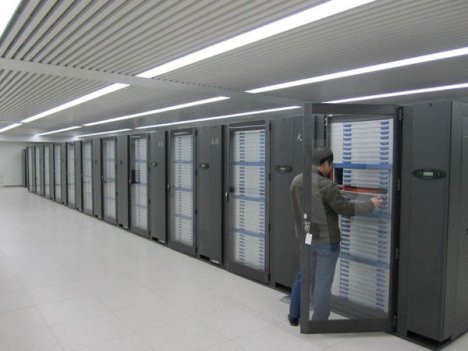
Tianhe 1A supercomputer (credit: National Supercomputer Center)
As the U.S. launched what’s expected to be the world’s fastest supercomputer at 20 petaflops (peak performance), China announced it is building a machine intended to be five times faster when it is deployed in 2015, IT World reports.
China’s Tianhe-2 supercomputer will run at 100 petaflops (quadrillion floating-point calculations per second) peak performance, designed by China’s National University of Defense Technology, according to the Guangzhou Supercomputing Center, where the machine will be housed.
Tianhe-2 could help keep China competitive with the future supercomputers of other countries, as industry experts estimate machines will start reaching 1,000-petaflops (1 exaflop) performance by 2018.
The government is aiming for China’s supercomputers to reach 100 petaflops in 2015, and then 1 exaflop (1,000 petaflops), in 2018, according to Zhang Yunquan, a professor at the Institute of Software Chinese Academy of Sciences, who also keeps track of China’s top supercomputers.
China briefly took the top spot on the world’s list of most powerful supercomputers in 2010 with the Tianhe-1A. That computer is now ranked fifth in the world, with a theoretical peak speed of 4.7 petaflops.
Note: Oak Ridge National Laboratory added confusion to supercomputer ratings by citing 20 petaflops for its Titan supercomputer in its Oct. 29 announcement. This is a peak value (Rpeak), whereas supercomputer ratings by Top 500 and the press have traditionally used the lower Rmax figure (the highest score measured using the LINPACK benchmark suite). To make matter worse, many press reports have failed to state which metric is being used. — Ed.
Comments (72)
by egore
By the way, does anyone know what LOL stands for? Love of life,hopefully?
by NakedApe
Laughing Out Loud, methinks.
by Marcos Marin
it means Lots of LOLs
by Marcos Marin
it can also mean Lots of LMAOs
by Marcos Marin
which of course is a short hand for ROFL
by egore
Is it possible all knowledge we know to be true now, will sooner or later be proven wrong?
by Graham Rounce
“will run at 100 petaflops (quadrillion floating-point calculations per second”
Hey Ed. Re your note about added confusion, for those of us who don’t know what a quadrillion is, maybe you could just give us the numbers in 10^n form? Thanks!
by D.Nollmeyer
The real problem is Consciousness or the ability to be totally aware. These machines would create a great deal of trouble if forced to choose between right and wrong or what is called having a conscience.
The AI sector or software coders to do not appear to be in an exponential manner.
The coding itself is such a hodgepodge of symbols it needs a breakthrough in language(s) that is stable and open source.
What are these supercomputers going to run on?
by Dr.Pratt
Yes, that IS a real problem. Because it, Consciousness, will not occur with a machine doing rapid calculations.
by Chris P. Kareem
What’s the difference between a silicon brain and a meat brain?
by Marcos Marin
Taste.
by Bri
One is kinda squishy.
by GAUSS
That’s the thing: we don’t know.
by Editor
“You don’t even know what you don’t know.” — Observer (Fringe)
by Mr.X
@ “Dr.” Pratt: So, what do you thing your brain is?
by Mr.X
*think :)Maybe my brain miscalculated (again);)
by Marcia Lucas
I thought 100-petaflops was something only achievable by Mitt Romney.
by Chris
Zing!
by Dr.Pratt
Your in the wrong set of threads dummy.
by Bennie Beaver
When I read reports like this, I want to know, what is America and the west doing to build an even faster and more useful computer? It seems I’m almost always left hanging with that question. It’s not answered in any useful context. Maybe someone believes that the competition between despotism and our democratic republic is no longer relevant.
What is America doing to keep ahead of a communist country like China, or is it true what Karl Marx warned that capitalism would sell the rope to hang itself? Maybe we’ve become so sanguine in our delusions that we’ve lowered our defenses. Where in history has that been a good idea?
I’ve always understood it to mean that the country having the fastest and most useful computer would lead the world in knowledge and power. Authors need to write competed articles explaining what we’re doing in response to a country like China building a bigger computer. I’m near 70 years old, so maybe I’m the one living in a parallel universe…but I don’t think so. I’ve got the history of the human race to back me up!
by GAUSS
“…is it true what Karl Marx warned that capitalism would sell the rope to hang itself?” It may well be.
“…we’ve lowered our defenses.” I wouldn’t say so. The US’s defense budget is the largest in the world, and proportionate to GDP it is extremely high. Armaments are being built by the thousands, and wars are being fought, but it’s with borrowed money. Much of the money we’ve borrowed is from China. This puts us in a sticky situation.
“I’ve always understood it to mean that the country having the fastest and most useful computer would lead the world in knowledge and power.” It completely depends on what you’re using that supercomputer for. In China’s case, I would tend to think they’ll be using it as a cyberweapon among other things. In the US, they tend to be used for seismic data, astronomy, cancer research, and nuclear physics. Genetics and pharmaceutical research are also common (the last article about Titan explains some of this).
The first country to create a massive AI with a supercomputer will definitely get an edge on their competition. Such a device can be used for strategy, economics, weapons prototyping, etc. The possibilities would be endless. This is where China may actually get an edge, because interestingly they dump a lot of money into AI research.
by fair
My dear Bennie, Why so be Sinophobia Chinese ‘s progress? Is that racism ? Think about the China her only 1/4 of agriculture land and largest population on earth need to be fed and has many problems need to be solved can beat the Great Anglosphere? the U.S/Australia/Great united Kingdom /NewZealand /Canada together occupy 1/3 of the continents and islands on earth , having huge resources and share sciences knowledge everyday and together have been united to fight all the wars for the interest of the Anglosphere! ( well, Against Nazi & Japan Empire which were good of course) ) The Chinese just can’t out -fox the Amglonations, the only thing they can do just for survival instead of challenging the Anlo empires on earth ! Most Chinese are worshiping the Anglonations .
by de Broglie
Of the top 500 supercomputers, the United States has 277, UK has 45, Germany has 27, France has 26, China has 21, Japan has 16, Canada has 9, Austria has 8, New Zealand, has 8, Russia has 8, and other countries has the 55 remaining supercomputers. China will have one at the top of the list but it is not quite blowing away the competition.
by Mr.X
@Bennie: If you think todays China is communist, then you are -frankely speaking- having idiot thoughts:)
Have a nice day.
Ps: Well, your last paragraph was strange, too.
by tim333
re “rough idea of just how many exaflops it takes to equal the processing power of 100 billion human neurons”
It depends if you are using the computer to process information efficiently (as in most practical AI ike Siri, Watson etc) or trying to simulate neurons in Blue Brain style which is approx 1000 times less efficient.
The numbers come out at about 0.1 petaflops in the first case and 10 petaflops in the second. These numbers are from Moravec for first case (http://www.transhumanist.com/volume1/moravec.htm) and Kurzweil for the second. Watson was about 80 TeraFLOPs = 0.08 petaflops.
So in terms of hardware we are getting around these levels now. Just need better software. Kurzweil’s new book looks promising on that front. And also for the hardware to get cheaper – Watson was made of 90 servers with 2880 cores so it’ll be a while before your iphone can do that.
by James
According to Ray Kurzweil the average human brain can do something like 16 trillion calculations per second which roughly equals 16 petaflops. So the IBM Blue Gene supercomputer was supposedly the first supercomputer to have the equivalent power of a human brain (it can do roughly 20 Petaflops).
by Gorden Russell
Thanks, James.
by Marcos Marin
But the question is a red herring because what matters is not what “the human brain can do” but how much “flops” would COST in silicon to “emulate what the human brain can do”. Unless you truly mean this when you ask, those are two very different questions.
by Gorden Russell
You’re right Marcos, so what is the answer?
by GAUSS
If you’ll forgive my piping in here: we need to understand the precise effects of neurotransmitters, and also the role(s) of brain wave synchronization. Any effects these have can be fairly easily modeled numerically, it’s just a matter of actually knowing what it is they do.
by snake0
Is the connectome a possible solution to this?
by Marcos Marin
I don’t think throwing in random terms at a problem ever seems to solve it…
by GAUSS
It doesn’t. Unless you’re using Fourier series. ;)
by Marcos Marin
I may concede that if you have a working quantum computer. hahaha ;-)
by GAUSS
It depends on how thorough your definition of a “connectome” is. If it’s simply the map of all connections, you’re missing several dimensions of complex interactions, like what I describe above. If it accounts for these interactions and accurately emulates them, then there stands a chance to approximate human-like cognition.
by Marcos Marin
You are, hereby, forgiven.
by Marcos Marin
I wish I knew, my friend, I wish I knew…
by Marcos Marin
Oh look! I’m closing 4 consecutive loops by answering to myself! RA!!
by Bri
Oh! I was wondering when you would chime in. Just couldn’t resist teasing you Marcos. Happy to have you here, putting in your two cents, or should I say, two sentence.
by Marcos Marin
Am I revealing some kind of pattern in my cents?
by Bri
I’m teasing you, like you tease Gordon and myself. Say whatever you want to say, just like Gordon and myself.
by Marcos Marin
You are again mistaken. I don’t tease you, nor Mr.Russel, willy-nilly.
I simply point out how idiotic your points are.
Quite different.
by Mr.X
If you only could do this for yourself:)
by Marcos Marin
Which shows how impossible it is:-) Not even you could do it!
by Bri
See now this is an example of how idiotic your points are. I’m teasing you not that you tease us. I know that you mean it but you don’t give any real debatable responses. I don’t bother arguing with you. I don’t bother arguing with Gordon if I disagree. Sometimes I point out my opinion, but he has his own. Putting a whole bunch of =) :- may seem smart to you. It may be programming language, but it’s not a good way of presenting you arguements. Most of the time I think your arguments are far off base, but sometimes I do agree with you. I won’t be obnoxious like you are and tell you not to post. You can say whatever you like. We are all entitled to our own opinions. If you disagree and want to post a response, go ahead. Nobody died and made either one of us God.
by Marcos Marin
“See now this is an example of how idiotic your points are.”
– No. Would you “booother” so much to explain? lol
btw, what point did I made when I spoke of “closing loops”??
No-one, NOT ONE. haha, the ONLY post of mine you replied in A LOOONG TIME.. sooo CONVENIENTLY! Why are you so afraid of even TRYING to argue? THAT’s why you “don’t bother” to, because you cant.
“I’m teasing you, like you tease Gordon and myself. ” + ” I’m teasing you not that you tease us. ” == DUMB!
” I know that you mean it but you don’t give any real debatable responses”
–That’s because My WORD is FINAL. Good thing you at least notice how magnanimous I am for sparing you the SHAME of “debating” with me.
” may seem smart to you. ”
– Quite the opposite. I do that for the simple benefit of YOU PUNY humans. Being one of the few hard coded patterns in your tiny brains, it serves as a escape valve for your brainless anxiety, which can’t stand being “proven wrong”(whatever that means inside your voluminous heads). Which is quite ironic if you could think about it.
“it’s not a good way of presenting you arguements. ”
– Why would you presume I would want to “present my arguEments[sic]” in a “good way” in a silver plate for idiots?! ohwait, that’s why…
” Most of the time I think your arguments are far off base, but sometimes I do agree with you. ”
– You should strive to invert those odds.
Maybe then you wouldn’t feel this all encompassing statement satisfactorily replaces the “bother of argument”… unconsciously of course, I wouldn’t expect you to get so sophisticated.
“I won’t be obnoxious like you are and tell you not to post. ”
– Are you implying I EVER said or WOULD EVER say that to anyone no matter how stupid you are?! OR it is this another instance when you come around and pretend you didn’t imply it, like the dumb equation above? It makes it even more obvious you don’t know what obnoxious even MEANS!!! How can you even judge me then? RA! Let the Sun God enlighten you: Yes, I am. MWAHAHAHAHA
“You can say whatever you like.”
– Oh thank you SO MUCH, Bri. You are so sweet for stop crying long enough for the Editor not to censor my posts! I know you don’t call it that, but a rose by any other name would smell just as “SHweeIT”, my so sweet friend. You denounce despotism but newspeak is so second nature to you! Mwahaha you will see what despotism is all about, my rosy friend.
“We are all entitled to our own opinions”
– I agree COMPLETELY. And I would say more! We are all entitled to be forever entitles to our own opinions of ever! However, THAT makes you an idiot. THIS is NOT an opinion! And this is NOT an offense, before you run crying.
“Nobody died and made either one of us God.”
– argument == Death, I let you Freudians out there work it out.
QED hahahahahahahahahhaha oh look ma! no smileys!!! It must mean it is well presented to you now.
by Mr.X
@Bri:. “Nobody died and made either one of us God.”
I didn’t die, but still I am God.Did you notice the similiarity to Dog?That’s how I found out!
Only god can understand godly jokes!
!
by Mr.X
I am on that part of the internet again!?
by Marcos Marin
When I said that to Mr.Russel it was only because it was exceedingly OBVIOUS he was going to come up AGAIN with his robots taxes BS. A simple pattern, simply because the article was ripe for it. Nothing more. But I was surprised that it took him so long, the thread was already full of posts.
by Marcos Marin
“Happy to have you here”
Who in their right mind would not be happy in My presence?! But remember your own words well (for a change) for the day approaches when I get finally tired of ‘waiting for approval’
by Mr.X
@Marcos: Such a speedy response (3 days)- you must be an AI!I guess you real name is Ramon.
by Marcos Marin
Timing is everything.;)
previous reply must time out before queue moves on.
by Marcos Marin
Ra-Mon;)
by GAUSS
Don’t take the Sun God’s name in vain.
by Marcos Marin
He doesn’t mind. (This one is not an idiot :))
by Mr.X
You speak about yourself in the third person?Let the Freudians work out this…
by Bri
AmunRe to that!
by GAUSS
*Snirk*
by Marcos Marin
lol.. try resisting your flea picking instincts…
by iterator
16 trillion operations is 16 TERAflops. 20 petaflops is 20,000 trillion floating point operations per second, your math is off by quite a bit. Additionally, see the note in the article about Rpeak and Rmax values, these are important when thinking about sustainable performance.
by Gorden Russell
Does anybody here have a rough idea of just how many exaflops it takes to equal the processing power of 100 billion human neurons?
by GAUSS
There is not yet any useful metric to be able to say that computer power will “equal” brain power. They work in very different ways, and until we understand the brain much better, we can’t say for sure. Estimates are likely to be weak since you cannot account for the processing that takes place in the molecular and electrochemical realm, which is arguably most of the brain’s processing ability.
by MrFriendly
Bingo.
by MrFriendly
If these silly estimates were anywhere near correct, we’d already have really advanced virtual fruit flies and honey bees flying around VR environments. You see neither, because each neuron is hugely complex, each with its own “intelligence.”
They’re finding more and more than even a single bacterium has a basic level of information processing capability, and even some organisms without neurons can solve mazes.
I just don’t think digital computers are up to the task of becoming as smart as complex creatures such as mammals and clever insects.
by Bri
The big difference is in the brains ability to reself organize. Neurons act like self directing computers. They are able to join up and reconfigure with whatever group of neurons they need to synch with. As we develope three dimensional computer chips, and parallel processing architecture, we will be able to emulate brain functioning. As computers are designed today, they aren’t flexible enough to achieve human capabilities and really can’t be related to brain function. The calculations per second comparisons are only rough estimates. As we learn more we will probably find that the brain is extremely efficient at processing information on a fragmented level. By this I mean that brain structures have evolved that take a problem and break it down into little pieces, that different groups of neurons tackle in parallel. This is very similiar to how GPUs handle graphic info. Different brain waves probably coordinate this, acting like conductors. We’ve all experienced when we’ve lost our train of thought. It’s hard to reinitiate the original thought. Massively parallel, reconfigurable computers are necessary to achieve this.
by Chris P. Kareem
That’s ridiculous. With a fast enough computer we will be able to match complex organisms. To say otherwise would be to say that meat-computers are somehow beyond information processing.
by chrisf
+1 to this. Today’s digital computers are capable of simulating any known physical system, given enough time and/or storage. Simulating a brain is purely a matter of getting the software right. No magical thinking required.
by GAUSS
I think it’ll eventually be doable, since any effect can be modelled numerically, but my point was merely that the metrics we’ve been using ignore a large portion of the model. It may turn out that those other variables have negligible importance in the final model, and that one can emulate the basic functions of the brain without them, but making these crazy projections is foolish when we simply don’t know. Too many tout the message of, “Behold, the almighty digital computer!”, when in truth we know very little of the actual differences in processing style. If they turn out to similar, great; if not, we have a lot more work to do. Either way, the point is that it’s much too early in the game to be making overly bold claims.
“Simulating a brain is purely a matter of getting the software right.” I mostly agree. Notice what I’m saying is that we can’t possibly get it right until we account for these other (extremely important) variables that are presently being ignored. The electrochemical components add many additional dimensions of computation, and we would do well to fully understand those before getting too ahead of ourselves. Once we know exactly what they do, and determine a numeric emulation of their effect on the overall system, then and only then can the software for brain emulation be right.
by chrisf
I fully agree with you Gauss (although personally I suspect that a lot of the complexity we see in physical brains will turn out not to be important for their information-processing abilities, but that’s pure speculation).
What I find silly is the notion that there’s something fundamentally different about the way brains work, which prevents them (theoretically) from being simulated on today’s digital computers. In principle, I reckon we could run a full human-level simulation on my desktop PC, if only we knew how to program it. Sure, it’d run 1000s of times slower than normal, but I believe it would have the exact same behaviour and experience as a “flesh and bones” human. No magical new hardware architecture needed.
by GAUSS
It may be that brains do work in a fundamentally different way, and if that is the case, I’m sure that at some point we’ll figure that out too. A quantum computer will help immensely with parallel problems, but let’s face it, those are a ways off. A lot of what I’ve been focusing on lately is how to get the most out of the systems we’re using now, taking a proactive approach to reducing the complexity of algorithms used in AI and machine learning.
by Bri
@ Chris and Christ: The brain coordinates many areas at the same time. That’s why I think parallel computing will solve the puzzle. It’s partly do to architecture and to programming. Although brute strength could achieve it, it’s more of a round about way to solve the problem.
by Chris P. Kareem
I’m sure GPUs would be up to the task, we just have to keep making them faster. Multi core CPUs would also help.