Complex circuits made of carbon nanotubes demonstrated
February 27, 2013
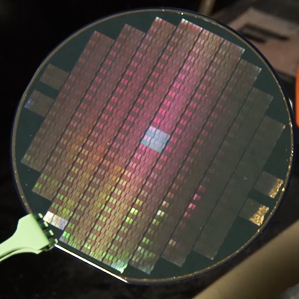
This wafer is patterned with a complex carbon nanotube circuit that serves as a sensor interface (credit: Stanford University)
A simple sensor circuit made of hard-to-handle but promising carbon nanotubes is a first step in making the materials practical for computing, MIT Technology Review reports.
Transistors made from these nanomaterials are faster and more energy efficient than silicon ones, and computer models predict that carbon nanotube processors could be ten times less power-hungry. But it’s proved difficult to turn individual transistors into complex working circuits.
Now researchers at Stanford University have demonstrated a way that this gap can be bridged, by building one of the most complex carbon nanotube circuits yet.
The demonstration carbon nanotube circuit shows that nanotube transistors can be made at high yields, says Subhasish Mitra, an associate professor of electrical engineering and computer science, who led the work with Philip Wong, a professor of electrical engineering at Stanford.
“This shows that carbon nanotube transistors can be integrated into logic circuits that perform at low voltage,” says Aaron Franklin, who is developing nanotube electronics at the IBM Watson Research Center.
Comments (4)
by Bri
I wish the article described the manufacturing techniques and the complexity of the circuit. Nano tubes come in many shapes and sizes. From short lengths to long. From fat to skinny. From single walled to multiple walled. If you put another material inside it changes it’s characteristics. The problem is controlling all these parameters and putting them where you want them. A nanotube is just a slice of graphene that has been rolled up. It’s just hard to do with our sticky fingers. Once the rolled up edges touch each other they join automatically. There was an article awhile ago on coaxing nanoscopic materials to bend and form more complex shapes. As I remember it used electrons but whatever the technique it should be applicable to graphene. The big trick is having the right sized pieces in the proper locations. The article on graphene supercapacitor manufacturing might present an elegant and inexpensive solution. Hydrophobic and hydrophilic substrates could be printed in any shape and configuration. Bringing the prospects of home printed micro electrical devices very close to a reality. It certainly isn’t too far away at this point. If that comes to pass, soon gordons visions of robots building robots will be a reality. Particularly if graphene and nano tubes can be printed interwoven into complex shapes. It almost looks absurdly easy when you think of the graphene manufacturing article today. Very exciting! Very possible! Very inexpensive!
by Editor
“manufacturing techniques and the complexity…”: good idea. Follow-up request sent to Stanford.
by Gorden Russell
Wow! You’ve all got to click onto Professors Mitra’s and Wong’s names and look at their biographies. These guys are real heavyweights.
Such low-voltage circuits will be of great value in putting computers into our heads.
by Jackus
We should reform the education system to produce more heavyweights.