Cracking open the scientific process
January 17, 2012 | Source: New York Times
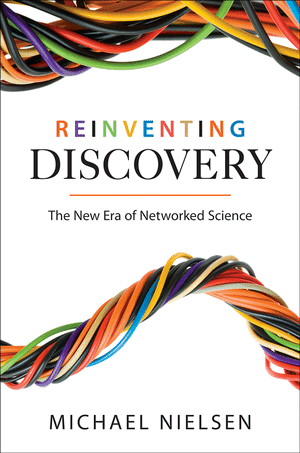
Peer review can take months, journal subscriptions can be prohibitively costly, and a handful of gatekeepers limit the flow of information. It is an ideal system for sharing knowledge, said the quantum physicist Michael Nielsen, Ph.D., only “if you’re stuck with 17th century technology.”
Dr. Nielsen, who left a successful science career to write Reinventing Discovery: The New Era of Networked Science, and other advocates for “open science” say science can accomplish much more, much faster, in an environment of friction-free collaboration over the Internet.
Open-access archives and journals like arXiv and the Public Library of Science (PLoS) have sprung up in recent years. And a social networking site called ResearchGate — where scientists can answer one another’s questions, share papers and find collaborators — is rapidly gaining popularity.
On Thursday, researchers will hold the sixth annual ScienceOnline conference.

Comments (5)
by Giulio Prisco
Technology can certainly help, but I think the problem is not the lack of adequate technologies, but the lack of an adequate spirit.
Like many other systems in our society, the science system is structured as a closes and inefficient system, wasteful by design, and mostly concerned with its own self-preservation. It s this system that, as this article says, must be cracked open.
I think the best we can do is to support arXiv, which will seen be even more open and interoperable with similar systems
http://news.library.cornell.edu/news/111025/arXiv_governance
by star0
@wsheridan
Well, there are “proof checkers” that one can use to check the correctness of mathematical proofs; and these have the potential to speed up the peer-review process in CS and mathematics. This still wouldn’t help with deciding whether the results were “interesting”, but it would greatly reduce the burden on the referee. Unfortunately, these proof checkers are, today, quite primitive, and it would take a lot of valuable time away from the author to “code” up his or her proof into logical formulas they require (proofs in CS and mathematics are usually written out in English sentences, with formulas). Perhaps better NLP and machine learning will one day solve this problem, allowing the author to write their results up using English sentences, though perhaps also requiring them to fill in all the little details that are often omitted in writeups though an application of the words “clearly”, “obviously”, “One can see that”, etc.
This wouldn’t work for physics, chemistry, or biology, however. I suppose they become more and more information sciences (e.g. software packages to simulate chemical reactions) it will be possible for a chemist, say, to just write what software package could be used to simulate some phenomenon they observed in the lab; and then the referee could plug the parameters into his or her copy of the software. Assuming the program indicates that the claim is likely to be correct, the referee would have good reason to believe the claims of the author — I can see this speeding up the process. But there still will be a need for a lot of human input in these fields.
by Giulio Prisco
I think the current system is badly broken: peer reviews takes month (at times years), which makes it useless for really important development. Those with important things to say publish on arXiv first and at times don’t even bother sending their papers elsewhere (a trend that should be encouraged in my opinion). Of course this is not the best way to make a career in science, but I think the publish-or-perish attitude is part of the problem, because it forces researchers to publish a lot of useless, third rate results, and hype them as fundamental discoveries.
by wsheridan
The peer review process is indeed time-consuming, so the idea of presenting findings in a more timely way is very appealing. So, in keeping with the previous comment, is there an effective and speedier way of preserving author attribution and still distributing electronically? Has anyone heard of any viable alternatives to peer review? AND, can a way be developed to address the need for veracity of posted materials? There is a tremendous amount of unreliable and unconfirmed information in electronic circulation these days, and we don’t want otherwise reliable and confirmed information to suffer “guilt by association with bogus claims.” Does anyone have suggestions on how to tackle this issue?
by star0
I participated in one of the polymath projects (and was a primary contributor). I can say with some confidence that it could greatly benefit the acceleration of computer science and mathematics. The only problems are, though, that our system is not presently set up to reward this kind of work and that there is a certain amount of pride that some people take in being the sole author of a work (i.e. symbolic immortality). If only we could change all this, I think it could greatly accelerate the pace of scientific innovation…