Dear science fiction writers: stop being so pessimistic!
March 21, 2012 | Source: Smithsonian Magazine
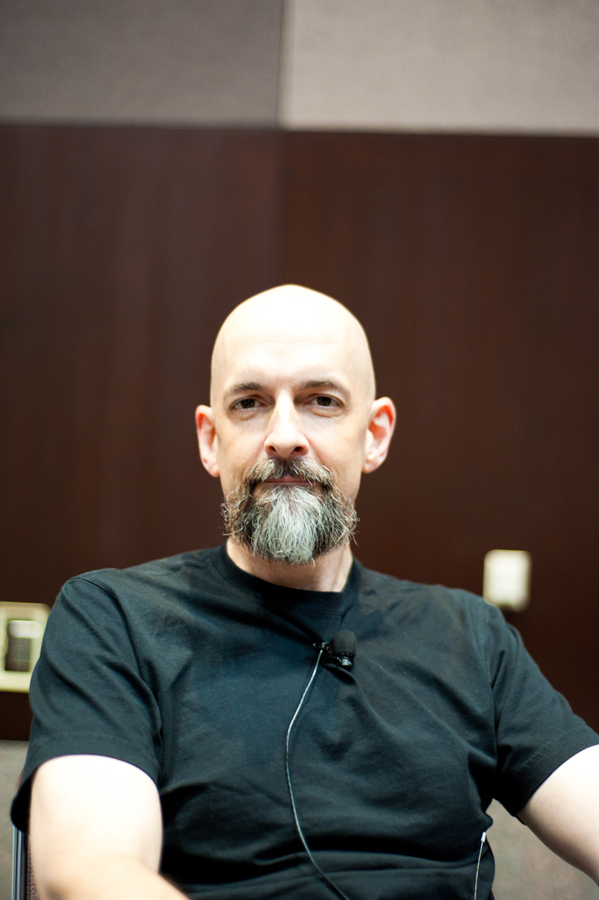
Stephenson has seen the future — and he doesn’t like it.
Today’s science fiction, he argues, is fixated on nihilism and apocalyptic scenarios — think recent films such as The Road and TV series like “The Walking Dead.” Gone are the hopeful visions prevalent in the mid-20th century.
So in Fall 2011, Stephenson launched the Hieroglyph project to rally writers to infuse science fiction with the kind of optimism that could inspire a new generation to, as he puts it, “get big stuff done.”
The Hieroglyph project’s first concrete achievement will be a sci-fi anthology from William Morrow in 2014, full of new stories about scientists tackling big projects, from building supertowers to colonizing the moon. He and his collaborators want to avoid pessimistic thinking and magical technologies like the “hyperspace” engines common in movies like Star Wars. And, he adds, they’re “trying to get away from the hackerly mentality of playing around with existing systems, versus trying to create new things.”
Stephenson’s greatest hope is that young engineers and scientists will absorb ideas from the stories and think, “If I start working on this right now, by the time I retire it might exist.”

Comments (13)
by Synova
If the goal is to inspire young people to do great and glorious things… it’s necessary to present *people* as being capable of great and glorious things.
And it’s really not more honest to insist that humanity is a plague or a cancer on the universe. It is, in fact, a willful belief sustainable only by refusing all other evidence. And really, are we still going on about overpopulation when negative fertility is becoming a crisis? Can’t inspire young people to dream of a future on one hand and explain how the future would be better without us in it on the other. Instead of viewing children as a resource and contributors, people to dream and create and accomplish what we haven’t even thought of yet, we insist on viewing them as consumers, takers, and expressions of selfishness on the part of their breeding parents.
Science is expanding in leaps and bounds. Only in my own lifetime did we realize how tectonic plates work, and now we’re discovering extra-terrestrial planets? How is that not mind blowing? And possible water on Mercury and the Moon and Mars? And we might get a Mammoth back. How cool is that? And ordinary people can manufacture intricate machine parts in nothing more than a hobby shop (though it’s not cheap) with computers and CNC machines and 3D printers, and build the future.
We figure that the days of “basement boys” are long behind us, but it could well be that they’ve just begun.
by Synova
“I think market forces are the biggest factor in why optimistic stories are rare now. I believe publishers buy pessimistic science fiction stories because they sell better than optimistic ones.”
What sells best?
This isn’t a matter of opinion. The data is available. I don’t have the data, but it is available. ;-)
Romance sells. Romance outsells all genres, as I understand it. Romance is optimistic, 100%. If the hero or heroine has been knocked around by life, if they live in a constrictive society, no matter what, it all works out, happily ever after.
In SF/F, fantasy sells and it is almost always optimistic… the good guys win, eventually. Paranormal sells (a lot) and that is also optimistic. The monsters get hunted, the protagonist is powerful, you get to imagine that you’re a cat or a vampire… lots of fun. Military science fiction sells pretty well, or at least I think it does. MilSF isn’t terribly nihilistic. Good guys, bad guys, lots of explosions, struggles and victory…
Mysteries get solved at the end. Thrillers, thrill and the bad guys are brought to justice, and maybe the hero gets the girl (or guy).
It’s true enough that in *science fiction* other than the sub-categories I listed, optimism seems rare.
But that doesn’t mean that pessimism *sells*.
by Grandonia
If you believe that human beings are potentially good I would also favor optimistic stories, but… as I know myself… boy, we are so disgusting mean, we love the worst things in the world and make them look good at the end ;) we mess up with everything and still think everything is fine… the pessimists are more honest in this sense. From the human race due to its powerful desire to be its own god, nothing good can be expected. Everything is fine till the moment when you loose your job, a war burst out, etc… then you really don´t care anymore about anyone, just yourself… this is the only thing you really workship. In times of peace we give the false impression that we love others by doing good things, in times of war there is no time to be false, there we are what we are.
by Spikosauropod
In the golden age of science fiction, ideas like time travel, space travel, miniaturization, travelling under the earth, going to the bottom of the ocean, and even exploring the jungles of the Amazon were fresh and exciting. Young men dreamed of battling dinosaurs and finding beautiful princesses awaiting rescue. My favorite example of this way of thinking is The Moon Maid by Edgar Rice Burroughs. For a simple model of this mindset, watch this film on Youtube:
http://www.youtube.com/watch?v=C4zbBEifkrU
After decades of Star Trek, Star Wars and Stargate, where all the possibilities (and impossibilities) have been plowed, replanted, and plowed again until the soil has lost all its nutrients, people simply do not have any more yearning for what science fiction has to offer. We are like wealthy heirs who have gotten fat from eating too much rich food and are now looking to alcohol and drugs.
That is what the new genres are. They are alcohol and drugs. They offer no nutrition and generally leave us with a hangover, but they momentarily relive our ennui.
by Ian
In what universe is The Walking Dead science fiction?
by Mac
The pessimissm seems to be a result of the fixation on the problems of the world around us, without the awareness of the fact that as individuals, the lives of people around the planet, with specific exceptions, have been steadily improving…….I strongly suspect there is a political element to the negative, as those who desire to empower government gain support for government by fixating on the ‘negative’ that needs to be ‘fixed’ by government…….a society that feels it is helpless as individuals is more prone to turn toward government solutions to problems.
by Dan Robinson
Many factors today, most of them related to population numbers, suggest the apocalypse will come before the singularity. But we can also remain hopeful about a renaissance. I’d like to see more stories about that. With everybody communicate electronically, and hopefully with more to say, wouldn’t one or two billion people, or communicating entities, be sufficient? Need we let nature decide that?
by Dizzle
We should be both pessi and opti. If pessi rules we stop. If opti rules we become carelees. You need a balance of both.
Read my .99cent ebook. It’s 2048 and It Happened at Nextfest.
http://www.amazon.com/dp/B004RD9EEY/
by melajara
@Allan,
I’m seeing this as a matter of Zeitgeist. Pessimism is around as the problems escalate more swiftly as the solutions are coming. Overpopulation is actually on the horizon and barring the opening of new frontiers, chiefly space at large, it will be a major concern for the coming age. Add to this concomittant problems like Earth natural resources depletion, climat change and Eco wars (e.g. competition for water), public debt crisis, more mass unemployement, bioterrorism threats, rational thought regression through religious radicalization (e.g. Djihadists versus Born Again), gray goo dystopias and indeed the future looks gloomy.
In that context, really enthralling prospects like transhumanist achievements look rather selfish. Who needs immortals (or emmortals as would say Stableford) in such a crowded and mad world?
We need to open new frontiers and space is the obvious solution but there is no global political foresight for it. In that context, I’m truly desperate at the complete stalling we are witnessing for space exploration or exploitation, given the rapid progress made in the sixties. The chief problem is a complete lack of progress in propulsion technologies for the last 50 years. The cost to channel a 1kg payload to the moon is still between 50 to 100k USD. This limit has to be lifted!
Now, as computing and neurosciences are still moving forward quickly, there will be a choice to be made for humanity to grow outwards and going for space, as exemplified by the 1930-1970 golden age of SF or to grow inwards by looking for soothing refuges in more and more sophisticated virtual worlds as exemplified by later SF predating the catastrophists. It seems that we are heading to this second choice as there are theoretically no technological barrier for continuous improvement and the market is already pushing hard for some decades here, e.g. through the gaming industry.
On the other hand, the multitude of telluric planets discovered are very good news but they are unreachable with current THEORETICAL science lest say current engineering. If only physicists from the establishment would be more open minded and press for funding of science on the fringe, the landscape could move on.
It’s such a pity and telling that such an interesting book ( see http://www.amazon.com/Unconventional-Flying-Objects-Scientific-Analysis/dp/1571740279/ref=wl_it_dp_o_pdT11?ie=UTF8&coliid=I386T31N01MCDU&colid=LGRPHCVTAISA) as Paul Hill’s utmost honest attempt at reverse engineering the possible modus operandi of well documented UFO cases had to be published after the complete retirement of its author from NASA.
Sometimes I’m inclined to believe the conspirationists who keep saying that aliens have induced the governments from Earth and the people in charge to stay away from space, space being reserved for truly sapient beings and no plagues like current humanity.
by Lance WInslow
Okay so, let me start by saying I am a fan of Stephenson’s project. It seems to me this challenge is much like Jerry Springer’s quote; “don’t blame me, it’s entertainment, I am just giving people what they want.” In other words the Sci Fi writers are delivering what the “public” wants, and they create scenarios, mostly scary, cataclysmic events, then they attempt to solve the crisis, after 1/2 the worlds population is taken out, yes, not good, but people pay for those types of things.
We do need to change that tact, but maybe we need to put forth really compelling Sci Fi stories and start the trend change, we need to get the public okay with the positive future genre too, and then perhaps we can move it forward. The human psyche seems to like conflict in their stories, but they also like the underdog winning, if we mellow out the conflict and increase the underdog triumph, perhaps it’s fixable. We’d only need a few really great stories like that to really put as dent in this “real” problem Stephenson points out, still, if people don’t watch those movies, or read those futuristic Sci Fi multimedia eBooks, then all that creative genius will be lost and the talent wasted. I’m with Stephenson, I agree, but as an entrepreneur, I am also a free-market realist, not that I appreciate Jerry Springer’s reality, it’s just that we have to also be cognizant of that hurdle ahead of us with regards to the viewer, reader, and Sci Fi enthusiast.
by Michael Ulis
I partially disagree with Allan. There is definitely a segment of viewers who are basically horror movie freaks who go for nitwit scenarios such as presented in the movie Event Horizon. There is also a huge following for the Star Trek series which shows a future where humanity has solved most of its problems and is immensely powerful and has a burning desire to explore the cosmos.
by Robert Kull
I agree that it would be great to see more optimistic science fiction and that this would be useful to inspire the younger generation to be more imaginative in the development of technology. Scientific progress requires nose-to-the-grindstone type work as well as imaginative breakthroughs. The creative thinkers in the technology industry are using their creative forces to create new technologies and breakthroughs in their field, rather than write fiction. The majority of creative fiction writers simply do not understand things like cutting edge quantum physics well enough to write good science fiction about it. As cutting edge science becomes more complicated it becomes more and more difficult for the average writer to produce relevant, forward thinking, and optimistic science fiction. If the writers are not working or educated in the field, it is very difficult for them to learn enough to write creatively about it. This being the case, well written, creative, and relevant science fiction stories becomes harder to write every year. On the flipside, reliable and easy to understand cutting edge scientific information becomes easier to acquire through the internet every day. The ease of access to this information is relatively new. You might just see a breakthrough in the production of optimistic science fiction in the near future!
by Allan
I think market forces are the biggest factor in why optimistic stories are rare now. I believe publishers buy pessimistic science fiction stories because they sell better than optimistic ones. Fear sells better than fun. Just look at front-page news for plenty of examples. At one time, science fiction was a niche market. Now it’s more broadly accepted, but in order to tap the broader market it has to appeal to the masses. The masses, on average, tend towards pessimism, and so creative works targeted at them need to be pessimistic to sell. There is a market for optimism, but it is only a niche market, just as intelligent stories are also only a niche market. A writer can try to inject some optimism and intelligence into a story, but they risk alienating the masses and thus not sell as well. To support my point, consider the qualities found in a successful summer blockbuster movie. I may watch and enjoy one, but I don’t expect to be intellectually satisfied. Blockbusters tend to be action-filled. Action tends to stem from a need to overcome a disaster. The presence of a disaster tends to imply a pessimistic quality.