Deep Computing Solutions
June 28, 2012
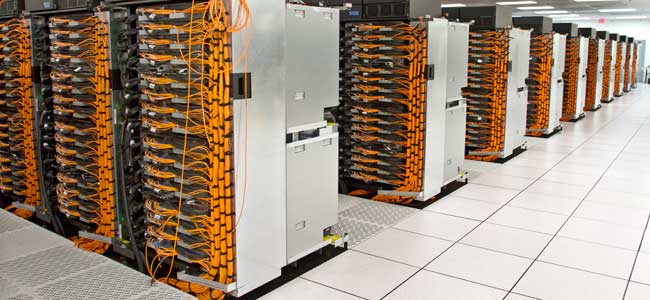
The Sequoia supercomputer (credit: Bob Hirschfeld/LLNL)
Researchers at IBM and Lawrence Livermore National Laboratory (LLNL) have announced an HPC collaboration called Deep Computing Solutions to take place within LLNL’s High Performance Computing Innovation Center (HPCIC).
The HPCIC was created to help American industry harness the power of supercomputing to better compete in the global marketplace. Deep Computing Solutions will add IBM’s computational science expertise to LLNL’s own, for the benefit of Deep Computing Solution’s clients.
LLNL’s HPCIC aims to become the nation’s premier provider of advanced computing solutions to understand and manage complex systems that underlie 21st century technology. Working within the HPCIC, Deep Computing Solutions will deploy the complementary strengths of IBM and LLNL to develop and implement industrial strength solutions that can help address its clients’ enterprise-critical problems.
Computer and domain science experts from IBM Research and LLNL will work together with a broad range of American industry collaborators to devise HPC solutions that can help accelerate the development of new technologies, products and services. Areas of interest include, but are not limited to: applied energy; green energy, including renewable(s); biology; materials science; fabrication; manufacturing; data management; and informatics.
LLNL has procured a five-petaflop (quadrillion floating point operations per second) system to support HPCIC and Deep Computing Solutions efforts as well as unclassified National Nuclear Security Administration (NNSA) research programs, academic alliances and LLNL institutional science and technology efforts.
Called Vulcan, the new 24-rack IBM Blue Gene/Q system based on the POWER architecture will be delivered in Summer 2012. Vulcan is part of the contract that brought Sequoia, the 20-petaflop Blue Gene/Q machine recently ranked no. 1 on the TOP500 list of the world’s fastest supercomputers, to Livermore.
Comments (3)
by Bri
I’m sorry to say, that it’s a done deal. All that will be inside a robots head in a few years, with , rock , paper , hands, speed. No more Mc donalds workers, no more sanitation workers. Think of construction sites. Would you want to carry insurance for workers death, or a CHEAP machine , that doesn’t miss read the blue prints, or sever the gas lines, or not fasten something together right. We all can benefit from this. We all will. It’s inevitable. Not even billionaires will be able to compete with roboust A I . AI’s eyes are already fixed on finance. It’s still sleeping. Kinda grogy right now, but waking up. Like I said, Ramona has a soul. It’s an emergent property. The same is true of the life form that is munching on the globe. Now, because of the Internet, it has a nervous system. We as cells in this nervous system can communicate to the primary driving centers, and steer it’s course. Taxes is one proposition, but there is a more central position. Municipalities strive for it to fund their pensions. They spread the risk, by investing across the board, to minimize exposure. But the returns don’t reflect the true valuations. The top one percent owns most of it. When the ratio gets as bad as it is now, often revolutions start. When my father bought this house it cost twenty four thousand dollars. He made eight in a year. Three years straight pay could buy it . Everyone told him it was crazy to pay the mortgage and survive. But then there was just his income. Now in order to buy this house with three years income I’d have to make 150 thousand a year. Before the crash, 200 thousand. It’s the relativity of goods. That’s a fictitious number. Do you know how much a billion dollars is. If you spent a thousand dollars a day, since Jesus was around, you’d still have over three hundred years to go! The relativity of goods is set by people who rig it in there favor. What’s worse is that they can’t even begin to spend it, and our economy is a consumer economy. Once there are no more jobs left. In order to continue as a consumer economy, they are gonna have to give us money to spend. End of story. Period. It’s the singularity. Even manufacturing can be done at the final destination. Like I said even billionaires won’t be able to compete. How this settles out, I don’t know, but it won’t be pretty for a while. The fabric of society is ripping apart and people seem more interested in their pets.
by Bri
Another really important point is the net energy gain we can get from robotics. In the past it was the power of labor that made any indever. We have leveraged machines to increase productivity. That’s how we have been able to adapt. It was still only a leverage point. Now that’s changed, because they are starting to surpass us in all respects. We can’t compete. No matter how much we integrate, they will have the edge, because they are designed specifically to a task. Something that would take evolution eons to do. What tasks we weigh them to do will define our future.
by Gorden Russell
Did you see where the article said Vulcan will be used for fabrication and manufacturing? This computer will put a lot of people out of work when it starts running highly automated factories. Our legislators have to step in and make it pay the unemployment taxes of all the workers it replaces.