Delivering drugs via nanoparticles to target mitochondria
September 21, 2012
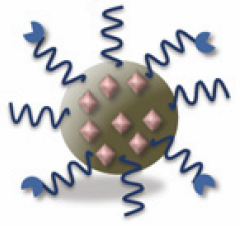
Targeted nanoparticle drug delivery system, created by blending PLGAb- PEG-OH and PLGA-COOH with PLGA-b-PEG-TPP, with mitochondria-acting therapeutics (pink) used as payloads (credit: S. Marrache et al./PNAS)
Researchers at the University of Georgia have refined the nanoparticle drug delivery process further by using nanoparticles to deliver drugs to a specific organelle within cells.
By targeting mitochondria, “the powerhouse of cells,” the researchers increased the effectiveness of mitochondria-acting therapeutics used to treat cancer, Alzheimer’s disease and obesity in studies conducted with cultured cells.
“The mitochondrion is a complex organelle that is very difficult to reach, but these nanoparticles are engineered so that they do the right job in the right place,” said senior author Shanta Dhar, an assistant professor of chemistry in the UGA Franklin College of Arts and Sciences.
Dhar and her co-author, doctoral student Sean Marrache, used a biodegradable, FDA-approved polymer to fabricate their nanoparticles and then used the particles to encapsulate and test drugs that treat a variety of conditions. Their results were published this week in early edition of the journal Proceedings of the National Academy of Sciences.
Targeting increased the effectiveness of the cancer drugs by more than 100 times
To test the effectiveness of their drug targeting system against cancer, they encapsulated the drug lonidamine, which works by inhibiting energy production in the mitochondria, and, separately, a form of the antioxidant vitamin E. They then treated cultured cancer cells and found that mitochondrial targeting increased the effectiveness of the drugs by more than 100 times when compared to the drugs alone and by five times when compared to the delivery of drugs with nanoparticles that target the outside of cells.
Similarly, the compound curcumin has shown promise in inhibiting formation of the amyloid plaques that are a hallmark of Alzheimer’s disease, but it quickly degrades in the presence of light and is broken down rapidly by the body. By encapsulating curcumin in the mitochondria-targeting nanoparticles, however, the researchers were able to restore the ability of brain cells in culture to survive despite the presence of a compound that encourages plaque formation. Nearly 100 percent of the cells treated with the mitochondria-targeting nanoparticles survived in the presence of the plaque-inducing compound, compared to 67 percent of cells treated with free curcumin and 70 percent of cells treated with nanoparticles that target the outside of cells.
Finally, the researchers encapsulated the obesity drug 2,4-DNP — which works by making energy production in the mitochondria less efficient — in their nanoparticles and found that it reduced the production of fat by cultured cells known as preadipocytes by 67 percent compared to cells treated with the drug alone and by 61 percent of cells treated with nanoparticles that target the outside of cells.
“A lot of diseases are associated with dysfunctional mitochondria, but many of the drugs that act on the mitochondria can’t get there,” Marrache said. “Rather than try to alter the drugs, which can reduce their effectiveness, we encapsulate them in these nanoparticles and precisely deliver them to the mitochondria.”
Bypassing the endosome
Dhar said that getting drugs to the mitochondria is no simple feat. Upon entering cells, nanoparticles enter a sorting center known as the endosome. The first thing Dhar and Marrache had to demonstrate was that the nanoparticles escape from the endosome and don’t end up in the cells’ disposal center, the lysosome.
The mitochondria itself is protected by two membranes separated by an interstitial space. The outer membrane only permits molecules of a certain size to pass through, while the inner membrane only permits molecules of a given range of charges to pass. The researchers constructed a library of nanoparticles and tested them until they identified the optimum size range — 64 to 80 nanometers, or approximately 1,000 times finer than the width of a human hair — and an optimum surface charge, plus 34 millivolts.
Dhar notes the components they used to create the nanoparticles are FDA approved and that their methods are highly reproducible and therefore have the potential to be translated into clinical settings. The researchers are currently testing their targeted delivery system in rodents and say that preliminary results are promising.
“Mitochondrial dysfunctions cause many disorders in humans,” Dhar said, ” so there are several potential applications for this delivery system.”
The research was supported by National Institutes of Health startup grant P30 GM 092378 and by the UGA Office of the Vice President for Research.