Did ants invent the Internet?
August 26, 2012
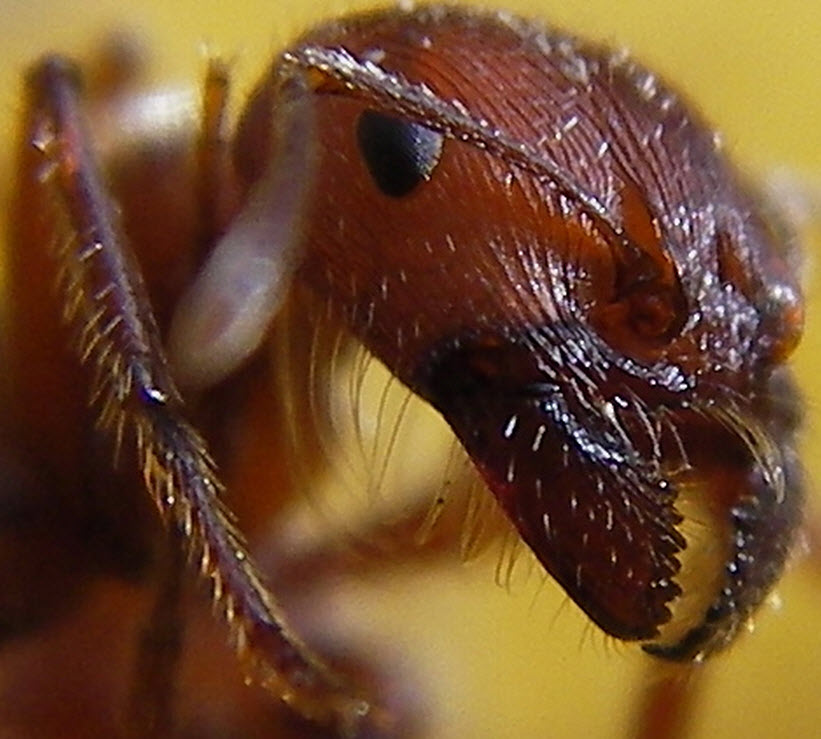
“If only we had used IPv6!” — Pogonomyrmex barbatus (credit: Steve Jurvetson)
Two Stanford researchers have discovered that harvester ants determine how many foragers to send out of the nest in much the same way that Internet protocols discover how much bandwidth is available for the transfer of data.
The researchers are calling it the “anternet.”
Deborah Gordon, a biology professor at Stanford, has been studying ants for more than 20 years.
When she figured out how the red harvester ant colonies (Pogonomyrmex barbatus) she had been observing in Arizona decided when to send out more ants to get food, she asked Balaji Prabhakar, a professor of computer science at Stanford and an expert on how files are transferred on a computer network.
At first he didn’t see any overlap between his and Gordon’s work. “The next day it occurred to me, ‘Oh wait, this is almost the same as how [Internet] protocols discover how much bandwidth is available for transferring a file!'” Prabhakar said. “The algorithm the ants were using to discover how much food there is available is essentially the same as that used in the Transmission Control Protocol.”
Transmission Control Protocol, or TCP, is an algorithm that manages data congestion on the Internet, and as such was integral in allowing the early web to scale up from a few dozen nodes to the billions in use today. Here’s how it works: As a source, A, transfers a file to a destination, B, the file is broken into numbered packets. When B receives each packet, it sends an acknowledgment (ack) to A, that the packet arrived.
This feedback loop allows TCP to run congestion avoidance: If acks return at a slower rate than the data was sent out, that indicates that there is little bandwidth available, and the source throttles data transmission down accordingly. If acks return quickly, the source boosts its transmission speed. The process determines how much bandwidth is available and throttles data transmission accordingly.
It turns out that red harvester ants behave nearly the same way when searching for food. Gordon has found that the rate at which harvester ants — which forage for seeds as individuals —- leave the nest to search for food corresponds to food availability.
A forager won’t return to the nest until it finds food. If seeds are plentiful, foragers return faster, and more ants leave the nest to forage. If, however, ants begin returning empty handed, the search is slowed, and perhaps called off.
An ant algorithm
Prabhakar wrote an ant algorithm to predict foraging behavior depending on the amount of food (i.e., bandwidth) available. Gordon’s experiments manipulate the rate of forager return. Working with Stanford student Katie Dektar, they found that the TCP-influenced algorithm almost exactly matched the ant behavior found in Gordon’s experiments.
“Ants have discovered an algorithm that we know well, and they’ve been doing it for millions of years,” Prabhakar said.
They also found that the ants followed two other phases of TCP. One phase is known as slow start, which describes how a source sends out a large wave of packets at the beginning of a transmission to gauge bandwidth; similarly, when the harvester ants begin foraging, they send out foragers to scope out food availability before scaling up or down the rate of outgoing foragers.
Another protocol, called time-out, occurs when a data transfer link breaks or is disrupted, and the source stops sending packets. Similarly, when foragers are prevented from returning to the nest for more than 20 minutes, no more foragers leave the nest.
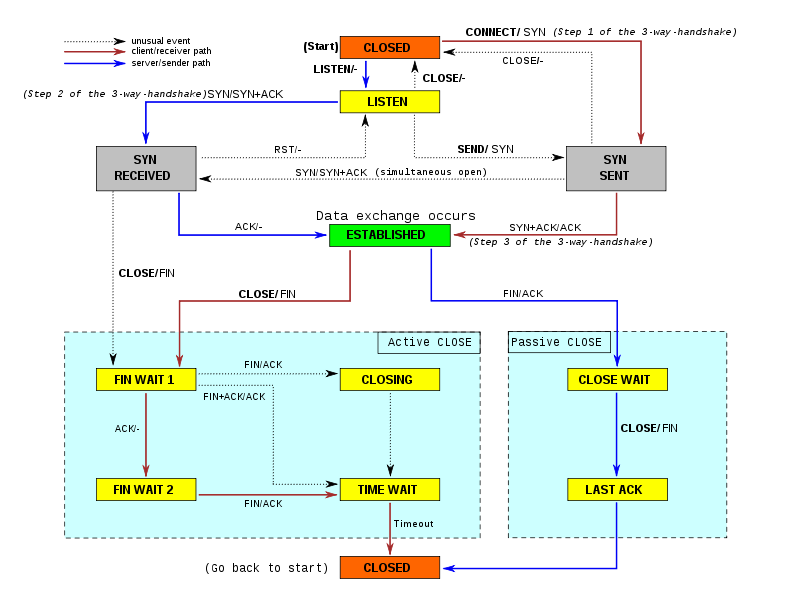
TCP state diagram (credit: Marty Pauley/Wikimedia Commons)
How ants can help network designers
Prabhakar said that had this discovery been made in the 1970s, before TCP was written, harvester ants very well could have influenced the design of the Internet.
There are 11,000 species of ants, living in every habitat and dealing with every type of ecological problem, Gordon said. “Ants have evolved ways of doing things that we haven’t thought up, but could apply in computer systems. Computationally speaking, each ant has limited capabilities, but the collective can perform complex tasks.
“So ant algorithms have to be simple, distributed and scalable — the very qualities that we need in large engineered distributed systems,” she said. “I think as we start understanding more about how species of ants regulate their behavior, we’ll find many more useful applications for network algorithms.”
“This is terrific work from Deborah Gordon,” author Howard Bloom, who was not involved in the research, told KurzweilAI. “I used another Internet metaphor in my just-published The God Problem, where I linked similar insects — bees — to search engines. “Bacterial colonies, civilizations, cultures, subcultures, and you and I act as search engines, too. And strange things like your depressions, elations, and insecurities are manifestations of your nature as a component in a massively parallel processing learning machine.”
The work was funded by NSF grant IOS-0718631 to D.M.G, and by a grant from the CleanSlate program at Stanford University to B.P. and D.M.G.
It is published in the Aug. 23 issue of the open-access PLoS Computational Biology.