Disruptions: on the fast track to routine 3D printing
February 19, 2013
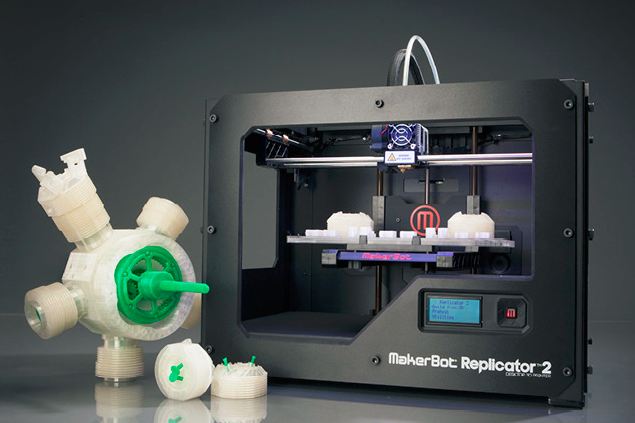
3D printer (credit: MakerBot)
Hod Lipson, an associate professor and the director of the Creative Machines Lab at Cornell, said “3D printing is worming its way into almost every industry, from entertainment, to food, to bio- and medical-applications,” The New York Times reports.
Dr. Lipson, the co-author of “Fabricated: The New World of 3D Printing,” said that the technology “is not going to simply replace existing manufacturing anytime soon.”
While it probably won’t create new jobs, he said he believed that it would give rise to new businesses. “The bigger opportunity in the U.S. is that it opens and creates new business models that are based on this idea of customization.”
The education system may want to speed things up. The time between predictions for 3D printers and the reality of what they can accomplish is compressing rapidly.
For example, in 2010, researchers at the University of Southern California said that another decade would pass before we could build a home using a 3D printer. Yet last week, Softkill Design, a London architecture collective, announced that it planned to make the first such home — which it will assemble in a single day — later this year.
The price of 3D printers has also dropped sharply over the last two years, with machines that once cost $20,000, now at $1,000 or less.
Comments (23)
by Ewout Meijer
Amsterdam is already printing a ‘Grachtenpand’ http://www.kamermaker.com/?lang=en
by steve
Technology is advancing to rapidly to create a distribution system from scratch. By the time you start building the system Quantum tech and nano particles will likely jump past this.
by Ralph Dratman
Returning to the idea of customization, which is certainly more immediate than bio-whatever, it has the potential to change our culture by weakening the grip of a Bauhaus-style utilitarianism — which, as a matter of practice, fronts for cheap, cruddy artifacts.
Buy something beautiful to serve a real-world purpose? Not in America, you don’t — at least, not in public. But that could change.
by DCWhatthe
I love that so many people still think reflexively “It’s not going to happen in our lifetimes”, about 3d printers and other apparent miracles. But it’s happening, right in front of us.
by Walter Baltzley
People have a hard time thinking EXPONENTIALLY…unless they are talking about doomsday scenarios, THEN they get it.
by Bob L.
This all sounds great but PLEASE if you make a reference to something interesting and related such as $1k 3D printers that used to cost $20k, tell us what your are thinking about and where to go to find them….. Thanks!
by Gabor
I think that the reference “$1k 3D printers that used to cost $20k, is based on the emergence of the desktop 3D printers as opposed to industrial big machines and not specific models that just got cheaper.
I am currently looking to buy a 3D printer (in the sub $1,000) market and most likely will delay for another year due to price and quality issues. Desktop 3D printers are still in their infancy (think of dot matrix 2D printers as opposed to laser printers that we are used to now). The above pictured is one of the best affordable desktop 3D printers but it will still set you back $2,000+ or about $3,000 if you want to print with ABS that is a stronger plastic than PLA. An interesting competitor that I found on Kickstarter is “robo3dprinter”, costs less than $1,000 but wont be available before August.
3D printing is a “disrupting” technology, we just need a little more patience for it to change from a novelty item to a useful and cost effective universal tool.
by Amit
Go to:
http://www.engadget.com/2013/01/29/3d-printer-guide/
Courtesy Edward Tomchin, Arizona
by Amit
My reply was meant for Bob, who wanted to know more about 3D printers currently in the market.
by Gorden Russell
Of course, that London architecture collective didn’t say that they were going to print it all out in a day, just assemble it. So, Bri, do you think that they will be using nanocellulose in their printers?
I’ll bet that collective will be using a very big crew of carpenters.
by Walter Baltzley
LOL…When you say “The Collective” I think about the BORG!
by Bri
Unfortunately Gordon they they will be using plastic. It’s another of those bizarre cocoon shaped things. It’s made to shap together. It’s another classic job destroying tech developments. The factory work could all be automated, it’s all delivered in vans, soon autonomous robots will assemble it on site. Right now it isn’t ready for prime time but in a little while they will make a superior product that will cost a fraction of a typical house today. Nanocellulose woukd be an ideal material but right now the feed stock is costly. Soon that should change. It has too many amazing properties. Always good to hear from you Gordon. Keep up the interesting posts, or to say in another way, keep your feet on the ground and your head in the stars!
by Walter Baltzley
It’s the Law of Accelerating Returns at work…Fabrication equipment is used to make…FABRICATION EQUIPMENT. Now that 3D Printers are cost effective enough to use for industrial fabrication, we will see them used more and more.
However, things will get MOST interesting when we connect 3D Printers to Micro-Reactor (or bio-reactor) Chemical Plants. This will give rise to the DIGITAL MATTER NET…a network of microscopic channels…for transporting nano-particles like the internet transports data. Then we will have a truly DIGITAL economy.
by Alfred Settino
Great comment Walter
by jlw3262
How will the particles be transported? In other words, how will they be pushed through whatever medium you are thinking of?
by Walter Baltzley
Very good question! Currently, I am investigating the possibility of using microscale magnetic “ferries” about the size of a human blood cell, and pushing it magnetically along a “coaxial” glass channel wrapped in a charged conductor sleeve. It works similarly to a mag-lev train.
Because the Digital Matter Net has not been INVENTED yet, the door is wide open. Maybe this is a problem YOU could solve. If you are interested, then join the REVOLUTION! Download the latest copy of the DMOSS (Digital Manufacturing Open Systems Standard) from my blog and get the word out.
Make it VIRAL friends! We are sitting
by Eric Anderson
How will this distributin system work? Use the sew infastructure to make the nano-Particles at the ‘new’ sewage plat and send the nano particles back in a tube inside the sewage system? Sounds good to me.
by Eric Anderson
Maybe Jacie Gleason was predicting our future with the SWAK line abou Sewer Workers Are Kings! Maybe just Kiss off this idea? But why not?
by Walter Baltzley
Sewers will be OBSOLETE in 20 years. We will use the abundant energy harvested from the sun, earth, air, and sea…with nuclear backup…to recycle 100% of our waste.
Using micro-reactors, this could be done ON SITE…that is to say in a TOILET or Septic Tank. The resulting nano-particles could then be transported over the Matter Net to wherever they are needed. Sewers would be a thing of the past.
by Walter Baltzley
You are thinking…that is GREAT. A Generic Micro-Reactor Plant could be used to break down sewage into its basic components…carbon, hydrogen, chlorine, etc…and turn it into nano-particles for use in 3D Printers.
We will have to build a network infrastructure…like the internet…to make the system work. Since we would no longer need the sewer tunnels, they would be an excellent place to run digital pipelines.
by Bri
Bioreactors and molecularfabricators are part of the 3D revolution. I don’t see how that would foster a centralized distribution system. The main trend Ray has spoken about. That is that we are moving toward a system of mainly information transfer. Most of the feed stock will be produced locally or be recycled at home.
by Walter Baltzley
The entire point of the Digital Matter Net is DE-centralization of distribution…it operates much like the internet. We would have a few large trunk lines with large bundles of “Vox-Cable” with mid-sized branches for large-scale distribution. However, I see the bulk of the matter network being comprised of small cables connecting individual devices.
Again, look at how the internet evolved…starting with large institutions connected with private lines, and then gradually expanding and opening up to more and more users. EXCEPT we already know about large-scale networks, and so we can build this thing out all at once and avoid many of the bottlenecks that slowed the development of the internet.
by Bri
It’s like a short in an electrical system. Also similar to how lightning seeks the path of least resistance. More and more energy will focus on this tech as this new pathway gets reinforced.