DNA and amino-acid precursor molecules discovered in interstellar space
March 2, 2013
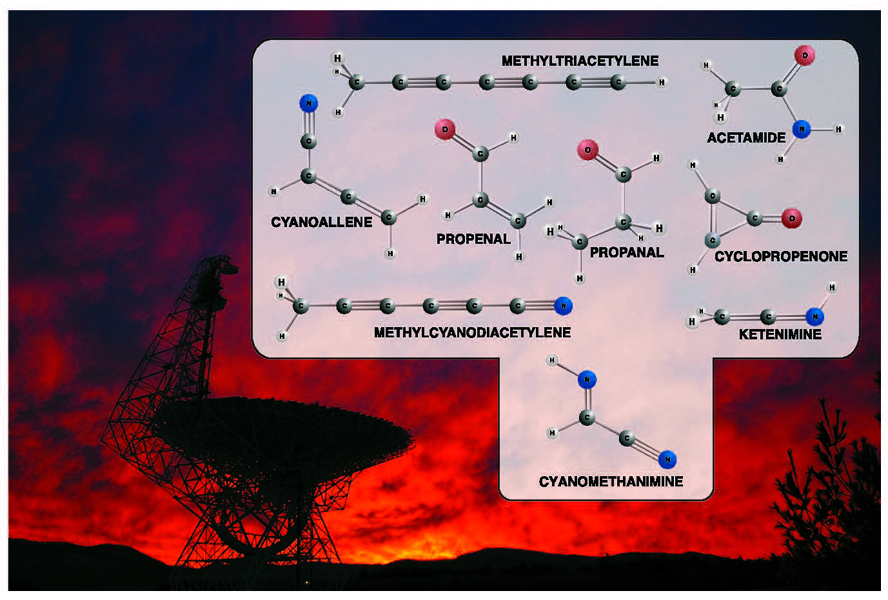
The Green Bank Telescope and some of the molecules it has discovered (credit: Bill Saxton, NRAO/AUI/NSF)
Researchers have discovered prebiotic (pre-life) molecules in interstellar space that may have formed on dusty ice grains floating between the stars.
The molecules were detected in a giant cloud of gas some 25,000 light-years from Earth, near the center of our Milky Way Galaxy — specifically, the star-forming region Sagittarius(Sgr) B2(N), which is the richest interstellar chemical environment currently known.
One of the newly-discovered molecules, called E-cyanomethanimine (E-HNCHCN) is one step in the process that chemists believe produces adenine, one of the four nucleobases that form the “rungs” in the ladder-like structure of DNA. The other molecule, called ethanamine, is thought to play a role in forming alanine, one of the twenty amino acids in the genetic code.
“Finding these molecules in an interstellar gas cloud means that important building blocks for DNA and amino acids can ‘seed’ newly-formed planets with the chemical precursors for life,” said Anthony Remijan, of the National Radio Astronomy Observatory (NRAO).
The newly-discovered interstellar molecules are intermediate stages in multi-step chemical processes leading to the final biological molecule. Details of the processes remain unclear, but the discoveries give new insight on where these processes occur.
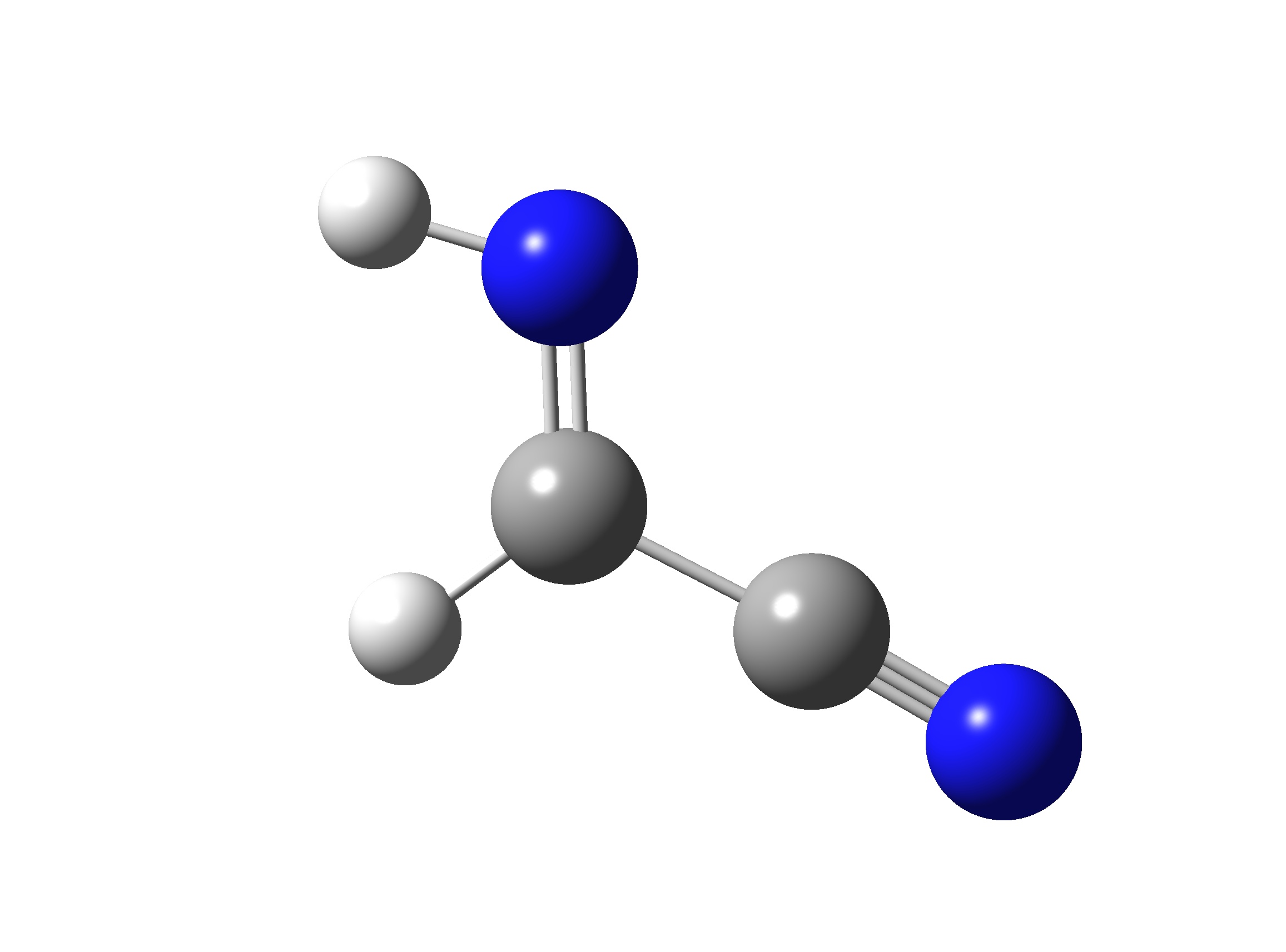
Structure of cyanomethanimine, newly discovered in interstellar space. Blue=nitrogen, grey=carbon, white=hydrogen (credit: NRAO/AUI/NSF)
Previously, scientists thought such processes took place in the very tenuous gas between the stars. The new discoveries, however, suggest that the chemical formation sequences for these molecules occurred not in gas, but on the surfaces of ice grains in interstellar space.
The discoveries were made possible by new technology that speeds the process of identifying the “fingerprints” of cosmic chemicals. Each molecule has a specific set of rotational states that it can assume.
When a molecule changes from one state to another, a specific amount of energy is either emitted or absorbed, often as radio waves at specific microwave frequencies (between 9 and 50 GHz) that can be observed with the Green Bank Telescope (GBT) in West Virginia.
New laboratory techniques have allowed astrochemists to measure the characteristic patterns of such radio frequencies for specific molecules. Armed with that information, they then can match that pattern with the data received by the telescope.
Laboratories at the University of Virginia and the Harvard-Smithsonian Center for Astrophysics measured radio emission from cyanomethanimine and ethanamine, and the frequency patterns from those molecules were then matched to publicly available data produced by a survey done with the GBT from 2008 to 2011.
A team of undergraduate students participating in a special summer research program for minority students at the University of Virginia (U.Va.) conducted some of the experiments leading to the discovery of cyanomethanimine. The students worked under U.Va. professors Brooks Pate and Ed Murphy, and Remijan. The program, funded by the National Science Foundation, brought students from four universities for summer research experiences. They worked in Pate’s astrochemistry laboratory, as well as with the GBT data.
The researchers reported their findings in Astrophysical Journal Letters and (open-access) ArXiv.