Driverless vehicles to zip at full speed through intersections
December 6, 2012
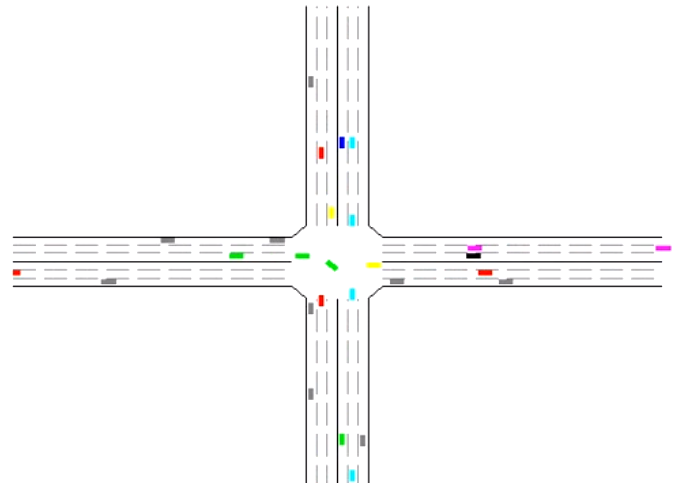
Driverless vehicles with automated intersection control (credit: Virginia Tech)
Driverless vehicles will safely wiz through intersections at the full speed limit, according to researchers from Virginia Tech Transportation Research.
Autonomous vehicles will turn themselves over to an automated intersection controller, with the controller tweaking their trajectory to prevent crashes, explained Ismail Zohdy of Cairo, Egypt, a Ph.D. student in civil engineering at Virginia Tech, and Hesham Rakha, director of the Center for Sustainable Mobility at the transportation institute and professor of civil engineering at the university.
Driver behavior is considered to be the leading cause of more than 90 percent of accidents, so safety is the primary motivation for driverless vehicles. A driverless vehicle can much more accurately judge distances and velocities, and react instantly to situations that could cause an accident due to a delayed human reaction, the researchers say.
Proposed intersection traffic-control system
The proposed system considers the vehicles’ location, speed, and acceleration plus the surrounding environment, such as weather and intersection characteristics. An intersection controller would allow vehicles to keep moving, reduces the delay for each vehicle compared to traditional intersection control.
Intelligent transportation systems are an interaction of many complex entities that communicate with each other, such as vehicles, traffic signals, and advisory signs. Driverless vehicles would be capable of interacting with these other entities, according to the researchers.
In Zohdy and Rakha’s research, the intersection controller governs vehicles within 200 meters (218.7 yards) from the intersection. The vehicles report their physical characteristics, such as power, mass, speed, location, and acceleration. “The aim of giving complete authority to the controller is to overcome any selfish behavior by an autonomous vehicle and benefit all vehicles in the intersection zone,” said Zohdy.
“The controller determines the optimum speed and acceleration at each time step for every vehicle within the intersection zone by processing the input data through a real-time simulator/tool.”
The research was done based on a four-way intersection with one vehicle entering from each direction and moving straight through. It has since been expanded and tested on more congested intersections involving not fully deployed systems and comparing this type of control to traffic signal and roundabout control.
Zohdy and Rakha will also be testing their system on a roundabout on the Virginia Tech campus as part of the Connected Vehicle/Infrastructure University Transportation Center.
Their research on Optimizing Driverless Vehicles at Intersections, presented at the Intelligent Transportation Society World Congress in Vienna, won the Best Scientific Paper Award for North America (ITS stands for intelligent transportation systems).
Related Links
Comments (24)
by Vin
If the software runs on windows, i’m never going out again.
by Editor
The “Blue Screen of Death” — literally :)
by tim the realist
Maybe you should stop running windows 3.1. My computer has not crashed for >10 years. When was the last time windows crashed on your computer?
by Editor
Hey thanks, I’m upgrading to 3.2! Hot damn! :=>
by Johnny5
These jokes are so old… I don’t think they are considered jokes anymore. I think they are just garbled text thrown up by a sea urchin.
by Cam
Hmm… I think perhaps they are overlooking that every car would need the same system. Who forces all individuals to submit their vehicles to this type of control?
What about bicycles etc travelling through those same intersections.
by Jerry
It would only require the same API, we don’t do too bad a job with standards in computing. In regards to cyclists, this is actually a perfect example where it would be beneficial. The intersection controls the walk/cross lights too, not like it doesn’t know which way is safe.
by Bob Vasquez
Just black-out the windows! Oh, yeah, I almost hit a cat the other day; well, if we can see a cat we won’t know that we hit it.
by JC
Young passengers who grew up with this system in place would probably be able to sit calmly through the near misses. Virtual training would probably work for calming down older passengers-in-training. Nearly everyone is now calm about plane takeoff and landing, which is a very threatening visual event. The cars would have to be built to keep people alive in the event of a 100 mph crash. Otherwise even though the average number of crash casualties would drop hugely, any person might be the target of a murder/terrorism attempt via a hack of the intersection controlling code. I think that is the biggest PR challenge this will face.
by Dwight
I suppose one way to do it would be to ramp up the system over a fairly long period of time. In other words, at the onset of implementing the traffic control system, have it go really slowly, making people accustomed to it. Then after a month or so, bring up the speed be a barely perceivable amount. After a matter of a couple years of the slow climb to top speed, nerves likely wouldn’t get so rattled by it. At the same time, the ramp up would give a good opportunity for the software developers to iron out the imperfections in a reasonably safe, slow speed setting. Sure, it may take a while, but things like this must be considered when we talk about making the switch to a driverless world. Even if it’s safer, it is sure going to feel scary as hell.
by Vin
Just equip pedestrians with a pogo-stick exoskeleton that will interface with the same intersection control software for the triggering. It would become like tech enhanced version of Parkour.
by Dwight
I don’t know how well it would go over. Sure, it could be 100% safe, but everybody’s gut reaction would be “Holy %&#$!!! I’m gonna die! I’m gonna die!”
Not kidding, either. It would take me YEARS to adjust to flying headlong into traffic at top speeds. I think for the sake of everybody’s psyche, they should make the cars carry out a more traditional intersection behavior. Or black out the windows.
by Heikos
I think you vastly underestimate the flexibilty of your own brain. I think you will get used to it. And fast.
by Krümelmonster
I agree that the system will need to account for failures. But im sure that still if there are accidents, the total number of accidents will be smaller than today with less damage per accident. Because the system can monitor every vehicle and a computer is faster than any human in detecting and responding to any deviance.
Ok, if the overall speed is higher the damage claim may be not true.
by Rob B
They’ve been doing this for years in S.E Asia ;)
by Marcos Marin
Helping old ladies across the street are becoming an ever MORE heroic act!
by Satan
You guys better contact these silly researchers and inform them what they have completely over looked! that was a close call…
by Marcos Marin
Old ladies?
by Satan
Who would buy a car that stopped for old ladies? The absence of the feature is the feature.
by Marcos Marin
You always gotta point, Satan! Can’t wait!
http://www.youtube.com/watch?v=YikK1uVtNok
by gaoptimize
I will not be an early adopter of this technology.
by Marcos Marin
Are you going to move somewhere without intersections?! The Unabomber would be proud.
by tim the realist
in high traffic conditions slower speed through intersections makes sense. when you are the only car going through by a wide margin, there is no reason to slow down.
This system will also have to provide for ways to stop traffic completely for pedestrians.
there is a full range of possible safe speeds in between these 2 extremes based on conditions
by Jay Bob
No, they won’t.
Even if we can take the human factor out of the picture, the algorithm will have to take into account mechanical failures as well as automation failures, combined with the law of inertia.
You don’t want a catastrophic accident just because a car happened to suddenly fail at the middle of an intersection.
They’ll have to slow down a bit.