Events in the future seem closer than those in the past
March 15, 2013
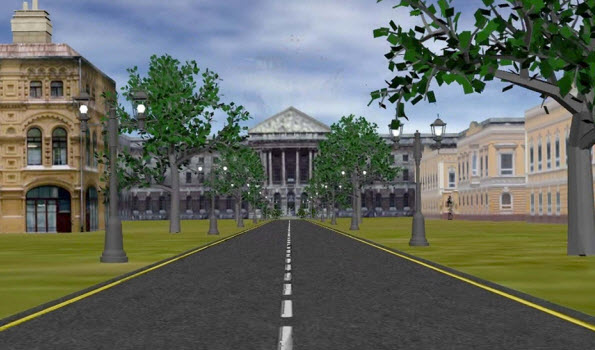
Screen capture of a virtual environment for testing time perception (credit: Caruso E M et al./Psychological Science)
We say that time flies, it marches on, it flows like a river — our descriptions of time are closely linked to our experiences of moving through space.
Now, new research suggests that the illusions that influence how we perceive movement through space also influence our perception of time. The findings provide evidence that our experiences of space and time have even more in common than previously thought.
The research, conducted by psychological scientist Eugene Caruso of the University of Chicago Booth School of Business and colleagues, is published in Psychological Science, a journal of the Association for Psychological Science.
Temporal Doppler effect
From research on spatial perception, we know that people feel closer to objects they are moving toward than those they are moving away from, even if the objects are exactly the same distance away. Because our perceptions of time are grounded in our experiences of space, Caruso and his colleagues hypothesized that the same illusion should influence how we experience time, resulting in what they call a temporal Doppler effect.
Surveying college students and commuters at a train station, the researchers found that people perceived times in the future (one month and one year from now) as closer to the present than equidistant times in the past (one month and one year ago).
Similarly, participants who completed an online survey one week before Valentine’s Day felt that the holiday was closer to the present than those who were surveyed a week after Valentine’s Day.
These findings hint at the relationship between movement in space and perceptions of time. To establish a direct link between the two, the researchers conducted a fourth study using a virtual reality environment.
Wearing a head-mounted display, college students were immersed in a scene with a two-lane road flanked by trees, streetlights, and buildings. Some of the students experienced the scene as though they were walking toward a bubbling fountain at the end of the road, whereas others felt as though they were walking backwards, away from the fountain. Later, the students reported how far away a date (three weeks in the future or three weeks in the past) felt to them.
Only those students who moved forward reported that the future felt closer than the past; students who experienced a mismatch between their movement (backward) and the direction of the event ( future) showed no temporal Doppler effect.
These results confirm that our perceptions of time are grounded in our experiences of movement through space: We tend to feel closer to the future because we feel like we’re moving toward it.
Caruso and colleagues argue that this orientation toward the future isn’t merely a perceptual quirk; they believe it serves an important purpose. Humans haven’t yet mastered the art of time travel, so we can’t change the past. But we can prepare ourselves for the future; perceiving future events as closer may be a psychological mechanism that helps us to approach, avoid, or otherwise cope with the events we encounter.
The researchers hope to explore the functional aspects of the temporal Doppler effect in future experiments. For example, is the effect associated with healthy psychological functioning? Are people who show a reverse asymmetry — experiencing the past as closer than the future — more prone to negative outcomes like rumination and depression? Does eliminating the effect make us worse at creating plans and making decisions about the future?
According to Caruso, “this research is important because the idea of psychological distance is central to theory and research in every sub-field of psychology — social, developmental, cognitive, clinical — yet there has been an implicit assumption that distance to the past is the same as distance to the future.”
While philosophers may debate the directionality of time, these studies suggest that our subjective experience of time is clearly directional.
“Our work suggests instead that there is a systematic difference in people’s perceptions of distance to the past and the future,” Caruso concludes.
In addition to Caruso, co-authors on this research include Leaf Van Boven of the University of Colorado, Boulder and Mark Chin and Andrew Ward of Swarthmore College.
This research was supported by the Neubauer Family Faculty Fellows program, research funds from The University of Chicago Booth School of Business, and the National Science Foundation.
Did the temporal and movement models bias the outcome? Another hypothesis: we experience the future as closer because it’s less spatially dense (there are fewer things to visualize as happening, compared to the past). It could perhaps be tested by presenting dense and sparse visual environments. There may also be individual differences between those who perceive time as movement vs. spatial density (or some other factor). — Editor
Comments (15)
by Mdvfunes
I wonder about how this supports the work of Lakoff and Johnson on structuring metaphors? They have looked at linguistic evidence to show that we structure the abstract in terms of our body moving in space. They say that ‘our conceptual system plays a central role in defining our everyday realities.’
Check this for an intro:
http://www.soc.washington.edu/users/brines/lakoff.pdf
I have found this research an interesting way to confirm their linguistic evidence.
by zqwerty
Time does not exist in and of itself.
by Sea bass
This effect is probably due to an evolutionary advantage about predicting the future, driven by sex and survival. Feeling closer to the future allows use to better predict it. Better predictions offer more chances at finding a mate and reacting to a potentially lethal situation. Evidence suggests our brain makes a decision before we choose it.
Ever feel like something bad is about to happen before it does?
by ErikSMeyer
Why would feeling closer to the future allow us to better predict it? I suppose it would make us more motivated…
As for the rest of it, to a hammer, everything looks like a nail, to someone fixated on Darwinism, everything is just another way of having more offspring.
Survival of the fittest is just survival of what survives, and most evolutionary explanations can be reduced to:
If x trait is here, it is because x trait made it more likely that whoever has x trait would have offspring that survived, namely the creatures displaying x trait.
Once they get going, people can and do explain everything this way (ie, blue eyes came into being among northern europeans because they conferred a reproductive advantage, increasing sexual desireability and likelihood of reproduction, etc. etc., all of which explaining why there are so many brown eyed people in the world who have a hard time having children, or rather not).
Any theory that can just as easily explain the existence of a trait as the existence of its opposite, as popular evolutionary talk does, is missing something.
I suspect quite a bit of what is seen in the world came about by chance, and persisted because there was no sufficiently toxic reason for it to die out.
by Sea bass
Your theory falls prey to a similar fallacy. I suspect quite a bit of what is seen in the world came about by choice, and persisted because other options died out and/or were out competed.
But you can view the glass however you like. I find it much easier to make predictions about the future to that which is closer to me, that which i am more familiar with. Thoughts, ideas, places, people, events, memories, knowledge. Whether I am physically or mentally closer doesn’t matter.
As for the rest of it, evolution it least tries to provide a mechanism as to how something ‘came about’. It may be wrong, but your chance idea just gives up without trying to explain anything. You may be right, but I find the former much more satisfying.
by Ralph Dratman
I agree with the last sentence of your comment. It seems to me that after the basics of life are well established, it is often more relevant to look at lack of survival as stopping a chain of ancestry, rather than waiting for a favorable characteristic to promote a new one.
by You
“Humans haven’t yet mastered the art of time travel…”
All credibility: lost.
by Aaron
Right, it would be *far* more credible if they had claimed we had already mastered time travel.
by Ralph Dratman
I don’t understand what you mean. Could you explain please?
by Ralph Dratman
“… we know that people feel closer to objects they are moving toward than those they are moving away from…”
But we are closer to objects we are moving toward than those we are moving away from. If, for example, at the moment of measurement we are equidistant from the two points, then by the time we get the words out to announce this, we will already be closer to the one ahead, and farther from the one behind.
The more time we spend discussing this, the truer it will be.
by Jod
the real reason why time appears to speed up as one ages is simply because the human mind becomes more and more accustom to the events that occur in day to day life.
by Michael
I think it’s also proportionate to how long you’ve already lived. i.e if you are only 1 year old, 5 years is going to seem like a long time as it’s 5 times you’re entire lifetime so far. If you are 55, 5 years might not seem like much of a big deal as you’ve already experienced it 11 times.
by Dennis R.
I’d suggest that time seems to move faster as we move forward since so much of the technological world is changing so quickly that we feel less prepared as we age. Not all of us can (or choose to) adapt as quickly and thus more of the future coming towards us is unfamiliar and approaching too fast for us to prepare for…
If the students are all of a similar age cohort, might that be a factor in their more positive notion of the approaching future?
by Gabor
This is fascinating. I was always wondering why is that time appears to speed up as we age.
The “temporal Doppler effect” would explain (at least partially) that as we get more experienced we feel closer to the future as we can anticipate it better.
The other factor could be the “relativity factor”, that is when we are young, we are functioning faster (biologically and mentally) and gradually slowing down as we age. Of course to us our own speed appear constant so something else has to give. Time appears to speed up as we are slowing down.
The real question is, how will we perceive time when we finally transcend our very limited biological brains and will be able to think thousands (millions?!?) of times faster and will also be able to simulate future events (just by thinking about them) much more accurately? Will time grind to a halt in our perception? Will it “feel” like an Earth day lasts forever?
I can’t help but think of Mr. Data when he described 0.68 seconds as “For an android, that is nearly an eternity…” in Star Trek: First Contact.
by JoukoSalonen
thank you Gabor for an inspiring moment. I’m having my morning coffee here in Helsinki and yes you are right – I already agreed with my wife to speed up somehow :)