Moderate exercise enhances memory and preserves gray matter
November 28, 2012
(Credit: Peter van der Sluijs/Wikimedia Commons)
A short burst of moderate exercise enhances the consolidation of memories in both healthy older adults and those with mild cognitive impairment, scientists with UC Irvine’s Center for the Neurobiology of Learning & Memory have discovered.
In their study, post-doctoral researcher Sabrina Segal and neurobiologists Carl Cotman and Lawrence Cahill had people 50 to 85 years old with and without memory deficits view pleasant images — such as photos of nature and animals — and then exercise on a stationary bicycle for six minutes at 70 percent of their maximum capacity immediately afterward.
One hour later, the participants were given a surprise recall test on the previously viewed images. Results showed a striking enhancement of memory by exercise in both the healthy and cognitively impaired adults, compared with subjects who did not ride the bike.
“We found that a single, short instance of moderately intense exercise particularly improved memory in individuals with memory deficits,” Segal said.
She believes the improved memory may be related to the exercise-induced release of norepinephrine, a chemical messenger in the brain known to play a strong role in memory modulation. This hypothesis is based on previous work demonstrating that increasing norepinephrine through pharmacological manipulation sharpens memory and that blocking norepinephrine impairs memory.
In the more recent research, Segal and her colleagues discovered that levels of salivary alpha amylase, a biomarker that reflects norepinephrine activity in the brain, significantly increased in participants after exercise. This correlation was especially strong in people with memory impairment.
“The current findings offer a natural and relatively safe alternative to pharmacological interventions for memory enhancement in healthy older individuals as well as those who suffer from cognitive deficits,” Segal noted. “With a growing population of the aged, the need for improvement of quality of life and prevention of mental decline is more important than ever before.”
UCI’s Alzheimer’s Disease Research Center and the National Institute of Mental Health, a division of the National Institutes of Health, supported the research.
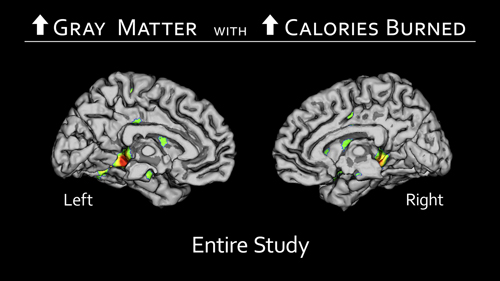
Cerebral hemispheres, showing the main effect of burning calories from a combination of different lifestyle activities on brain structure in 876 elderly individuals. A higher level of calories burned is related to larger gray matter volumes in areas of the brain important for cognitive function including the anterior cingulate gyrus and temporal lobes. The magnitude of the effect is represented by the varying green, yellow, and red colors. Hotter colors, such as red, indicate a stronger effect. (Credit: Raji,C. et al./RSNA)
Preserving your gray matter
In a related study, UCLA researchers have found that an active lifestyle helps preserve gray matter in the brains of older adults and could reduce the burden of dementia and Alzheimer’s disease (AD), according to a study by Cyrus Raji, M.D., Ph.D., radiology resident at UCLA and colleagues.
They examined how an active lifestyle can influence brain structure in 876 adults, average age 78 years, drawn from the multisite Cardiovascular Health Study. The patients’ condition ranged from normal cognition to Alzheimer’s dementia.
“We had 20 years of clinical data on this group, including body mass index and lifestyle habits,” Dr. Raji said. “We drew our patients from four sites across the country, and we were able to assess energy output in the form of kilocalories per week.”
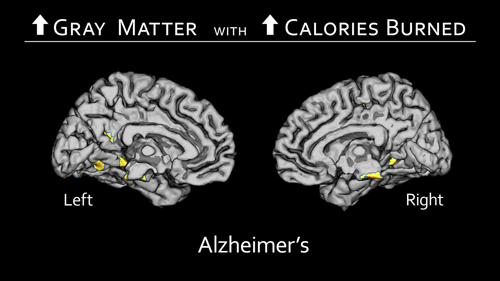
This figure is of the cerebral hemispheres in profile showing the interaction effect of burning calories from a variety of lifestyle activities on brain structure in persons with Alzheimer’s dementia. Gray matter structure in this group is larger in persons who burn a larger number of calories with different lifestyle activities. The brain areas protected by these lifestyle activities are the posterior cingulate and temporal lobes, regions that are targeted by the pathology of Alzheimer’s disease. (Credit: Raji,C. et al./RSNA)
The lifestyle factors examined included recreational sports, gardening and yard work, bicycling, dancing and riding an exercise cycle.
The researchers used magnetic resonance imaging (MRI) and a technique called voxel-based morphometry to model the relationships between energy output and gray matter volume.
“Voxel-based morphometry is an advanced method that allows a computer to analyze an MR image and build a mathematical model that helps us to understand the relationship between active lifestyle and gray matter volume,” Dr. Raji said. “Gray matter volume is a key marker of brain health. Larger gray matter volume means a healthier brain. Shrinking volume is seen in Alzheimer’s disease.”
After controlling for age, head size, cognitive impairment, gender, body mass index, education, study site location and white matter disease, the researchers found a strong association between energy output and gray matter volumes in areas of the brain crucial for cognitive function. Greater caloric expenditure was related to larger gray matter volumes in the frontal, temporal and parietal lobes, including the hippocampus, posterior cingulate and basal ganglia. There was a strong association between high energy output and greater gray matter volume in patients with mild cognitive impairment and AD.
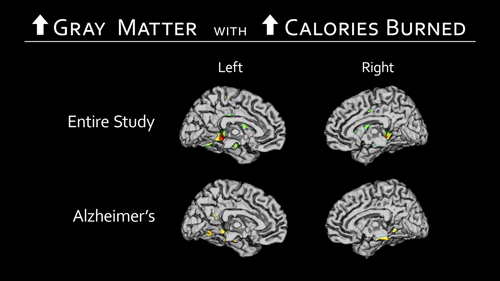
This figure summarizes the results of the prior two figures onto one slide to show that caloric burn from a diversity of lifestyle activities benefits gray matter and the brain in aging and Alzheimer’s disease (credit: Raji,C. et al./RSNA)
“Gray matter includes neurons that function in cognition and higher order cognitive processes,” Dr. Raji said. “The areas of the brain that benefited from an active lifestyle are the ones that consume the most energy and are very sensitive to damage.”
Lifestyle choices and activities
“What struck me most about the study results is that it is not one but a combination of lifestyle choices and activities that benefit the brain,” he said.
Dr. Raji said the positive influence of an active lifestyle on the brain was likely due to improved vascular health. “Virtually all of the physical activities examined in this study are some variation of aerobic physical activity, which we know from other work can improve cerebral blood flow and strengthen neuronal connections,” he said. “Our initial results show that brain aging can be alleviated through an active lifestyle.”
Video: This video shows a three-dimensional representation of the human brain with results from the multi-site Cardiovascular Health Study of 876 patients shown. The first set of images shows the right and left hemispheres of the brain with green, yellow, and red colors showing how with more calories burned in a variety of lifestyle activities, the larger gray matter volume becomes. Larger gray matter volume with aging means a healthier brain.
Video: This video bridges the results of prior work done by Dr. Raji and his collaborators on obesity and brain shrinkage with the results of the current study showing how an active lifestyle improves brain structure in both normal individuals and persons with Alzheimer’s. While certain lifestyle factors such as obesity are related to shrinkage as shown in the video and increase risk for Alzheimer’s disease, other factors including a diversity of physical activities such as dancing, cycling and gardening can build a better brain. This is thought to occur by improving blood flow and delivery of oxygen and glucose to neurons leading to larger gray matter volumes and improved brain health with aging. The final portion of the video cites published work by Dr. Raji and his collaborators, in addition to the work presented at RSNA 2012, which supports this model of how powerfully positive or negative lifestyle influences the brain.