Faster-than-light neutrino puzzle claimed solved by special relativity
October 14, 2011
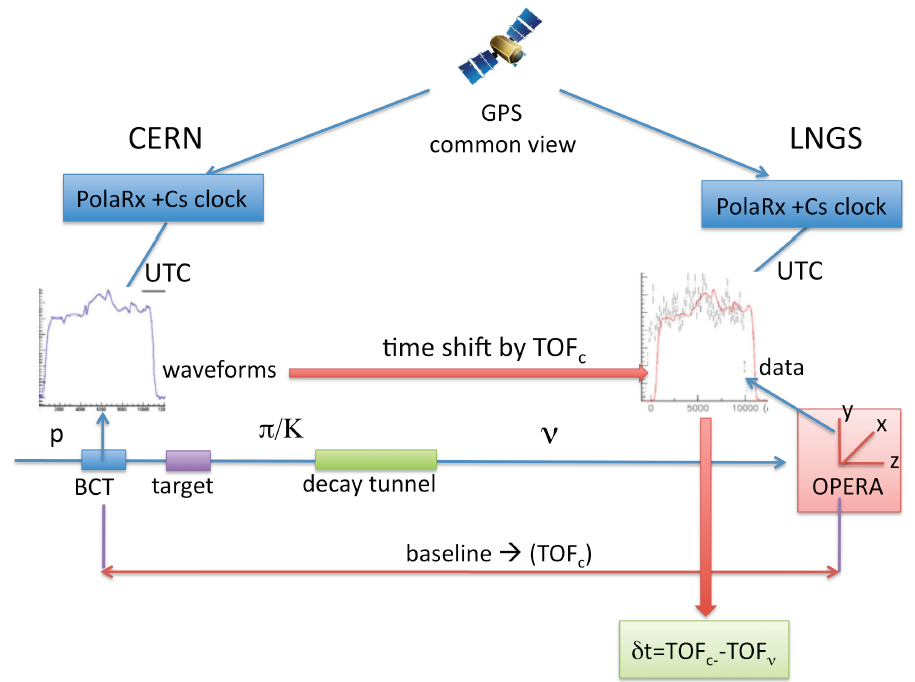
(Credit: CERN)
The relativistic motion of clocks on board GPS satellites exactly accounts for the superluminal effect in the OPERA experiment, says physicist Ronald van Elburg at the University of Groningen in the Netherlands, The Physics arXiv Blog reports.
“From the perspective of the clock, the detector is moving towards the source and consequently the distance travelled by the particles as observed from the clock is shorter,” says van Elburg. By this he means shorter than the distance measured in the reference frame on the ground. The OPERA team overlooks this because it assumes the clocks are on the ground not in orbit.
Van Elburg calculates that it should cause the neutrinos to arrive 32 nanoseconds early. But this must be doubled because the same error occurs at each end of the experiment. So the total correction is 64 nanoseconds, almost exactly what the OPERA team observed.
Ref.: Ronald A.J. van Elburg, Times Of Flight Between A Source And A Detector Observed From A GPS Satellite, arxiv.org/abs/1110.2685:
Related Site Content:
- OPERA neutrino experiment on breaking speed of light — UPDATE #2: CERN seeks independent replication | September 23, 2011
- OPERA neutrino experiment on breaking speed of light — Update #1: Live webcast, ArXiv paper posted | September 23, 2011
- A six-sigma signal of superluminal neutrinos from OPERA | September 23, 2011
- Change in material boosts prospects of ultrafast single-photon detector | July 3, 2011
Comments (9)
by Liten uppdatering om de snabba neutrinerna | Stjärnstoft och kugghjul
[...] och detektorerna befinner sig i samma referensram utan rör sig i förhållande till varandra. Här kan man läsa om det. Den här idén kom från en person som inte själv är involverad i vare sig OPERA eller GPS, och [...]
by Faster-than-light neutrino puzzle claimed solved by special relativity « Uchida Koichi's Blog
[...] from http://www.kurzweilai.net [...]
by gvseostud
Contacted author. His retraction / corrected comments appear at this link:
http://home.kpn.nl//vanelburg30//Publications.html
by DanR
I won’t try to make sense of this. But then wouldn’t the same measurement apply to a light beam? Shouldn’t this same effect have been seen sooner?
by The Explanation For The “Faster Than Light” Neutrinos « Tai-Chi Policy
[...] Relativity messes with clock measurements once again. Share this:StumbleUponDiggRedditLike this:LikeBe the first to like this post. Tags: Neutrinos, Physics Comments RSS feed [...]
by nlw
@gvseostud thanks so much for the references!
I really don’t like all the blogs giving attention to this article with no questioning whatsoever. This is absurd.
by gvseostud
My fear is that this paper will only add to the confusion regarding GPS time. Any complete treatment of GPS time should discuss how a ground receiver is using time, in accordance with ICD-GPS-200:
http://www.navcen.uscg.gov/pubs/gps/icd200/ICD200Cw1234.pdf
This has been debated already in literature here:
http://tycho.usno.navy.mil/ptti/1996/Vol%2028_16.pdf
The conclusion was that relativistic corrections were being accounted for by OCS Kalman filtering to within 2.5mm, for time of flight corrections to within 8 pS.
I am not saying there are not systematic errors in the propagation of GPS time, but I am saying that van Elburg’s paper is not a good treatment of them.
by gvseostud
Note especially this quote from the second linked reference:
“…this error would be incurred only if the station clocks were independent of the GPS satellite clocks, each MS keeping its own time. That’s not the way the OCS works. Station time is estimated in the Kalman filter together with the SV clocks, and each MS clock is effectively being updated continuously by the satellites. The station clock is used only to bridge the gap in time between measurements; but since several satellites are always in view, these measurements are virtually instantaneous, except for the different signal propagation times from different satellites. These times are about 0.1 sec, and, multiplying by 7, once more we derive an error of about 2.5 millimeters.”
by crowlogic
Seems plausible, but there are yet other explanations. http://matpitka.blogspot.com/2011/10/triumph-for-tgd-m-89-hadron-physics.html maybe these explanations are equivalent