FDA clears first autonomous telemedicine robot for hospitals
January 28, 2013
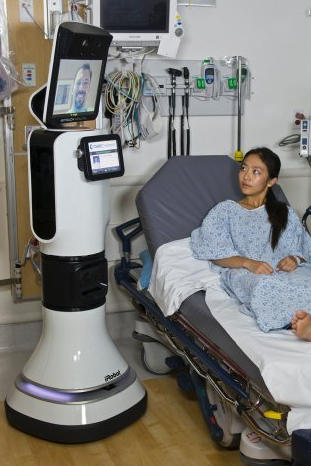
The iRobot RP-VITA in action (credit: iRobot)
iRobot Corp., a leader in delivering robotic solutions, has announced that its RP-VITA Remote Presence Robot has received 510(k) clearance by the U.S. Food and Drug Administration (FDA) for use in hospitals. RP-VITA is the first autonomous navigation remote presence robot to receive FDA clearance.
RP-VITA is a joint effort between iRobot and InTouch Health. The robot combines the latest in autonomous navigation and mobility technologies developed by iRobot with state-of-the-art telemedicine and electronic health record integration developed by InTouch Health.
RP-VITA allows remote doctor-to-patient consults, ensuring that the physician is in the right place at the right time and has access to the necessary clinical information to take immediate action.
The robot has unprecedented ease of use. It maps its own environment and uses an array of sophisticated sensors to autonomously move about a busy space without interfering with people or other objects. Using an intuitive iPad interface, a doctor can visit a patient, and communicate with hospital staff and patients with a single click, regardless of their location.
The FDA clearance specifies that RP-VITA can be used for active patient monitoring in pre-operative, peri-operative and post-surgical settings, including cardiovascular, neurological, prenatal, psychological and critical care assessments and examinations.
RP-VITA is being sold into the healthcare market by InTouch Health as its new flagship remote presence device. iRobot will continue to explore adjacent market opportunities for robots like RP-VITA and the iRobot Ava mobile robotics platform.
“FDA clearance of a robot that can move safely and independently through a fast-paced, chaotic and demanding hospital environment is a significant technological milestone for the robotics and healthcare industries,” said Colin Angle, chairman and CEO of iRobot. “There are very few environments as difficult to maneuver as that of a busy ICU or emergency department. Having crossed this technology threshold, the potential for self-navigating robots in other markets, and for new applications, is virtually limitless.”
“Remote presence solutions have proven their worth in the medical arena for quite some time,” said Yulun Wang, chairman and CEO of InTouch Health. “RP-VITA has undergone stringent testing, and we are confident that the robot’s ease of use and unique set of capabilities will enable new clinical applications and uses.”
Comments (24)
by godot
Doesn’t it bother anyone else that the FDA has usurped authority to approve and license a robot? Is this anywhere near their jurisdiction? Will they next demand to approve google’s self-driving cars?
by mj
Does not Skype accomplish the same thing and its free?
by Editor
Yes (http://beta.skype.com/en/features/video-chat/). The iRobot device adds mobility, but that could be accomplished by a nurse or PA carrying a (less intimidating) iPad or ultrabook around, with the added advantages that the iPad could include medical apps, allow for closeup views of the patient, and allow the nurse to add updated information and observations. In addition, patient contact by a live person can be healing, reduce stress, and answer more personal questions that they wouldn’t want to shout out in a room. Or better, why not give patients the iPad (those who want it) and Skype them directly? Could any doctors comment on this? Note: I just added two related links at the bottom of the article.
by ProfessorZ
Good idea, because everyone knows nurses and PAs are cheap and commonly available.
by Michael
or if you insist on the tablet route it’s even better and cheaper with a nexus7 or 10. by a LOT.
by DrDubious
More jobs lost and lower income for those still working.
by ChrisF
Plus double the number of patients for each remaining doc to see each day. Yay !
by McTruck
What about bacteria and germs that are carried by this telepresence system from patient to patient? Shouldn’t it be sprayed down after every visit?
by Dave Torgersen
Funny that the prior article is this: “A hydrogel that destroys superbugs and drug-resistant biofilms” http://kurzweilai.us1.list-manage.com/track/click?u=aad1a7eea269839c7d10845e8&id=9a20c0ca19&e=82567b3390
by Gorden Russell
Right, Dave Torgersen, or even better, the surface of the robot could have a permanent coating of a material that kills germs. Perhaps they could dope a plastic with chlorine?
by Bucephalos
Yes, I agree.
Should have a device akin to a shower nozzle (better have many of them) attached to the surface.
And nanotech-based super-slippery surface to expel the germs.
by Dillon
same thing could be said about nurses :P lol
by ProfessorZ
Are nurses sprayed down after every visit?
by Mattgolfs
It’s my understanding that doctors many times have to make rounds which include more that one hospital. To take over one of these when available at another hospital all the way across time makes sense. Any docs out there?
by Bucephalos
What is shown on the picture is more like a telepresence robot.
But anyways great progress.
Talking about telepresence, I am reminded of the “central station connected to multiple real life locations” in Hans Moravec’s essay “Pigs in Cyberspace”.
Would be great if 3D printers are also installed at the terminals (for the human or virtual being’s exiting) at the real life locations, so that a customized telepresence robot may be produced (for maneuvering in different enviroments, different robots are needed).
I apologize if this comment is off topic.
by melajara
@Editor
Here is a video with the same cooperative patient and smiling doctor
http://www.youtube.com/watch?v=hoAPTpwkFtw
P.S. I’m not convinced by this development. Besides personal acquaintance and reassurance for the patient in talking to the true specialist face to face, smell is an important (neglected) factor in assessing a patient’s health. The poor doctor will have to compensate with the biophysical data relayed by the robot and I hope the robot is able to autonomously navigate from (patient) room to room or the doctor will lose all his time in circum navigation at 2mph
But, true, a few generations down, health care robots will be unavoidable and really practical, so this is only a humble beginning.
by Gorden Russell
Perhaps each doctor will have two of these robots, so the doctor can click from one to the other as they leapfrog from one examination room to the next.
Also, sensors have already been developed so that robot hands can “feel” and transmit that feeling to remote waldo gloves worn by the doctor. Our industrious editor here has posted articles about sensors laid under the molded skin of robot hands. I only wish that I had saved them to disk so that I could bring them back to you now, melajara.
by Whittaker
They will need sensors of many sort, because the sense of touch is very complex and actually should make the number of senses more than five.
Touch consists of texture, agitation, temperature and electric current.
Therefore we possess more than five senses. Should be 9 or 10.
Jeff Hawkins, in his book “On Intelligence” had in depth discussion on sense of touch. As well, his theory is somewhat similar to the working principles of Ray Kurzweil’s deep-heirarchy.
by trakk
try one generation down
by trakk
I meant one human generation :) But with regards to telepresence robots, you are right.
by ChrisF
I agree, “innovations” like this feel like a step backwards. Surely this is one area where the human factor is important part of the interaction ? Imagine being stuck in a hospital bed with one these rolling TV screens for company…. a pretty gloomy existence I would imagine
by Whittaker
By saying so you deny the development of artificial intelligence with social ability. The robots need to learn how to interact with people, too, not just being cold and alienating forever.
by ChrisF
Oh no, I’d personally love to be treated by a true AI “robo-doc”… but this tech just seems de-humanising for both the patient and the doctor, and doesn’t seem to offer any improvements (other than lower costs). Maybe it’s a necessary first step, but I rather hope that it turns out to be an evolutionary dead-end.
by Editor
I would probably refuse treatment by a monstruous, impersonal machine like this one, but I would welcome a small, friendly device (iPad, iPhone, etc.) that I (or a trusted surrogate) could personally control to some extent and communicate with some degree of personal touch with doctors and other staff.