Fed-funded research: magic mushrooms create ‘openness’
September 30, 2011 by Amara D. Angelica
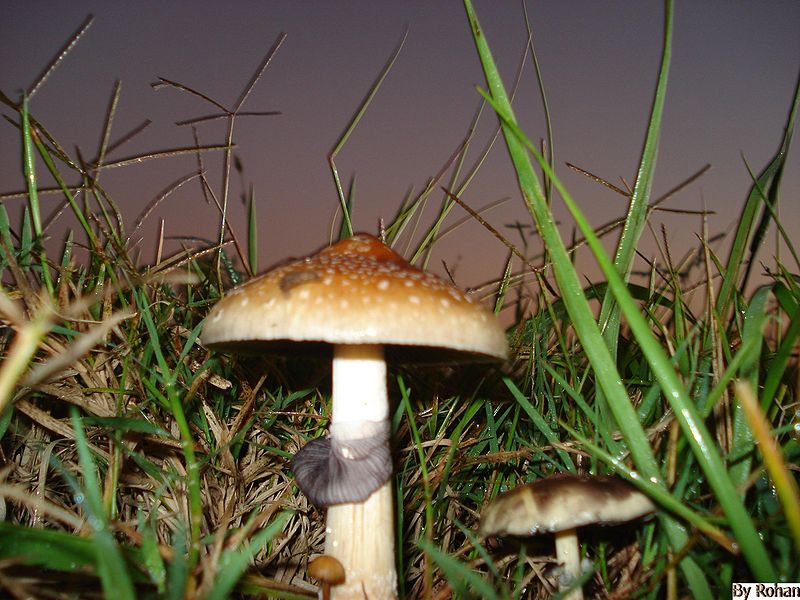
Psilocybe cubensis (credit: Wikimedia Commons)
A single high dose of the hallucinogen psilocybin, the active ingredient in “magic mushrooms,” was enough to bring about a measureable and lasting personality change — “openness” — lasting at least a year in nearly 60 percent of the 51 participants in a new study, say Johns Hopkins researchers.
Well, doh, didn’t Timothy Leary discover that in the 60s? Um, OK, controlled experiments….
By “openness,” they mean traits related to imagination, aesthetics, feelings, abstract ideas, and general broad-mindedness, the researchers said. Changes in these traits, measured on a widely used and scientifically validated personality inventory, were larger in magnitude than changes typically observed in healthy adults over decades of life experiences, the scientists say.
Don’t trust anyone over 30?
Researchers in the field say that after the age of 30, personality doesn’t usually change significantly. “Normally, if anything, openness tends to decrease as people get older,” says study leader Roland R. Griffiths, a professor of psychiatry and behavioral sciences at the Johns Hopkins University School of Medicine.
Oh, yeah! Where we saying? I forget.
The research was approved by Johns Hopkins’ Institutional Review Board and funded in part by the National Institute on Drug Abuse. The study participants completed two to five eight-hour drug sessions, with consecutive sessions separated by at least three weeks. Participants were informed they would receive a “moderate or high dose” of psilocybin during one of their drug sessions, but neither they nor the session monitors knew when.
Hmm. No placebo control group? I haven’t seen the paper yet, so I’ll update this later. (Tryin’ to be “open” here….)
During each session, participants were encouraged to lie down on a couch, use an eye mask to block external visual distraction, wear headphones through which music was played and focus their attention on their inner experiences.
Permanent changes
Personality was assessed at screening, one to two months after each drug session and approximately 14 months after the last drug session. Griffiths says he believes the personality changes found in this study are likely permanent since they were sustained for over a year by many.
Nearly all of the participants in the new study considered themselves spiritually active (participating regularly in religious services, prayer or meditation). More than half had postgraduate degrees.
OK, that sounds like a group that’s already imaginative and open to abstract ideas. Would have helped to include some close-minded types? Griffiths does admit that they “don’t know whether the findings can be generalized to the larger population,” though.
Griffiths says lasting personality change is rarely looked at as a function of a single discrete experience in the laboratory. In the study, the change occurred specifically in those volunteers who had undergone a “mystical experience,” as validated on a questionnaire developed by early hallucinogen researchers and refined by Griffiths for use at Hopkins. He defines “mystical experience” as among other things, “a sense of interconnectedness with all people and things accompanied by a sense of sacredness and reverence.”
Hallucinating your way to a cure
Griffiths says he believes psilocybin may have therapeutic uses. He is currently studying whether the hallucinogen has a use in helping cancer patients handle the depression and anxiety that comes along with a diagnosis, and whether it can help longtime cigarette smokers overcome their addiction. “There may be applications for this we can’t even imagine at this point,” he says. “It certainly deserves to be systematically studied.”
Griffiths cautions that that some of the study participants reported strong fear or anxiety for a portion of their daylong psilocybin sessions, although none reported any lingering harmful effects. He cautions, however, that if hallucinogens are used in less well supervised settings, the possible fear or anxiety responses could lead to harmful behaviors.
Ref.: Katherine A. MacLean, Matthew W. Johnson, and Roland R. Griffiths, Mystical Experiences Occasioned by the Hallucinogen Psilocybin Lead to Increases in the Personality Domain of Openness, Journal of Psychopharmacology, 2011; [DOI: 10.1177/0269881111420188]
Comments (9)
by kensp11
There are two things that we seem to know about many hallucinogenic substances:
1) They are relatively benign, even in comparison to pharmaceuticals.
2) They seem to help people in certain ways.
They deserve more attention than they receive. Negative stereotypes against users of these substances are simply due to ignorance. Whenever I see a stupid stoner on TV, I cringe.
by weedian
Your environment will generally determine your trip and the impact is has on you. Physically, emotionally, and spiritually.
The “openness” is an understatement. Lasttime i had them, everything changed immedietly. The universal connection is right. You can see how things are connected and effected by each other. Its more like a new lens of viewing things that are already there.
Medical studies also show that when taken at the right dose and right time the can help with dealing or stopping cluster headaches, also known as suicide headaches.
http://www.erowid.org/plants/mushrooms/mushrooms_medical1.shtml
by Wernstrum
I haven’t read the study but from your description I would say that the sessions before the double blinded random initiation of the psilocybin trial function as controls. You state that they were measuring openness after each session whether shrooms were used or not which should enable you to compare the pre shroom openness to the post shroom openness.
by marrianB
Psilocybin is the active ingredient in what are usually referred to as “magic mushrooms,” or “God’s Flesh.” Magic mushrooms are just one of several drugs being studied for their potential uses in treating everything from cancer, depression, post-traumatic stress disorder and a host of other mental disorders. LSD, ecstasy and magic mushrooms are all being studied by researchers as potentially therapeutic drugs.
by marrianB
In a study published in the Journal of Psychopharmacology, so-called magic mushrooms were recognized as a potentially healing drug. The research found that patients who were given a controlled dose of psilocybin were more open about their feelings and self-reported better life satisfaction over one year later. Controlled magic mushroom doses could have psychotherapeutic uses. In just a single high dose, psilocybin — a hallucinogen and active ingredient in magic mushrooms — produced notable changes for at least one year in the personalities of almost 60 percent of 51 volunteers in a new Johns Hopkins study. It was believed that psilocybin may have therapeutic uses and is currently studying whether it can help cancer patients handle the depression and anxiety that comes with diagnosis, and whether it can help longtime cigarette smokers quit.
by AmandaT
This is another significant research in the field of medicine. Psychotherapeutic drugs could be costly to produce and rather unstable. One study, however, has discovered that the normal narcotic in magic mushrooms could be used to treat some psychological problems. The research found that spiritual participants that took psilocybin, the active narcotic in magic mushrooms, noted mystical experiences and better life fulfillment 14 months later. Article resource: Controlled magic mushroom doses could have psychotherapeutic uses
by Vstoriguard
As I recall, Scientific American ran some material on the use of “magic mushrooms” in the treatment of depression and other disorders about a year or so back. — > http://www.scientificamerican.com/article.cfm?id=psilocybin-book
Again, Signme noted, the researchers were particularly interested in using the drug to lighten the burdens of those in the last stages of terminal diseases.
victor-storiguard.blogspot.com
by NakedApe
I have found that on cannabis I also experience thoughts and insights that are unconventional and dreamlike and, if I remember them, quite creative and even useful. What worries me, however, is that people who are ‘spiritual’ and given to superstitious beliefs (theistic) are actually reducing their rationality even further (a form of brain dysfunction). For all I know, this could help them function better in the world but I have always firmly believed that being firmly rooted in verifiable reality is the way to go over some fuzzy ‘in-touch-with-the-Universe’ wishful thinking. That is why science works and shows results while superstitions do NOT. There is no big bright light at the end of the tunnel for me. Sorry!
by Singme
Agreed, there have been great uses for this with terminal patents and depression too.